Titanium Anodes for Pool Water Disinfection
A pool water disinfection anode fails slowly, then all at once: output drops, the controller runs longer, and by the time someone opens the housing the plates are white or the coating is gone. Almost none of it starts with the titanium. It starts with the water, the current density, and the coating picked for the job.
Salt chlorine cells / On-site hypochlorite / Water parks / Hotel & resort pools / Competition pools
Coating life
6,000-15,000 h
Current density
200–300 A/m²
Ru-Ir loading
8–20 g/m²
Minimum order
1 set
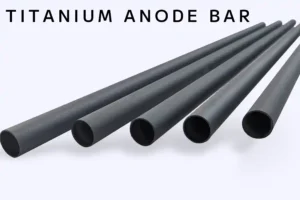
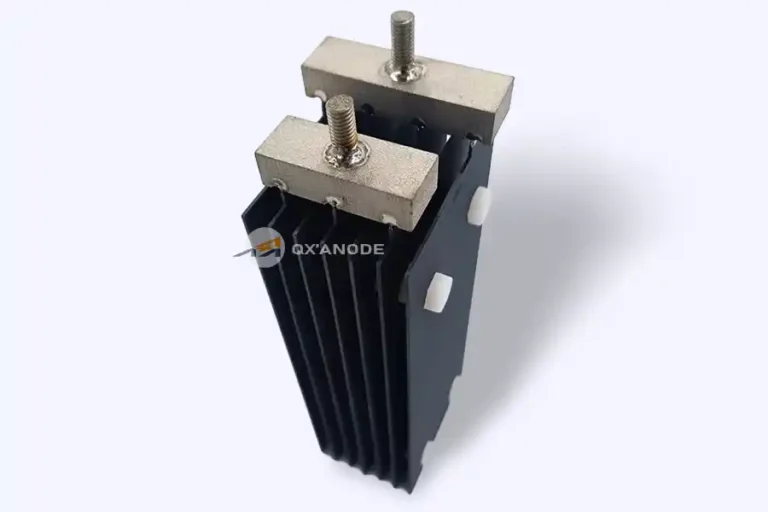
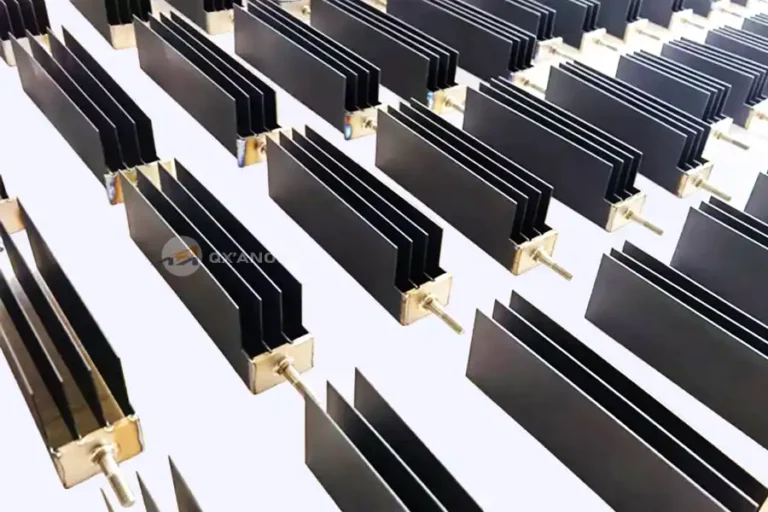
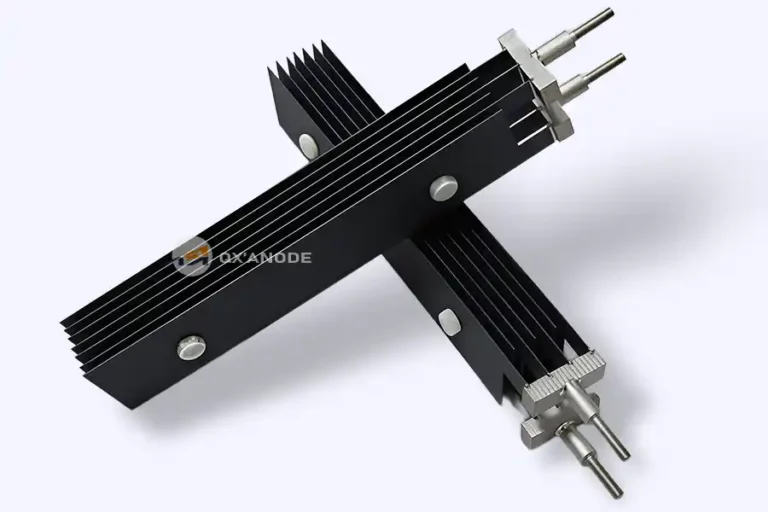
A pool water disinfection anode is a Grade 1 or Grade 2 titanium plate coated with mixed metal oxides, usually RuO₂ and IrO₂. Mounted in an electrolytic cell, it oxidizes dissolved chloride into chlorine gas, which dissolves as hypochlorous acid (HOCl) — the same active sanitizer you get from liquid chlorine. Residential salt cells typically run 6,000–15,000 hours. Commercial brine systems run two to five years.
Same electrochemistry. Very different duty
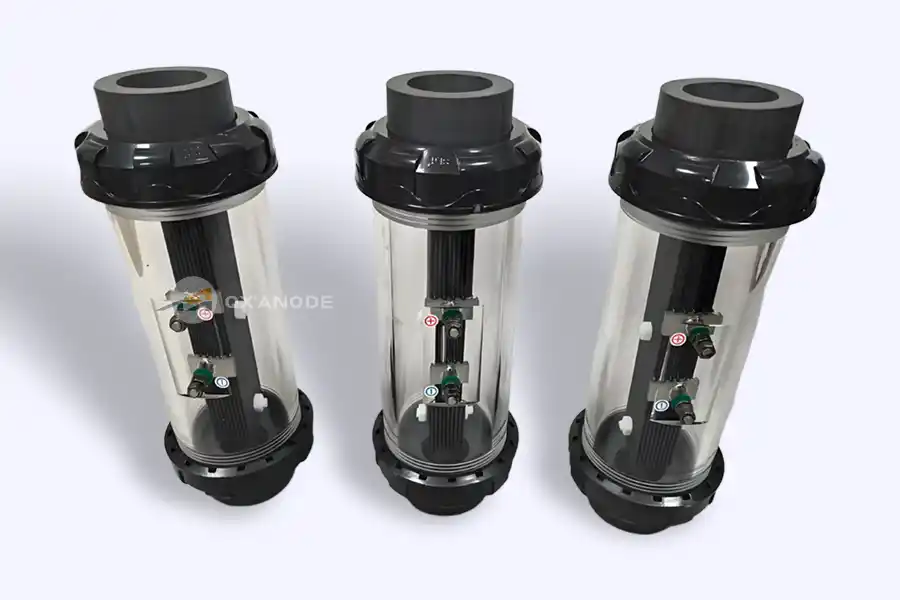
Pool disinfection runs this reaction at two scales. In a residential salt cell, the pool itself is the electrolyte. In a commercial plant, brine is electrolyzed in a side stream and dosed as hypochlorite. The anode is the same class of part in both. What you ask it to survive is not.
The pool is the brine tank
Salt is dissolved in the pool at 2,700–4,000 ppm. A cell in the return line electrolyzes the pool water as it passes, and the chlorine it makes goes straight back into the pool. No storage, no dosing pump, no chemical delivery. The trade-off is that everything in the water passes through the cell — including the calcium that scales it.
- Typical output10–250 g/h
- Current density200–400 A/m²
- pH effectRises; acid dosing usually needed
- Best fitResidential, hotel, small commercial
Brine in a side stream
Saturated brine is mixed with softened water and electrolyzed into roughly 0.8% sodium hypochlorite. The hypochlorite goes into a storage tank and a metering pump doses it into the pool. Salt never enters the pool, which keeps chloride away from fixtures and heat exchangers — and lets you run a higher current density in a smaller cell.
- Typical output0.5–20 kg/h
- Current density500–1,000 A/m²
- pH effectDosed and corrected separately
- Best fitWater parks, municipal, competition pools
| Decision | In-line salt chlorination | On-site hypochlorite |
|---|---|---|
| Where the salt sits | In the pool, 2,700–4,000 ppm | In a brine tank; pool stays low-chloride |
| Cell size for the same output | Larger — lower current density, more plate area | Smaller — higher current density, tighter stack |
| Storage and handling | None beyond pool salt | Hypochlorite tank, venting, dosing pump |
| Operator workload | Clean the cell, watch pH and stabilizer | Check brine, softener, tank strength, dosing |
| Typical failure pressure | Scale from hard water | Heat, chlorate formation, brine quality |
| Anode coating | Ru-Ir, sized for reversal | Ru-Ir; Ir-Ta where the duty is harsh |
Specification note
Do not size a brine anode like a salt-cell anode. Brine systems run at two to five times the current density. A coating that lasts 12,000 hours at 300 A/m² will not last 12,000 hours at 1,200 A/m². If a quote treats them as interchangeable, the number on the quote is the problem.
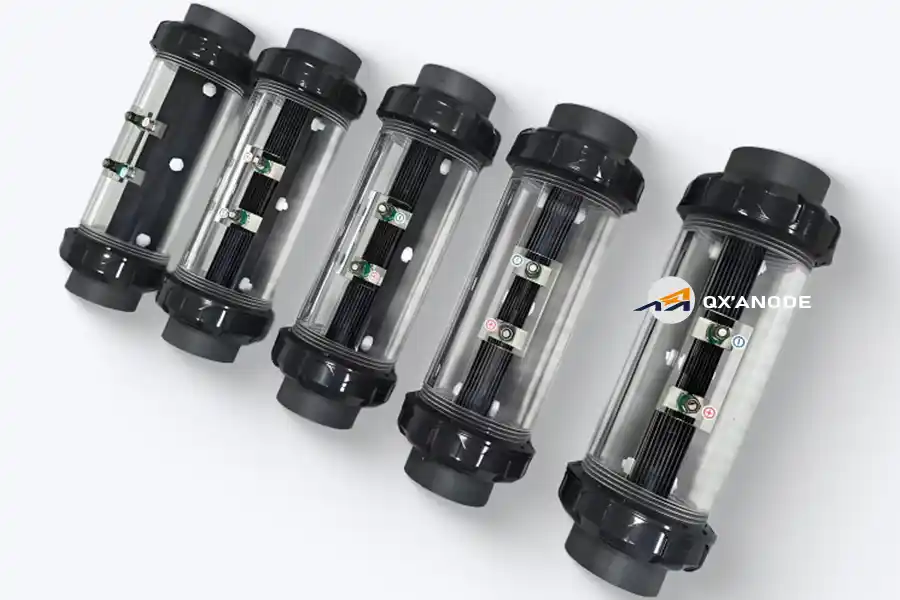
The water decides how long the coating lasts
Current density gets the attention in datasheets. In the field, water chemistry does most of the damage. These are the parameters worth checking before you blame the anode — and the ones to send us with an RFQ.
| Parameter | Typical public-pool target | Why the anode cares |
|---|---|---|
| Free chlorine | 1–3 ppm 1 ppm minimum in US public pools | This is a residual, not a cell setting. If the pool needs 4 ppm to hold a reading, the cell is undersized or there is a chlorine demand nobody has found. |
| pH | 7.2–7.8 | Above 7.8, calcium comes out of solution on the cathode and creeps across the gap. Below 7.0, the coating is attacked directly. Both cost coating life. |
| Combined chlorine | ≤0.2 ppm ideal 0.5 ppm common cap | Chloramines do not sanitize. ORP sags, the controller extends run time, and the anode pays for the extra hours. |
| Cyanuric acid | 30–50 ppm some codes allow to 100 | CYA binds hypochlorous acid and flattens the ORP response. Controllers over-chlorinate to compensate, which means more current through the coating. |
| Calcium hardness | 200–400 ppm | The main cause of scaling in hard-water pools. Scale insulates the cathode, raises cell voltage, and pushes current to the uncovered edges of the anode. |
| Salt | 2,700–4,000 ppm up to 6,000 for some cells | Too low: high voltage, heat, and coating stress. Too high: corrosion of rails and fixtures — not usually the anode. Check the cell rating and local code. |
| ORP | 650–750 mV | The number most controllers actually control on. It drifts with pH and CYA, so a dirty probe can make a healthy cell run itself to death. |
| Fluoride, iron, manganese | F⁻ <1 ppm metals filtered out | Fluoride etches titanium wherever the coating is thin. Metals plate onto the cathode, stain the cell, and hide the scale you need to see. |
Ranges reflect common US public-pool practice and WHO guidance; your local health code governs. See references at the end of this page.
What this looks like in practice
A white cell with rising amps is a water problem, not a coating problem. Acid-wash it, correct the pH and hardness, and check the flow switch before ordering plates. Replacing an anode into the same water buys you one more season of the same failure.
Pick the coating for the water, not the catalog
All three coatings evolve chlorine. They differ in what else they will tolerate: oxygen, polarity reversal, low chloride, hard water. That is the decision.
RuO₂–IrO₂
Ruthenium does the chlorine work. Iridium keeps the layer from passivating when the cell reverses polarity or the current is interrupted. Highest chlorine efficiency of the three and the lowest cell voltage — which is why it is the default for pool duty.
- Loading8–20 g/m²
- ReversalGood
- Use whenSoft to moderately hard water
IrO₂–Ta₂O₅
Tantalum stabilizes iridium against oxygen evolution. Choose it when reversal is aggressive, hardness is high enough that the anode spends part of each cycle making oxygen, or the controller reverses on a short interval. Chlorine efficiency is a step lower; life in rough duty is longer.
- Loading8–20 g/m²
- ReversalExcellent
- Use whenHard water, frequent reversal
Platinum on Ti
Platinum works where chloride is low and current density is modest: mineral pools, low-salt systems, some spa cells. It is not a substitute for Ru-Ir in a brine cell. At high chloride and high current density you pay more for the metal and lose it faster.
- Loading1–5 μm Pt
- ReversalLimited
- Use whenLow-salt, mineral systems
| Coating | Chlorine efficiency | Polarity reversal | Hard water | Typical pool duty |
|---|---|---|---|---|
| RuO₂–IrO₂ | Highest | Good | Moderate | Residential and commercial salt cells; clean brine |
| IrO₂–Ta₂O₅ | Lower | Excellent | Good | Hard water, short reversal cycles, high-current brine |
| Pt on Ti | Duty-dependent | Limited | Good | Low-salt and mineral pools, spa cells |
More detail on each chemistry: Ru-Ir coated titanium anode, Ir-Ta coated titanium anode, platinum-plated titanium anode.
The numbers, and what moves them
Standard range below. Every line can be changed. The trade-off is always the same three things: service life, cell voltage, or cost.
| Substrate | Grade 1 titanium, ASTM B265 (Grade 2 on request) |
|---|---|
| Coating | RuO₂–IrO₂ standard; IrO₂–Ta₂O₅ for harsh duty |
| Coating loading | 8–20 g/m², set by duty rather than by price |
| Coating thickness | 5–25 μm, multiple thermal decomposition layers |
| Plate thickness | 0.5–1.5 mm |
| Plate size | To your drawing; typical pool plates 100–500 mm long |
| Electrode gap | 3–6 mm |
| Current density | 200–400 A/m² in-line cells · 500–1,500 A/m² brine cells |
| Water temperature | 10–45 °C (50–113 °F) |
| Chloride | 2,700–6,000 ppm in-line · saturated brine in brine systems |
| Service life | 8,000–15,000 h at rated current density |
| Terminals | Welded Ti stud, threaded stud, lug, bus bar |
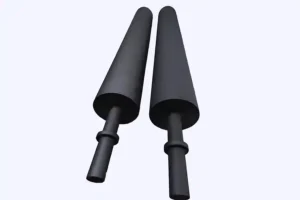
| Shapes | Flat plate, perforated plate, expanded mesh, tube |
| Testing | Coating weight, adhesion, dimensions, accelerated life test; SGS report on request |
| Packing | Export crate, plates separated and edge-protected |
Plate and mesh formats: titanium anode plate · MMO titanium mesh anode · tube anode for swirl electrolysis.
Chlorine output is a mass balance, not a marketing number
Three equations get you from pool volume to anode area. If a supplier cannot show you this math, they are guessing at your cell size.
g/h = volume (m³) × dose (mg/L) ÷ run hoursA = g/h × 0.756 ÷ current efficiencym² = A ÷ current density (A/m²)0.756 Ah/g is the theoretical charge for chlorine at 100% efficiency (2 faradays per mole of Cl₂). Active area counts both faces of every plate. A 300 × 140 mm plate exposes 0.084 m², not 0.042 m².
Cell sizing estimate
Estimated requirement
Planning estimate only. Confirm against a chlorine demand test, the controller’s rated output, and local code. Counts both faces of each plate.
Worked example
A 25 × 12 m pool with 1.5 m average depth holds 450 m³. At a 2 mg/L daily dose and 8 hours of filtration, the cell has to make 112.5 g/h. At 85% efficiency that is about 100 A. At 300 A/m², the anode needs 0.334 m² of active area — four 300 × 140 mm plates, both faces counted.
Put six plates of that size in the same cell and the current density drops to about 200 A/m². You get the same chlorine at a lower voltage, and the coating lasts longer. That is the whole trade: plate area costs money once; current density costs coating life every day.
What actually kills a pool anode
Five patterns cover most of the returns we see. None of them is solved by buying a thicker coating.
White scale, climbing voltage
The plates look furred, especially the cathodes. Amperage rises while chlorine output falls.
pH above 7.8, hardness above 400 ppm, low flow, or cold water. Calcium precipitates on the cathode and bridges the gap.
Acid-wash (5:1 water to muriatic acid), correct pH and hardness, verify the flow switch. Do not scrape the anode.
Output fades, plates look clean
No scale, no visible damage, but the cell makes less chlorine each season and the controller runs at 100%.
Coating passivation. Usually from running above rated current density, low chloride, or years of high hours.
Recoat or replace. Then check the controller’s rated output against the cell’s plate area — the mismatch is what used up the coating.
Black or blue spots, pitting
Small dark spots on the anode, often at edges or welds, spreading into the titanium.
A coating breach plus fluoride, stray current, or a scratched surface. Once chloride reaches bare titanium, the substrate corrodes fast.
Replace the plate. Test fluoride and check grounding and wiring before the new set goes in.
Melted terminal or cracked weld
The stud is discolored, the weld has a hairline crack, or the plate is warped at one end.
Loose connection, dry run, or an air pocket in the housing. Resistance heat does the rest.
Torque to the cell maker’s spec, confirm the flow switch and air bleed, and check terminal condition at every service.
Cell runs, chlorine will not hold
The cell tests fine on the bench, but free chlorine drops to zero within hours of running.
CYA too high, combined chlorine, an undersized cell, or too few run hours. None of these is an anode fault.
Dilute to bring CYA down, breakpoint shock, then re-check the sizing math. Replace the anode only after the water is right.
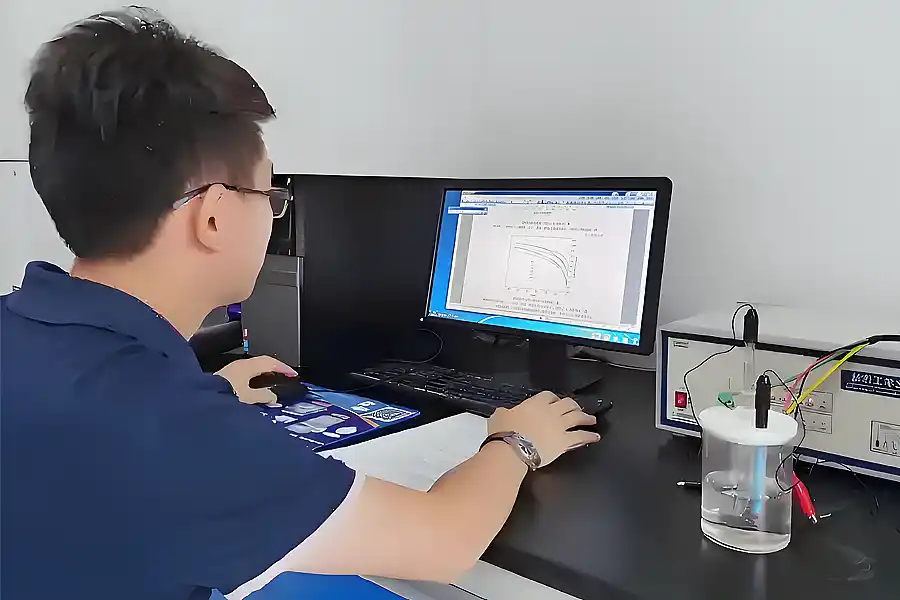
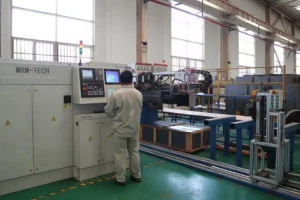
Most of the work happens before the coating
A coated anode is a surface product. If the titanium underneath is not prepared, the best oxide recipe in the world will flake off in the first season.
Substrate
Gr1 strip cut, flattened, pickled and blasted. Surface profile is what the oxide grips.
Coating
Ru and Ir salts brushed on and baked, pass after pass. Loading builds in layers, not one dip.
Sintering
Each pass is fired. Temperature and dwell decide whether the oxide is crystalline or just dried on.
Test
Coating weight, adhesion, dimensions, terminal pull, and an accelerated life sample from the batch.
Pack
Plates separated, edges protected, crated for export with the coating record inside.
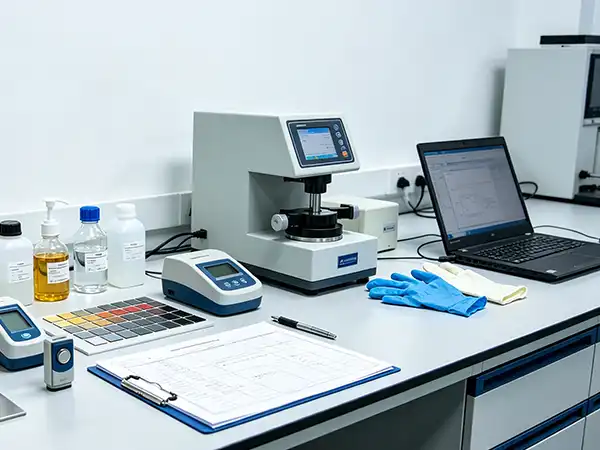
What leaves the factory
Plates and welded anode assemblies, packed to the cell drawing you sent. We do not make controllers, housings, or pumps, and we will tell you when a failure is in one of those.
- Edges deburred, corners radiused so the coating does not start at a sharp edge.
- Welded titanium stud or lug — not a pressed or riveted connection.
- Coating stops below the terminal, so chloride creep does not start at the joint.
- Batch traceable to a coating-weight record and an adhesion check.
Quality system: ISO 9001:2015. Coating analysis by SGS on request. See how we develop coatings.
What to send with an RFQ
Six details let us quote a coating and a plate layout instead of a price per kilogram. If you have a dead cell, send that — it is faster than a drawing.
- Cell drawing, or the old plate set with dimensions and thickness
- Rated chlorine output in g/h or kg/h, and daily run hours
- Salt level and calcium hardness of the water it will see
- Controller reversal interval, if it has one
- Terminal type: welded stud, threaded stud, lug, or bus bar
- Plate count and spacing inside the existing housing
Send drawings to info@mmo-anode.com or use the contact form. Files in PDF, STEP, or DXF are all fine.
Straight answers
The questions that come up in almost every pool anode inquiry. More on our titanium anode FAQ.
What is a titanium anode for pool water disinfection?
It is the coated electrode inside an electrolytic cell that turns dissolved chloride into chlorine. The substrate is Gr1 or Gr2 titanium; the active layer is a mixed metal oxide, usually RuO₂–IrO₂. The chlorine dissolves as hypochlorous acid, which is the sanitizer that actually kills bacteria and oxidizes bather waste.
How long does a pool anode last?
In residential and light commercial salt cells, 8,000–15,000 operating hours is the normal range, which is roughly three to five seasons. Commercial brine systems typically run three to five years. Current density and water chemistry move that number more than plate size does.
Can I replace only the plates instead of the whole cell?
Usually yes. The housing, cable, and controller are the expensive parts, and the plates are the wear item. Send the old plates or the cell drawing and we will match the dimensions, hole pattern, and terminal type. Replacing plates alone typically costs less than a complete cell.
What salt level should a saltwater pool run?
Most residential cells are rated for 2,700–4,000 ppm, with an operating range up to about 6,000 ppm. Follow the cell manufacturer’s rating. Low salt raises voltage and heat at the plates; high salt raises corrosion risk for rails, ladders, and heaters rather than for the anode itself.
MMO or platinum for a pool cell?
Ru-Ir MMO for anything with meaningful chloride: salt pools and brine systems. Platinum is for low-salt and mineral systems where chloride is low and current density is modest. Platinum in a brine cell at high current density is an expensive way to lose metal.
Why does my cell scale so fast?
Check pH first, then calcium hardness, then flow. Above pH 7.8 calcium comes out of solution on the cathode. Low flow and cold water make it worse. Reverse-polarity controllers shed some scale, but they cannot compensate for water that is out of balance.
Does cyanuric acid affect the cell?
Indirectly, and significantly. CYA binds hypochlorous acid and flattens the ORP response, so the controller runs longer to hold a reading. That means more current hours on the coating. Keep CYA in the 30–50 ppm range unless your local code says otherwise.
Can you match an existing cell from another brand?
Yes. Send a drawing, a sample plate, or the old set. We replicate plate dimensions, thickness, hole pattern, spacing, and terminal style. If the original coating was undersized for the duty, we will say so and quote a heavier loading instead of an exact copy.
Do you supply complete salt cells or just the electrodes?
Electrodes and welded anode assemblies. We do not make controllers, housings, flow switches, or pumps. For complete systems, we work with the cell makers and OEMs who build around our plates — see the salt chlorine generator anode page for that supply model.
Send the cell you are trying to replace.
A photo, a drawing, or the old plates is enough to start. We will come back with a coating recommendation, a plate layout, and a price — not a catalog page.
References and further reading
- Centers for Disease Control and Prevention. Operating and Managing Public Pools, Hot Tubs and Splash Pads. Free chlorine minimum and pH range for public aquatic venues.
- World Health Organization. Guidelines for Safe Recreational Water Environments, Volume 2: Swimming Pools and Similar Environments. Residual chlorine and combined chlorine guidance.
- NSF/ANSI/CAN 50, Equipment for Swimming Pools, Spas, Hot Tubs and Other Recreational Water Facilities. The equipment standard most US certification bodies test against.
- Qixin Titanium. The Titanium Anode Guide and coating failure and maintenance.