From sponge to certified mill products: the complete process chain
Titanium Plate, Bar, Wire, Tube: Complete Manufacturing Guide
Titanium mill products are not shaped in a single step. The process chain moves from titanium sponge (and qualified revert) → ingot melting under vacuum (VAR, or EBCHM for the highest-purity service) → forging and rolling that set the microstructure → semi-finished plate, bar, wire or tube → surface processing → a documented QC and certification gate (chemistry, mechanical tests, NDT, heat traceability, MTR per EN 10204). Every property you specify — strength, corrosion resistance, weldability, ultrasonic quality — is decided upstream, mostly at the melt and the forge.
Raw Materials: Where Titanium Starts
Commercial titanium production begins with titanium sponge. Natural rutile or ilmenite is upgraded to titanium dioxide (TiO₂), chlorinated to titanium tetrachloride (TiCl₄), then reduced — most commonly with magnesium in the Kroll process (with sodium-based Hunter reduction used in some plants). The result is a porous, sponge-like mass of pure titanium crystals that becomes the building block of every mill product.
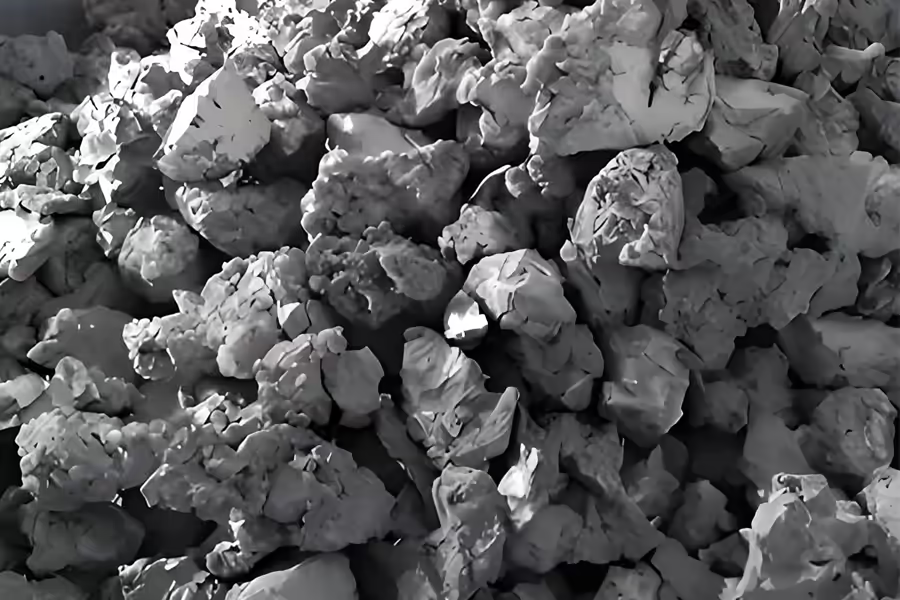
Three feed streams go into a titanium melt:
- Primary sponge — graded by hardness (Brinell), particle size and impurity level (notably oxygen, iron, nitrogen, chlorine and magnesium). Low-oxygen sponge is mandatory for ELI (extra-low interstitial) and implant grades.
- Qualified revert / scrap — internally generated cropped ingot ends and certified customer scrap, blended in controlled ratios. Only material with full chemistry traceability enters the melt; unknown scrap is rejected.
- Master alloys — e.g., aluminum-vanadium (60/40 Al-V), Al-Mo and other additions that set the final alloy chemistry (Ti-6Al-4V, Ti-3Al-2.5V, Ti-0.3Mo-0.8Ni, etc.).
Oxygen is the single most important impurity: it strengthens titanium dramatically but destroys ductility and toughness. That is why oxygen limits are spelled out grade by grade (e.g., 0.18% max for Grade 2, 0.13% for Grade 23 ELI), and why vacuum or inert-atmosphere handling runs through the entire process.
| Feed material | Role | Key control points |
|---|---|---|
| Titanium sponge | Primary titanium source | O, Fe, N, Cl, Mg content; BHN hardness; particle size; lot-to-lot consistency |
| Qualified revert / scrap | Cost-efficient recycle | Chemistry traceability; inclusion risk; maximum blend ratio per spec |
| Master alloys (Al-V, Al-Mo…) | Alloying additions | Alloy chemistry; melting point; homogeneity |
Melting: From Sponge to Ingot
Molten titanium reacts violently with oxygen, nitrogen and most refractories, so melting happens under vacuum using water-cooled copper crucibles. The two dominant routes:
Vacuum Arc Remelting (VAR)
Compacted sponge/alloy electrodes are remelted under vacuum in an electric arc furnace. Aerospace and medical specifications normally require double or triple melting: each remelt improves chemical homogeneity and removes porosity. VAR is the workhorse for the large majority of plate, bar, wire and tube stock.
Electron Beam Cold Hearth Melting (EBCHM)
An electron beam melts feed in a water-cooled copper hearth before the metal flows into the ingot mold. The hearth gives inclusions a chance to settle or dissolve — high-density inclusions (e.g., tungsten carbide from tooling) sink and are trapped, while low-density inclusions (nitride/oxide defects) float and are removed. EBCHM is therefore specified for critical rotating aero-engine components and other high-integrity applications; plasma arc melting (PAM) is used for specialty alloys.
| Process | Key feature | Typical use |
|---|---|---|
| VAR (double/triple melt) | Homogenization, cleanliness, reproducibility; large ingots | Standard mill products, most aerospace and industrial grades |
| EBCHM | Inclusion removal via cold hearth refining | Rotating engine parts, highest-integrity applications |
| PAM / ISM | Inert-atmosphere melting for specialty alloys | Intermetallics, reactive alloys, small specialty melts |
The finished ingot is cropped top and bottom (both ends contain solidification defects), surface-conditioned, and sampled for full chemistry before release to the forge.
Forging and Primary Conversion
Forging does two jobs: it shapes the ingot into workable forms, and — more importantly — it builds the microstructure that controls final properties. Titanium has two crystal structures: alpha (hcp) at lower temperature and beta (bcc) above the beta-transus. Where you forge relative to that transition temperature decides what you get:
- Alpha-beta forging (below the beta-transus) produces a fine, equiaxed-alpha structure — the best balance of strength, ductility and fatigue life, and the standard for most plate, bar and billet.
- Beta forging (above the transus, with controlled finishing) gives a transformed lamellar structure with superior fracture toughness and creep resistance, at some cost in ductility — used where toughness dominates, e.g., large airframe forgings.
- Open-die forging (upsetting and cogging) converts round ingots to slab, bloom or billet; closed-die forging produces net or near-net parts; ring rolling produces seamless rings for flanges and engine cases.
Control points during conversion: heating practice (time/temperature windows to avoid oxygen pickup and grain growth), reduction ratio, strain distribution and finish temperature. These are written into each supplier’s process control documents and verified by sampling mechanical properties and microstructure from forged billet ends.
Mill Products: Plate, Bar, Wire and Tube
Titanium plate and Titanium sheet — ASTM B265
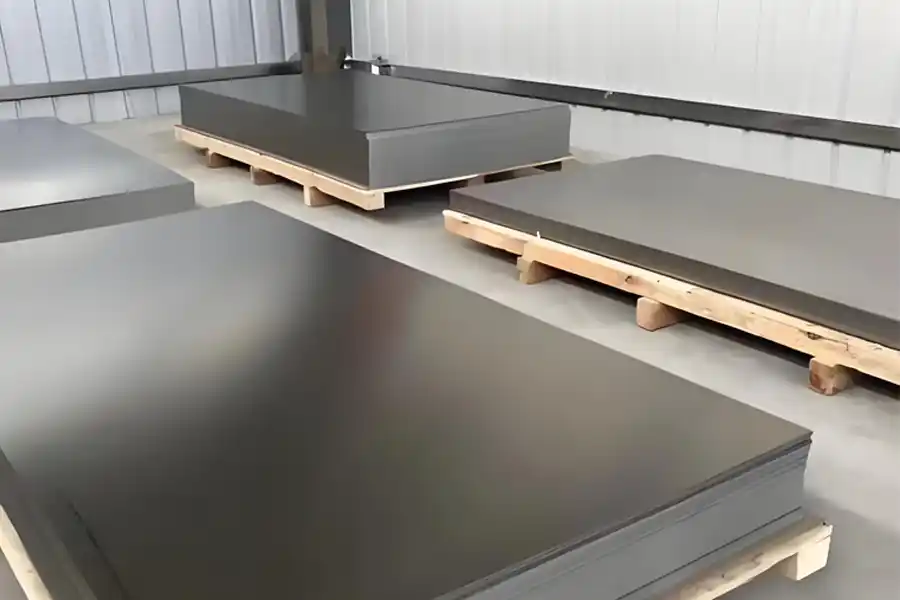
Slabs are hot-rolled on reversing plate mills; thin sheet is further cold-rolled. Under B265, sheet is under 4.76 mm (0.187 in) thick; plate is 4.76 mm and up. Plate is supplied flat-rolled, cut to ordered dimensions (plasma, abrasive water jet, or machining), and is available in thicknesses to 100 mm and beyond by machining. Grade 2 dominates corrosion-service plate; Grade 5 and Grade 23 dominate aerospace and medical bar-stock-derived plate.
| Form | Thickness (per B265) | Typical grades | Key properties checked |
|---|---|---|---|
| Sheet | < 4.76 mm | Gr1–Gr4, Gr5, Gr9, Gr12 | Tensile, bend, flatness, surface |
| Plate | ≥ 4.76 mm | Gr2, Gr5, Gr7, Gr12 | Tensile, UT (if ordered), thickness tolerance, flatness |
Titanium bar and Titanium rod — ASTM B348
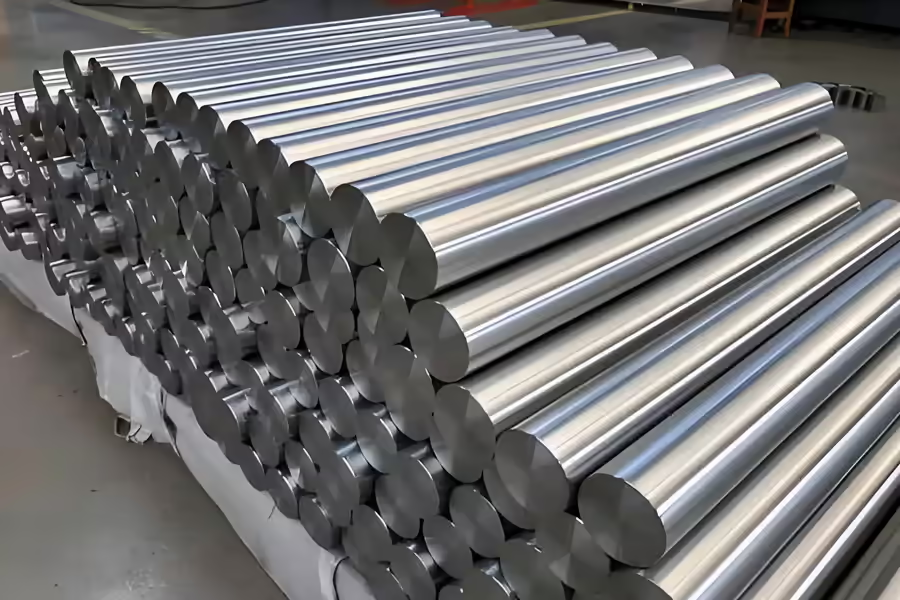
Billet is rolled or forged to round, square, rectangular or hexagonal bar. Surface conditions range from hot-rolled and pickled to turned, centerless ground or peeled for tight dimensional control and surface integrity. Straightness and alpha-case-free matter for machining and medical applications. Bar is the raw material for machined parts, shafts, fasteners, flanges and forged fittings.
Titanium wire — ASTM B863
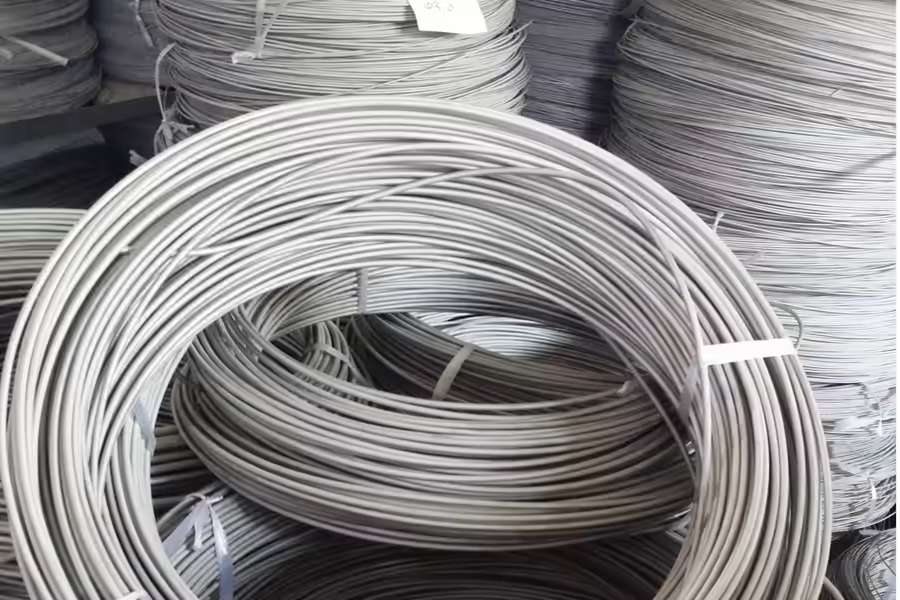
Wire is drawn from rolled rod through successive dies with intermediate anneals, supplied on spools, in coils, or in straight lengths. Diameters commonly range from a few tenths of a millimeter up to ~7 mm (larger sizes overlap rod). Uses include welding wire (ERTi-2, ERTi-5, ERTi-23 per AWS A5.16), fasteners, springs, mesh, medical instruments and additive manufacturing feedstock. Surface cleanliness, diameter tolerance and tensile consistency (for spring wire) are the decisive QC items.
Titanium tube and Titanium pipe — ASTM B861 (Seamless) and B862 (Welded)
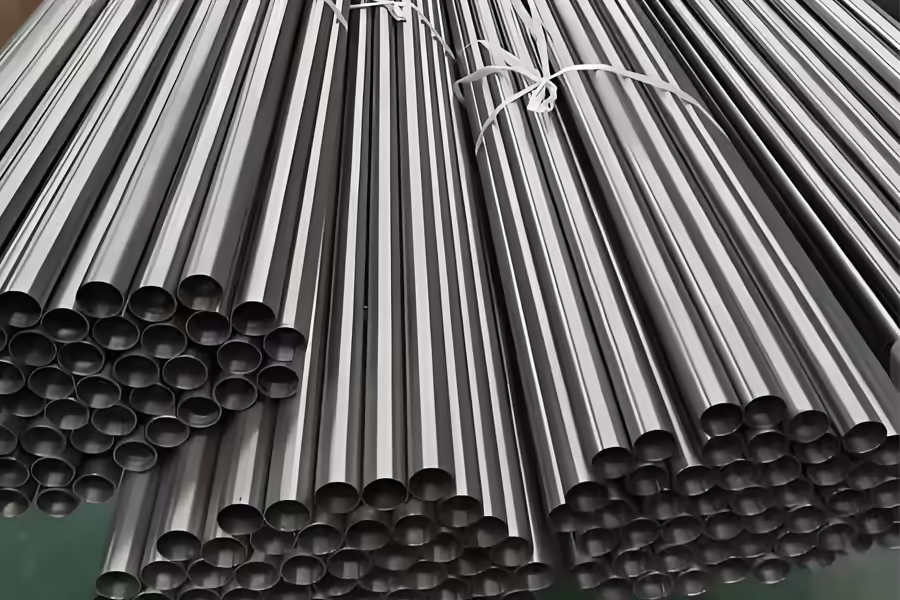
Seamless tube starts from a hollowed billet — extruded or rotary-pierced, then reduced on a pilger mill or draw bench to final dimensions. Welded tube is roll-formed from titanium strip and longitudinally TIG/plasma welded, then sized and annealed; B862 requires welded tube to meet the same mechanical and chemistry requirements as seamless in the same grade. Seamless is preferred for pressure service and aggressive media; welded tube wins on thin walls, long lengths and cost. Applications: heat exchangers, condensers, offshore seawater systems, chemical reactors and aerospace hydraulic lines (often Grade 9).
Processing and Surface Finish
Between the mill and the customer, semi-finished products routinely go through secondary operations that change cost, lead time and, sometimes, specification:
- Machining — titanium’s low thermal conductivity and work-hardening demand rigid setups, sharp tooling and flood coolant; machining itself does not alter the certified mill properties.
- Forming — hot forming for tight radii and springback control; CP grades form readily, alpha-beta alloys less so.
- Welding — must be done under inert gas shielding (GTAW/TIG) because molten titanium absorbs oxygen and nitrogen from air; weld zones are typically inspected by dye penetrant and X-ray.
- Surface treatment — pickling removes the oxygen-enriched alpha case from hot working; shot blasting, grinding, polishing and anodizing are applied per application.
Quality Control and Certification
| Check | Method / reference | What it proves |
|---|---|---|
| Chemical composition | OES (metals); inert-gas fusion / LECO for O, N, H; ICP for trace elements | Conforms to grade limits; interstitial control |
| Tensile, yield, elongation | ASTM E8 / E8M | Meets specification minimums at room temperature |
| Hardness | ASTM E18 (Rockwell) / E10 (Brinell) | Consistency and heat-treatment state |
| Bend test | ASTM E290 | Ductility / formability of sheet and strip |
| Ultrasonic inspection | ASTM E2375 (aerospace) / E213 (tube) | Internal soundness; no cracks or inclusions |
| Eddy current | ASTM E426 (tube) / E309 (wire) | Surface and near-surface defects on tube and wire |
| Microstructure | ASTM E3 (preparation), E407 (etching), E112 (grain size) | Correct processing; no alpha case or abnormal grain |
| Traceability | Heat number on every piece; MTR per EN 10204 Type 3.1 (3.2 with third-party witness) | Full chain from ingot to final product |
For aerospace, add the relevant AMS specification (e.g., AMS 4911 for Ti-6Al-4V sheet/plate, AMS 4928 for bar); for medical implants, ISO 5832-2 (CP) and ISO 5832-3 (Ti-6Al-4V ELI) apply.
Grade Selection: A Buyer’s Shortlist
| Grade | Composition (nominal) | Typical tensile (annealed) | Best fit |
|---|---|---|---|
| Gr 1 | CP, low O | ≥ 240 MPa | Maximum formability, deep drawing, heat exchangers |
| Gr 2 | CP | ≥ 345 MPa | Default CP grade: chemical, marine, desalination, general fabrication |
| Gr 5 | Ti-6Al-4V | ≥ 895 MPa | Aerospace structures, high-load mechanical parts, medical (as Gr 23 ELI) |
| Gr 7 | Ti-0.15Pd | ≥ 345 MPa | Severe reducing-acid corrosion service |
| Gr 9 | Ti-3Al-2.5V | ≥ 620 MPa | Hydraulic tubing, aerospace line systems |
| Gr 12 | Ti-0.3Mo-0.8Ni | ≥ 483 MPa | Chemical processing with crevice-corrosion risk |
| Gr 23 | Ti-6Al-4V ELI | ≥ 895 MPa | Medical implants, cryogenic service |
Mechanical values are typical specification minimums for annealed condition; always verify against the exact edition of the governing standard for your order.
FAQ
What is the difference between titanium plate and titanium sheet?
Under ASTM B265, sheet is less than 4.76 mm (0.187 in) thick, while plate is 4.76 mm (0.187 in) and thicker. Sheet is normally supplied cold-rolled or hot-rolled with tighter flatness and surface tolerances; plate is hot-rolled, often from forged slabs, and may be machined or abrasive-water-jet cut to ordered dimensions.
Which titanium grade should I choose: CP Grade 2 or Ti-6Al-4V?
Commercially pure Grade 2 is the default for corrosion service (chemical processing, marine, desalination) where moderate strength is enough and formability and weldability matter. Ti-6Al-4V (Grade 5) roughly doubles the strength and is the standard for aerospace structures and high-load mechanical parts. For corrosive media with higher strength needs, consider Grade 7 (Ti-0.15Pd) or Grade 12 (Ti-0.3Mo-0.8Ni).
How is titanium melted, and why is vacuum melting necessary?
Titanium reacts aggressively with oxygen and nitrogen at elevated temperature, so ingots are melted under vacuum or inert atmosphere. Vacuum Arc Remelting (VAR) is the workhorse, typically double- or triple-melted for aerospace and medical grades. Electron Beam Cold Hearth Melting (EBCHM) adds a refining step that removes high- and low-density inclusions, making it preferred for rotating aero-engine parts.
What is the difference between seamless and welded titanium tube?
Seamless tube (ASTM B861) is produced from hollowed billets by extrusion or rotary piercing plus pilgering, with no longitudinal weld seam. Welded tube (ASTM B862) is formed from titanium strip and longitudinally welded, offering tighter wall tolerances and lower cost at thin walls and long lengths. Welded tube made to B862 must meet the same mechanical and chemistry requirements as seamless in the same grade.
What documents should I request with titanium mill products?
Request a Material Test Report (MTR) per EN 10204 Type 3.1 (or 3.2 with third-party inspection) covering heat number, chemical composition (including oxygen, nitrogen, hydrogen, carbon and iron), mechanical properties, and confirmation of conformity to the ordered specification such as ASTM B265, B348, B863, B861 or B862. For aerospace or medical use, ask for the corresponding AMS or ISO 5832 specification and any NDT reports (ultrasonic, eddy current).
How is titanium quality controlled during production?
Quality control covers chemistry by optical emission spectrometry and inert-gas fusion (O/N/H), mechanical testing per ASTM E8/E8M and hardness per ASTM E18/E10, bend tests per ASTM E290, ultrasonic inspection per ASTM E2375 for aerospace, eddy-current testing for tube and wire, and metallographic examination of grain structure per ASTM E3/E407. Heat traceability is maintained from ingot to final product.
Specifying titanium plate, bar, wire or tube for your next anodes?
Send your grade, dimensions, quantity and required standard