Titanium Anodes for Sodium Hypochlorite Generators: Manufacturing and Application
A sodium hypochlorite generator titanium anode is a mixed metal oxide (MMO) coated titanium electrode built for chlorine evolution from brine or seawater. The standard build uses a Grade 1 or Grade 2 titanium substrate, per ASTM B265, with a ruthenium based coating, typically RuO₂-IrO₂-TiO₂, applied by thermal decomposition. In normal service the anode runs at 1 to 3 kA/m² in 2 to 4% brine at 10 to 40 °C, and chlorine current efficiency usually stays above 85% in a properly designed cell. This article covers how these anodes are manufactured, why the coating is formulated the way it is, and how to specify them for a new generator.
How a Sodium Hypochlorite Generator Works
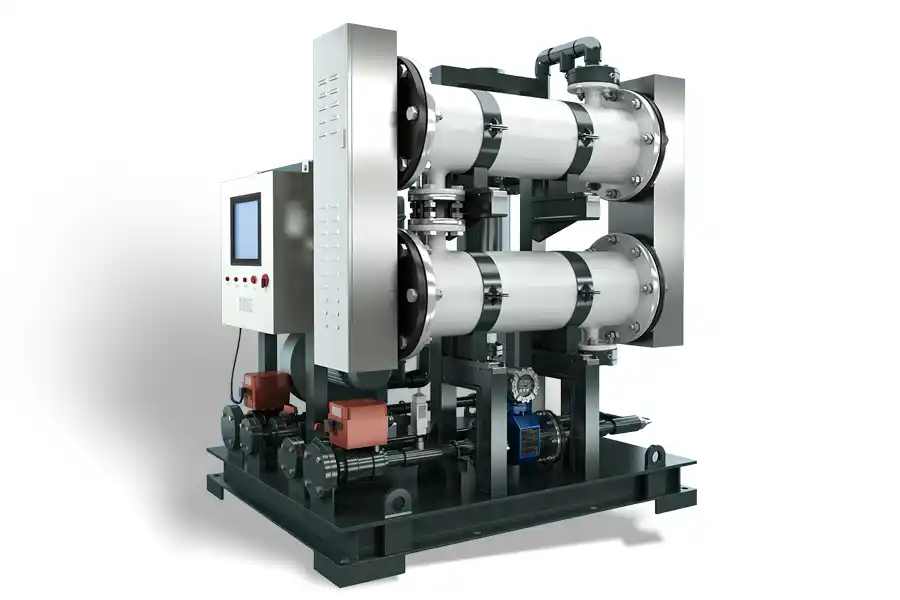
A sodium hypochlorite generator produces sodium hypochlorite (NaOCl (NaClO)), the same active compound as liquid bleach, by electrolyzing a sodium chloride (NaCl) solution. The anode oxidizes chloride ions to chlorine gas, the cathode reduces water to hydrogen and hydroxide ions, and the chlorine and hydroxide combine to form hypochlorite. The overall reaction can be written as NaCl + H₂O to NaOCl (NaClO) + H₂.
Because the anode carries the chlorine side of the reaction, its coating must be formulated for chlorine evolution. A coating designed for oxygen evolution, such as an iridium type or lead dioxide type, will not give the same hypochlorite output and will wear differently in this service. This is the single most common specification error in hypochlorite cell design, and it is why the coating chemistry matters more than any other component choice.
Why Titanium for the Substrate
Titanium is the substrate because it stays dimensionally stable in chloride electrolytes, which is where the term dimensionally stable anode (DSA) comes from. Grade 1 and Grade 2 titanium, per ASTM B265, cover nearly all hypochlorite generator duty. Grade 2 is the common default for plates and tubes. Grade 1 is slightly softer and is often used for mesh and expanded metal, where the metal is formed after rolling.
Under anodic polarization titanium forms a thin, self healing oxide film, so the base metal does not dissolve in brine the way graphite or lead alloy electrodes do. That film is also why the MMO coating must be applied to a clean, roughened surface: the coating bonds through mechanical interlocking as well as oxide growth, and a contaminated or polished surface will not hold it.
The MMO Coating System
The active layer on a hypochlorite anode is a mixed metal oxide (MMO) coating with ruthenium dioxide (RuO₂) as the main catalyst. A common formulation is RuO₂-IrO₂-TiO₂: ruthenium keeps the chlorine evolution overpotential low, iridium slows passivation and adds resistance to the oxygen evolution that always accompanies chlorine generation, and titanium dioxide acts as a stabilizer and diluent.
The coating is applied in multiple thin layers, usually 5 to 15 coats, to a finished thickness of 2 to 8 microns, with a precious metal loading of 5 to 15 g/m² depending on the duty. Coatings with a higher iridium share are specified where the cell runs hotter, above roughly 40 °C, or with frequent polarity reversal, because iridium is the component that resists both oxygen evolution and the anodic wear that reversal causes.
The Manufacturing Process
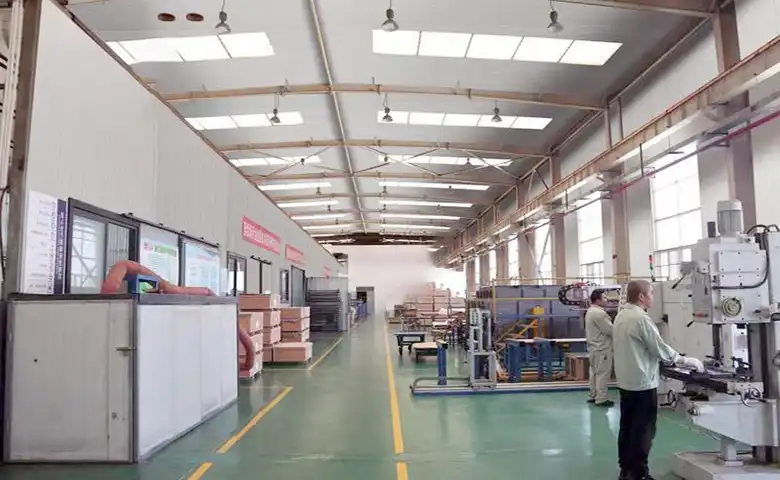
MMO coated anodes for hypochlorite generators are made in a six step process. Each step is controlled because the final coating performance depends on the condition of the surface before the first coat is applied.
- Substrate preparation. Titanium is cut and formed to the required geometry, then cleaned, sand blasted, and acid etched. Blasting and etching roughen the surface so the coating can grip the metal.
- Coating solution preparation. Precursor compounds, typically ruthenium chloride and chloroiridic acid, are dissolved with a titanium alkoxide in an organic solvent. Hydrochloric acid is added to keep the solution stable and to control the oxide chemistry during sintering.
- Coating application. The solution is applied to the prepared surface by brushing, spraying, or dipping. Brushing is common for small or complex parts; spraying and dipping are used for large plates and mesh.
- Thermal decomposition. Each coat is dried and sintered in air at 350 to 500 °C. The heat converts the chloride salts into the oxide coating and burns off the organic solvent.
- Layer buildup. The apply and sinter cycle repeats until the target coating thickness and precious metal loading are reached, typically 5 to 15 coats in total.
- Inspection and packing. The finished anode is checked for coating adhesion, thickness, and electrochemical response, then packed for export.
Quality Control and Testing
Quality control on MMO hypochlorite anodes focuses on three things: coating adhesion, coating composition, and electrochemical life.
- Adhesion. The coated part is checked by thermal shock and bend testing. The coating must survive heating and bending without spalling or flaking, because a coating that separates from the substrate fails fast in service.
- Composition and morphology. Scanning electron microscopy with energy dispersive X ray analysis (SEM/EDX) verifies the oxide composition and the coating structure across the surface. Consistent composition across a large plate matters because a thin or uneven area becomes the weak point in service.
- Electrochemical life. Accelerated life testing (ALT) is the standard life indicator. The anode runs at 10,000 to 20,000 A/m² in the target electrolyte until the cell voltage rises sharply, and the hours to failure are recorded. ALT hours are compared against a reference electrode with a known field history, because ALT does not translate directly into calendar years.
Sizing and Selection Parameters
| Parameter | Typical Range / Standard |
|---|---|
| Substrate material | Titanium Grade 1 or Grade 2 (ASTM B265) |
| Coating system | MMO, RuO₂-IrO₂-TiO₂, thermal decomposition |
| Coating thickness | 2 to 8 microns |
| Precious metal loading | 5 to 15 g/m² (duty dependent) |
| Brine concentration | 20 to 40 g/L NaCl (2 to 4%) |
| Current density | 1 to 3 kA/m² |
| Operating temperature | 10 to 40 °C |
| Chlorine current efficiency | Above 85% in a properly designed cell |
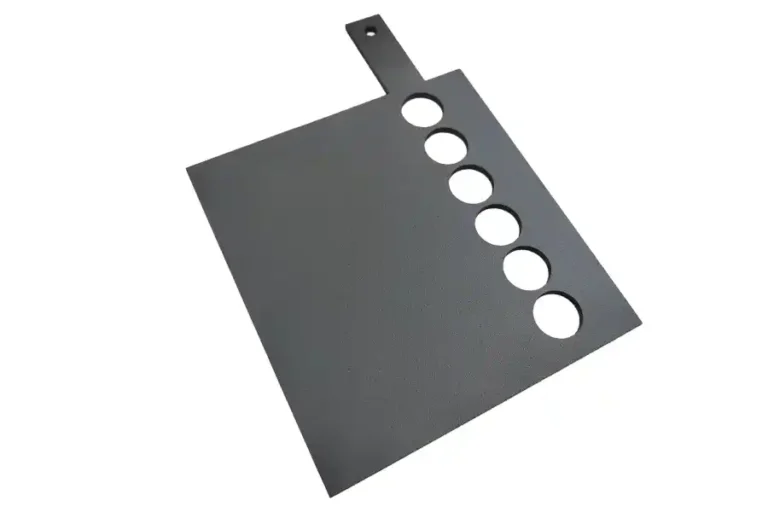
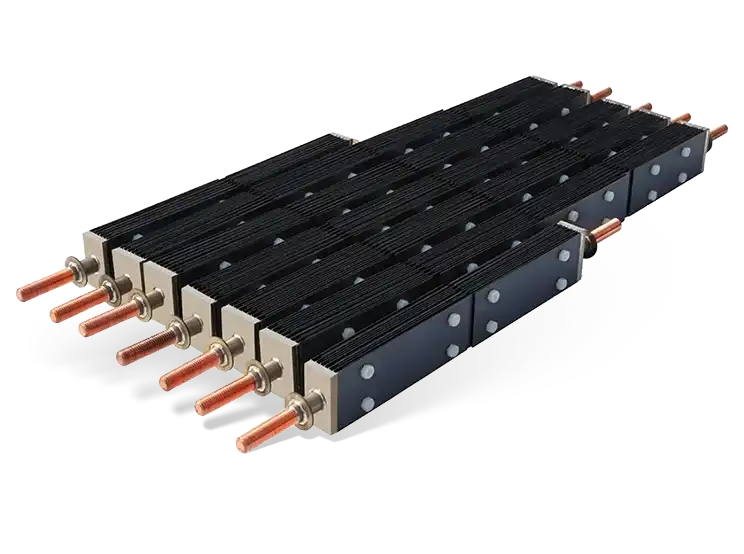
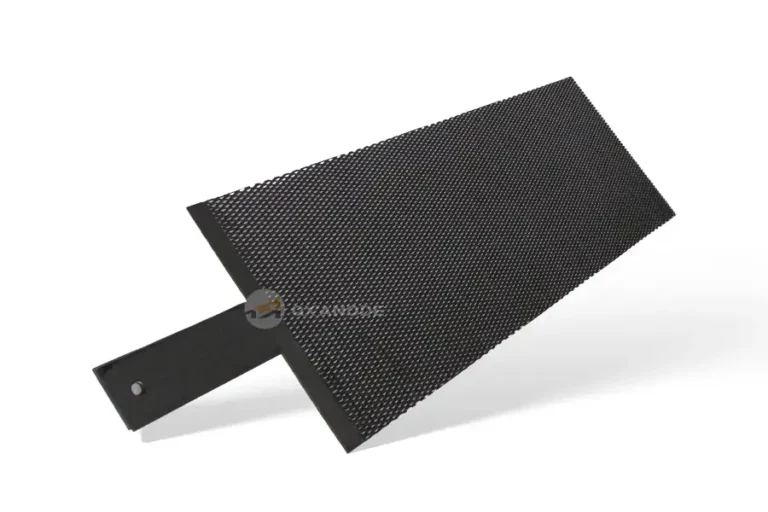
| Available shapes | Plate, mesh, expanded metal, tube, rod, custom |
| Connection method | Titanium copper titanium welded lug, threaded bolt |
| Polarity reversal | Supported; frequency depends on water hardness |
| Certifications | ISO 9001:2015 |
Design and Maintenance Considerations
Several design decisions determine how long a hypochlorite anode lasts in service. The most consequential ones are listed below.
- Polarity reversal. Calcium and magnesium scale build up on the cathode in hard water. Reversing the polarity dissolves the scale, but it also stresses the anode coating. Frequent reversal, needed in hard water, is a reason to choose a coating with a higher iridium share.
- Temperature. Chlorine current efficiency falls as temperature rises, and coating consumption accelerates above roughly 40 °C. Cooling the brine, or keeping the cell below that point, protects both efficiency and anode life.
- Current density. Running above the rated 1 to 3 kA/m² shortens coating life faster than any other operating error. Design the electrode area for the peak current, not the average.
- Cell geometry and flow. The anode to cathode gap and the flow path must carry chlorine gas away from the electrode surface. Gas blinding raises local resistance and wastes energy.
- Brine strength. Chloride below roughly 2% raises the oxygen share of the reaction, which cuts hypochlorite output and wears the coating faster. Keep the feed at 2 to 4% for the best balance.
Applications
- Marine chlorination. Seawater electrolysis on ships, offshore platforms, and power plant cooling water systems to prevent marine growth in pipes and heat exchangers.
- Drinking water disinfection. Municipal plants and small scale water systems that generate hypochlorite on site instead of handling bulk liquid bleach.
- Swimming pools. On site generation keeps a steady free chlorine residual without storing drums of chemical.
- Aquaculture and seafood processing. Disinfection of process water and wash water in hatcheries and processing plants.
- Wastewater and greywater. Disinfection of treated effluent and reuse water in decentralized treatment schemes.
- Food and beverage sanitation. Clean in place (CIP) and washdown disinfection where a continuous oxidant supply is needed.
Frequently Asked Questions
What is the difference between a chlorine evolution anode and an oxygen evolution anode?
A chlorine evolution anode uses a ruthenium based MMO coating, such as RuO₂-IrO₂-TiO₂, that keeps the chlorine overpotential low. An oxygen evolution anode uses an iridium based or lead dioxide coating. Using the wrong coating for the electrolyte cuts hypochlorite output and shortens anode life, so the two types are not interchangeable in a hypochlorite generator.
How long does an MMO anode last in a sodium hypochlorite generator?
Service life is set by the duty, not by a fixed calendar number. In normal service, 1 to 3 kA/m² in 2 to 4% brine at 10 to 40 °C, with sensible polarity reversal practice, MMO anodes in hypochlorite generators commonly run for several years. Hard water, high temperature, and over current all shorten life. Ask your supplier for an expected life based on your actual duty cycle. The maintenance routine and recoating decision behind that number are covered in our titanium anode guide.
Can the same anode run on seawater and on dilute brine?
Yes, in most plate and mesh designs the same coating chemistry works for both, because the chloride content of seawater is still high enough for efficient chlorine evolution. The practical differences are the higher current density in seawater service and the heavier scaling on the cathode, which drives more frequent polarity reversal.
Why does the coating contain iridium if ruthenium is the catalyst?
Iridium stabilizes the ruthenium oxide and improves resistance to oxygen evolution and to polarity reversal. A pure ruthenium coating passivates faster in service, so iridium is added even though it is the more expensive component. The exact Ru to Ir ratio is tuned to the operating temperature and the reversal frequency.
What is accelerated life testing and why does it matter?
Accelerated life testing (ALT) runs the anode at a high current density, typically 10,000 to 20,000 A/m², in the target electrolyte until the cell voltage rises sharply, which marks the end of the coating. The hours to failure are compared against a reference electrode with known field performance. ALT is a relative ranking tool, not a direct prediction of calendar years in service.
Need an anode specified for your brine, current density, and cell geometry?
Send us your brine concentration, operating temperature, current density, dimensions, and expected duty cycle. We will confirm the coating spec and return a quotation within 48 hours.