
Get straight answers from Qixin coating engineers on MMO titanium anode selection: Ru-Ir and Ir-Ta coating chemistry, realistic service life expectations, recoating economics, and custom manufacturing for electroplating, water treatment, and electrochlorination duty.
Product Basics
An MMO titanium anode is an electrochemical electrode made of a titanium substrate, Grade 1 or Grade 2, carrying a mixed metal oxide catalytic coating, typically ruthenium-iridium oxide or iridium-tantalum oxide. The coating drives the anode reaction, while the titanium base provides the structure and corrosion resistance. Compared with lead or graphite anodes, it runs at a lower cell voltage, holds its dimensions in service, and does not dissolve into the electrolyte, so the bath stays clean. The substrate can be stripped and recoated when the coating reaches end of life.
MMO and DSA describe the same family of anodes from two angles. MMO, mixed metal oxide, describes the coating: a mixture of precious metal oxides such as ruthenium oxide and iridium oxide on a titanium base. DSA, dimensionally stable anode, describes the behavior: the anode keeps its dimensions in service instead of wearing away like graphite or lead. In practice the two terms are used interchangeably across electroplating, water treatment, and electrowinning.
Three reasons come up on most lines. First, lead and graphite anodes wear and change shape, which shifts current distribution and deposit thickness; titanium anodes hold their dimensions. Second, lead dissolves into the bath and ends up in the product and the sludge, which is a compliance problem in plating shops; MMO coatings stay on the anode. Third, MMO anodes run at lower overpotential, which shows up as lower cell voltage and lower energy cost per ampere hour.
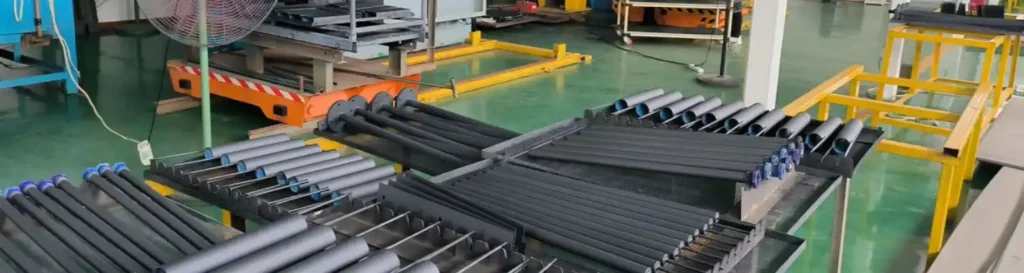
We manufacture plate, mesh, tube, rod, and wire anodes, plus basket and special shapes built to drawing. Mesh gives high active area per kilogram for copper foil and water treatment; plates suit copper foil plating and wastewater cells; rods, tubes, and wire fit cathodic protection groundbeds, deep well anodes, and electrowinning. Dimensions, substrate thickness, and coating area are set by your drawing and tank geometry.
Coating Selection and Performance
Start from the reaction your process needs at the anode. Ruthenium-iridium (Ru-Ir) evolves chlorine and is the standard choice in seawater, brine, and hydrochloric acid based baths, which covers electrochlorination, chlor-alkali, and sodium hypochlorite generation. Iridium-tantalum (Ir-Ta) evolves oxygen and holds up in sulfuric acid and mixed acid baths, which suits electrowinning, copper foil, and electro-oxidation of wastewater. Platinum coated titanium serves neutral to mildly acidic electrolytes in electroplating and precision finishing. Send your electrolyte and current density and our engineers confirm the coating.
Yes. PbO₂ coated titanium anodes are available for oxygen evolution in strong acid, high current density service such as electrocatalytic oxidation and hydrometallurgical applications. PbO2 is a lower cost alternative to precious metal coatings where lead contamination is not a constraint. As with all our coatings, the formulation and coating load are matched to your electrolyte and operating data.
Coating life depends on current density, electrolyte composition and temperature, and whether the cell sees polarity reversal, so a single published figure would be misleading. What we do instead is quote an expected service life with each quotation, based on your operating data. The failure mode is well understood: the precious metal loading depletes gradually and cell voltage creeps up. When that happens the titanium substrate is still intact and can be stripped and recoated.
Yes, within limits set by the coating system, not by one universal number. Higher current density consumes the coating faster, and each coating family has a temperature range where it stays stable. Rather than publish generic limits, we select the coating formulation and loading for your actual current density, electrolyte, and temperature, and confirm the expected life in the quotation. Send us those three inputs and we will tell you what the anode can carry.
Applications and Products
Our anodes run in electroplating and galvanizing (zinc, nickel, copper, and chrome baths), water and wastewater treatment (electro-oxidation of organic pollutants, disinfection), chlor-alkali and sodium hypochlorite generation, electrowinning of metals from solution, cathodic protection of buried pipelines, marine structures, and concrete reinforcement, and ballast water treatment on vessels.
Porous titanium filter elements are made by sintering titanium powder into cartridges and tubes with a controlled pore structure. They filter electroplating baths, chemical process liquors, and water in duties where polymer filters would degrade, and they resist acids, alkalis, and seawater. When an element loads up it is regenerated by backwashing or ultrasonic cleaning and returned to service, so a set of elements lasts through many filtration cycles.
The electroplating consumables line covers titanium anode baskets, mesh baskets, anode bags, and auxiliary anodes. Titanium baskets hold soluble anode material in the bath without contaminating it, and auxiliary anodes are built to shape to improve throwing power on complex parts. All items are made to your tank and part drawings.
Ordering, Customization and Support
Yes, custom manufacturing is the core of our business. We build to drawing or to sample: shape, dimensions, substrate thickness, coating type, and coating load. Our engineering team works with you from design review through production. Drawing and quote requests are answered within 12 hours, and the lead time for each order is confirmed with the quotation, because it depends on complexity and quantity.
Five inputs are enough to start: a drawing or sketch with dimensions, the electrolyte composition, the working current density, the bath temperature, and the total current per anode. If some of these are not final, send what you have; our engineers will confirm the missing inputs from your process description. Quotes and coating recommendations are returned within 12 hours through the contact form or info@mmo-anode.com.
Yes. When an MMO coating reaches end of life the titanium substrate is normally intact. We strip the spent coating, re-prepare the surface, and recoat the substrate at a lower cost than a new anode. Returning anodes for recoating also keeps titanium out of the scrap stream. We can evaluate a used anode and confirm whether it is a recoat candidate before you ship it. See our guide to coating failure and maintenance for the failure signs to watch on your line.
Baoji Qixin Titanium Co., Ltd. was founded in 2006 in Baoji, Shaanxi, China’s titanium industry hub. We are an ISO 9001 certified manufacturer with an in-house R&D lab and more than 10 granted patents, and we have shipped anodes to clients in over 25 countries, including the United States, Germany, and South Korea. Mill certificates and material traceability are supplied with shipments. More background is on the about page.