MMO titanium anodes rarely fail without warning. Most coating failures trace back to a short list of causes: gradual electrochemical consumption of the precious metal oxide layer, passivation of the titanium substrate under prolonged oxygen evolution, mechanical damage during handling or cleaning, and chemical attack from contaminated electrolytes. For plant operators, three habits determine most of the service life you actually get: keeping current density inside the design window, keeping the electrolyte free of fluoride and debris, and cleaning deposits gently before they harden. This guide explains each failure mechanism in plain terms, the warning signs you can read from your rectifier and visual inspections, and a maintenance routine you can run with existing staff.
The preventive side of this topic, including the maintenance schedule and the selection logic that avoids most failures in the first place, sits in our titanium anode maintenance and selection guide.
What Actually Fails on an MMO Anode
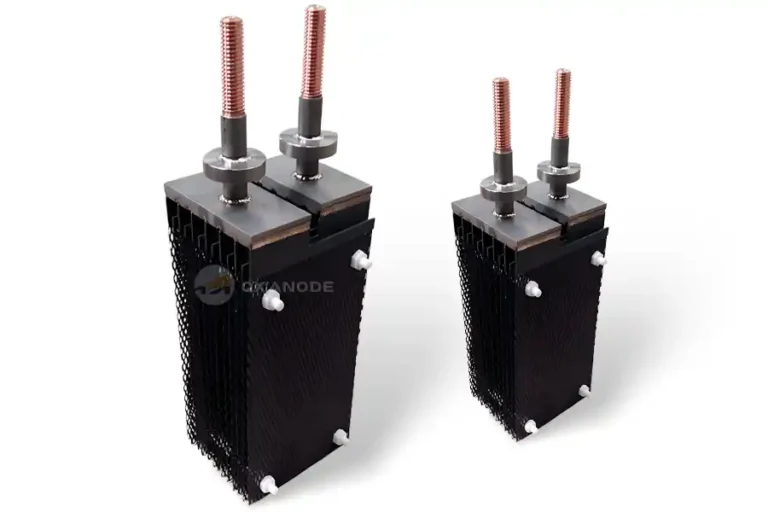
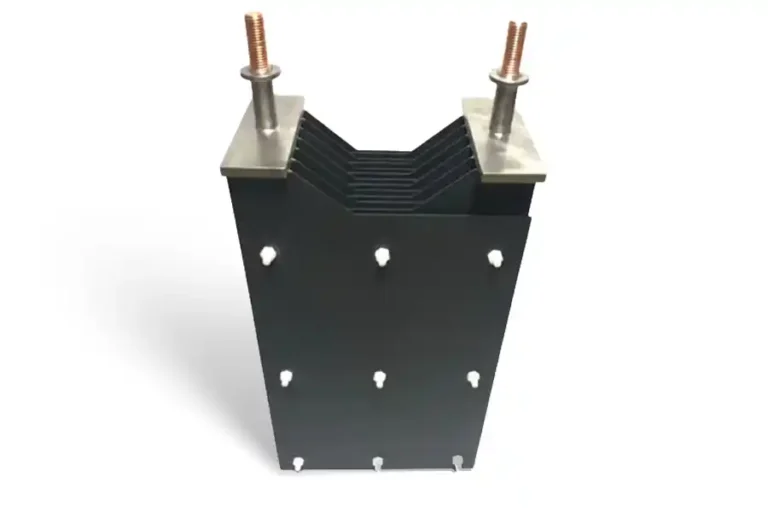
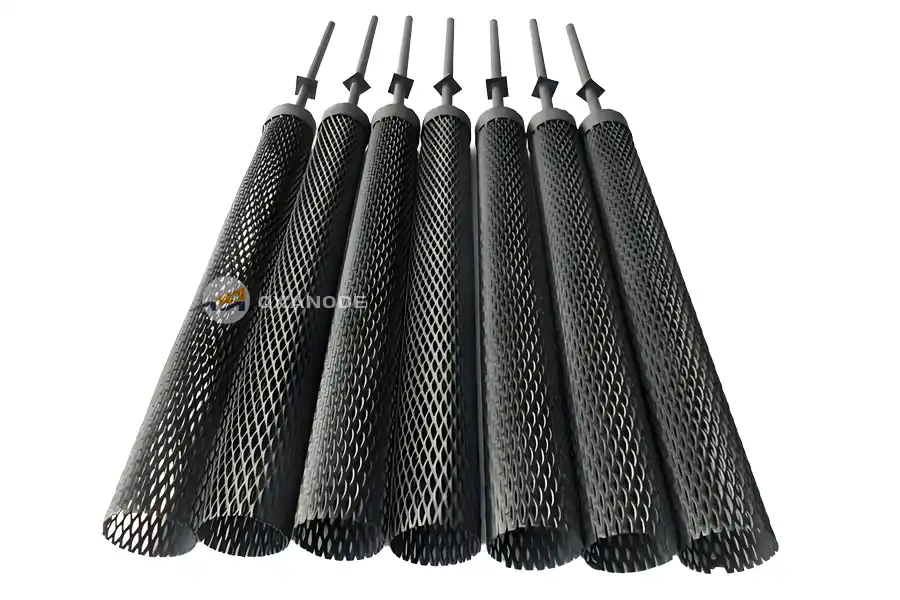
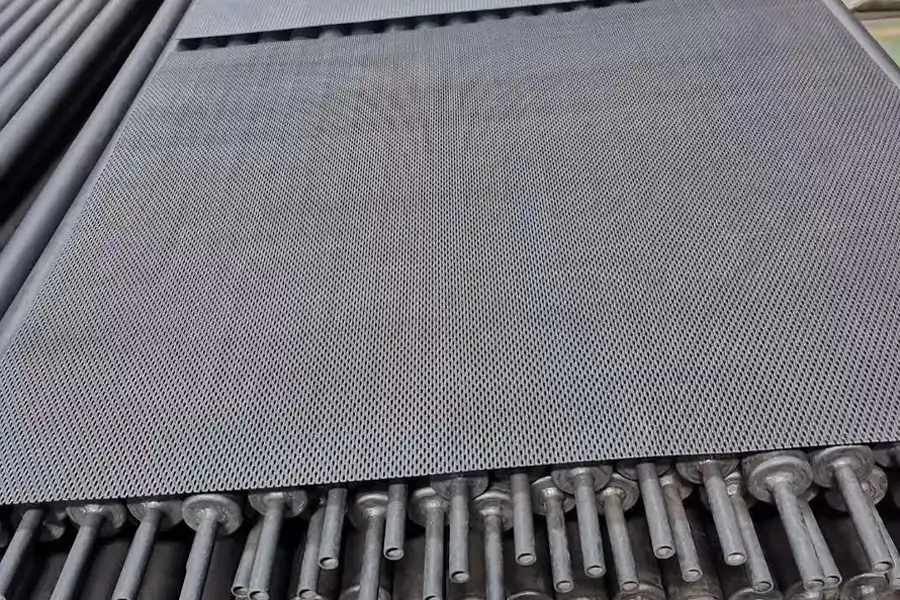
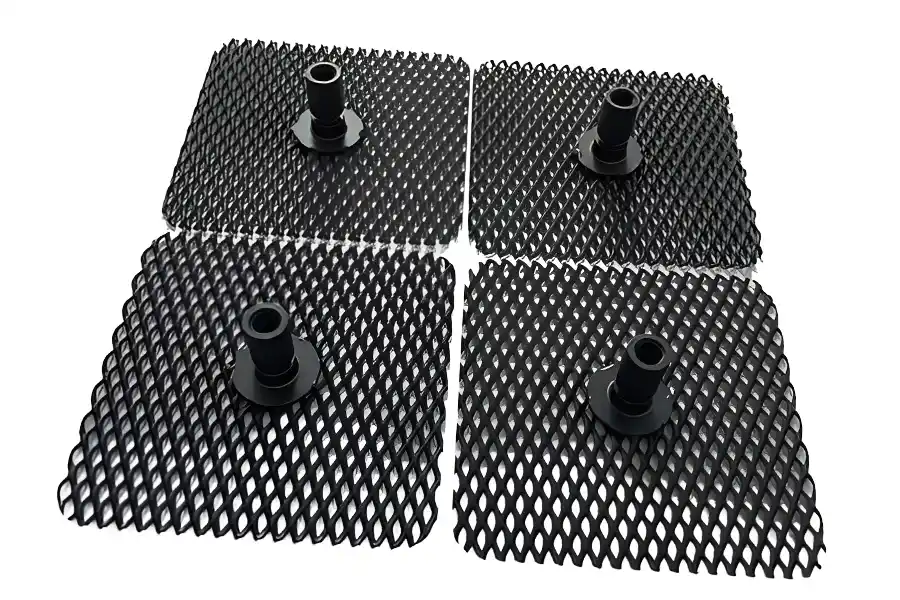
An MMO (mixed metal oxide) anode is a titanium substrate carrying a thin active coating, typically an iridium oxide and tantalum oxide mixture for oxygen-evolving service, or a ruthenium oxide and iridium oxide mixture for chlorine-evolving service. The coating is only a few microns thick, so it deserves more careful treatment than the robust-looking metal underneath it suggests. Four mechanisms account for the majority of field failures.
1. Normal electrochemical consumption
The active oxides dissolve slowly into the electrolyte during operation. This is expected behavior, not a defect, and it proceeds at a rate set by the coating formulation and the operating conditions. Anodes that run continuously at moderate current density consume their coating far more evenly than anodes cycled between overload and shutdown.
2. Substrate passivation
Beneath the coating, titanium naturally forms a passive oxide film. That film is what makes titanium corrosion resistant, but on an anode it is also an insulator. Under prolonged anodic polarization, especially in oxygen-evolving electrolytes such as sulfate baths, this interlayer grows thicker season by season. As it thickens, cell voltage climbs and current distribution degrades. Passivation is the quiet failure: the coating may look intact while the electrode is already delivering less and less.
3. Delamination and mechanical damage
Coating adhesion is strong against normal electrolyte flow and gas evolution, but it does not tolerate scraping, impact, or abrasion. Hard tools, careless stacking, and aggressive ultrasonic cleaning all strip coating locally. A bare titanium spot does not stop the anode from working; it concentrates the full current load onto the remaining coated area, accelerating consumption precisely where the electrode can least afford it.
4. Chemical attack from the electrolyte
Fluoride ions are the classic killer. Even at low concentrations they attack the titanium substrate through any pore or microcrack in the coating, undercutting it from below. Organic contamination, oil films, and heavy metal sludge produce a different problem: they blanket the coating, block gas release, and create local hot spots. In seawater and hard-water systems, calcium and magnesium scale deposits behave the same way if left to build up.
Failure Modes at a Glance
| Failure mode | Typical appearance | Electrical signature | Common root causes |
|---|---|---|---|
| Gradual coating consumption | Uniform color fading across the active area | Slow, steady rise in cell voltage over months or years | Normal aging; operation above design current density |
| Substrate passivation | Coating visually intact, sometimes darker | Progressive voltage rise with falling current efficiency | Long service in oxygen-evolving electrolytes; high temperature |
| Local coating loss | Bare gray titanium patches, often at edges or handling points | Uneven current distribution; voltage rise depends on affected area | Mechanical impact, scraping during cleaning, abrasion from packing |
| Undercutting corrosion | Blistering or flaking coating, pitted substrate beneath | Rapid voltage instability | Fluoride contamination; electrolyte pH outside the design range |
| Surface blocking | Scale crust, sludge film, or oil sheen on the coating | Local overheating, uneven gas release | Hard-water scale, suspended solids, inadequate filtration |
| Reverse-polarity damage | Darkened, spongy coating; rapid coating loss | Sudden voltage drop then failure | Anode made cathodic in systems with polarity reversal |
Early Warning Signs Worth Logging Daily
Your rectifier is the cheapest diagnostic instrument in the plant. Read it the same time every shift and write down the numbers.
- Cell voltage trend. A slow rise with stable temperature and electrolyte composition points to passivation or coating consumption. A sudden jump points to scale, a short circuit, or a connection problem.
- Current efficiency. In sodium hypochlorite generation and electrowinning, falling product yield at constant amperes usually means the anode surface is compromised before anything is visually obvious.
- Gas pattern. Healthy anodes release gas evenly across the active area. Silent zones indicate blocked or lost coating.
- Visual checks at every planned shutdown. Look for color change, edge damage, bare titanium spots, blisters, and deposit buildup. Photograph the same electrodes each time; a photo series catches slow changes that memory does not.
Daily and Periodic Maintenance Routine
The routine below fits most chlor-alkali, hypochlorite, electroplating, and water treatment installations. Adjust the intervals to your duty cycle and keep the sequence, because the order matters.
| Frequency | Action | Key points |
|---|---|---|
| Every shift | Record cell voltage, current, and bath temperature | Trend matters more than any single reading; log against electrolyte concentration |
| Daily | Confirm current density is inside the design window | Overcurrent shortens coating life faster than any other operating error |
| Daily | Check electrolyte filtration and visible clarity | Suspended solids settle onto anode faces and block gas release |
| Weekly | Inspect cables, busbars, and mounting contacts | High-resistance connections masquerade as anode degradation |
| Weekly | Test for electrode-to-cathode shorts and debris bridges | Shorts burn coating locally within hours |
| Monthly | Check fluoride level and pH against the anode supplier’s limits | Fluoride is the most common chemical cause of premature failure |
| Each shutdown | Visual inspection plus photo record | Compare against the previous set; look at edges and mounting points first |
| As needed | Remove scale deposits | Follow the cleaning rules in the next section |
How to Clean an MMO Anode Without Destroying It
More coatings are destroyed by cleaning than by electrolysis. The coating is a ceramic-like layer measured in microns, so treat it like a nonstick pan rather than a steel plate.
Safe practices
- Soften and remove calcium and magnesium scale with a dilute mineral acid rinse, such as 5 to 10 percent hydrochloric acid or a citric acid solution, at ambient temperature, limited to the time needed to dissolve the deposit.
- Rinse thoroughly with clean water afterward and let the anode dry naturally.
- Handle electrodes by the titanium frame or busbar, never by the coated mesh or plate face.
Never do these
- Never use hydrofluoric acid or any fluoride-containing cleaner, in any concentration.
- Never scrape, wire-brush, or sand the coating surface, even gently.
- Never use aggressive ultrasonic cleaning; it can erode coating at edges and defects.
- Never apply direct flame or sudden high heat to dry deposits off the surface.
- Never run an anode dry under load, and never lift energized electrodes out of the bath with current still flowing.
Storage and Handling Between Campaigns
- Store anodes dry, upright or flat with soft spacers, in a ventilated area away from acid fumes and chlorinated atmospheres.
- Keep coated faces from touching each other or any metal rack during storage and transport.
- Rinse off residual electrolyte before storage; dried salt crusts hold moisture against the coating and can cause pitting at coating defects over time.
- Protect coated surfaces from welding spatter and grinding dust in shared workshops; both damage coatings irreversibly.
- If anodes will sit idle for extended periods in their cells, follow the supplier’s guidance on wet layup versus dry storage for the specific electrolyte.
Knowing When an Anode Is Finished
Replace or recoat when you see a combination of these, not just one:
- Cell voltage has climbed past the economically acceptable point for your process, with electrolyte conditions and connections confirmed normal.
- Visible bare substrate exceeds the area the supplier defines as the limit, commonly stated as a percentage of the active surface.
- Blistering or flaking shows substrate-level attack rather than surface wear.
- Current efficiency can no longer meet production requirements.
Do not discard a failed anode. Titanium substrates can usually be stripped and recoated, which costs a fraction of a new electrode and preserves the dimensional investment. Send the used anode back with your operating records, current density history, and electrolyte composition notes; that history lets the coating supplier reformulate for the actual duty rather than the nameplate duty.
Frequently Asked Questions
How long do MMO titanium anodes last?
Service life depends on the coating formulation, current density, electrolyte chemistry, and temperature. Suppliers typically state life expectations against defined test conditions rather than as universal figures, so compare anodes on their tested basis, not on a single headline number.
Can a failed anode be recoated instead of replaced?
In most cases yes. The titanium substrate is dimensionally stable and can be stripped, re-etched, and recoated. Recoating is standard practice for plate and mesh anodes whose substrates remain dimensionally sound.
Why did my anode fail within months when the previous set lasted years?
Short-run failures are almost always operational, not material: fluoride in the electrolyte, current density above the design window, shorts, dry operation, or cleaning damage. Investigate the process before blaming the coating.
Is a small area of exposed titanium acceptable?
It depends on the location and area, and this is a question for your supplier with photos in hand. Edge nicks and handling scratches are usually tolerable; spreading bare patches on the active face mean the anode is approaching end of service.
Need a custom anode for your process?
Send us your drawing or specs — we’ll quote within 12 hours.