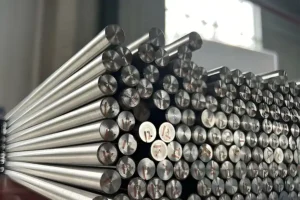
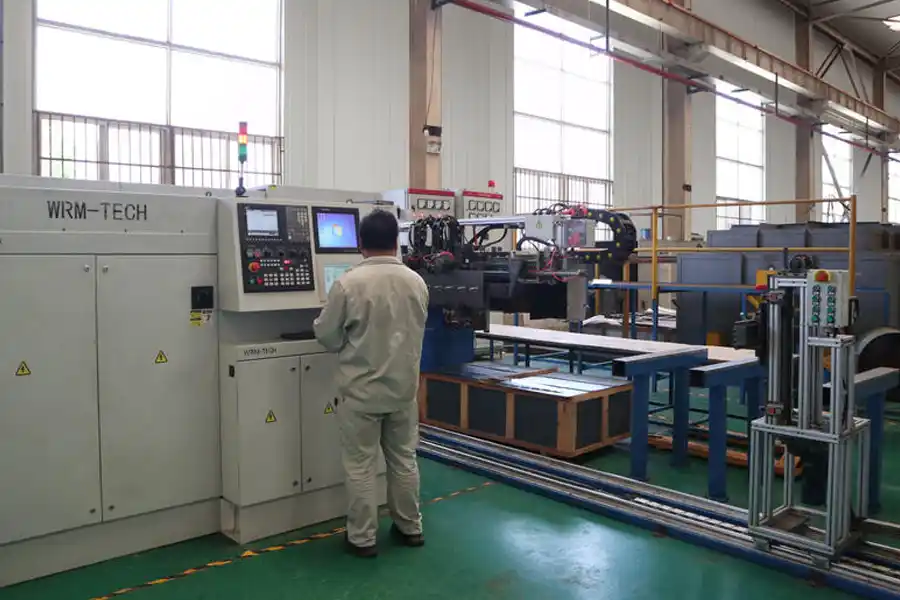
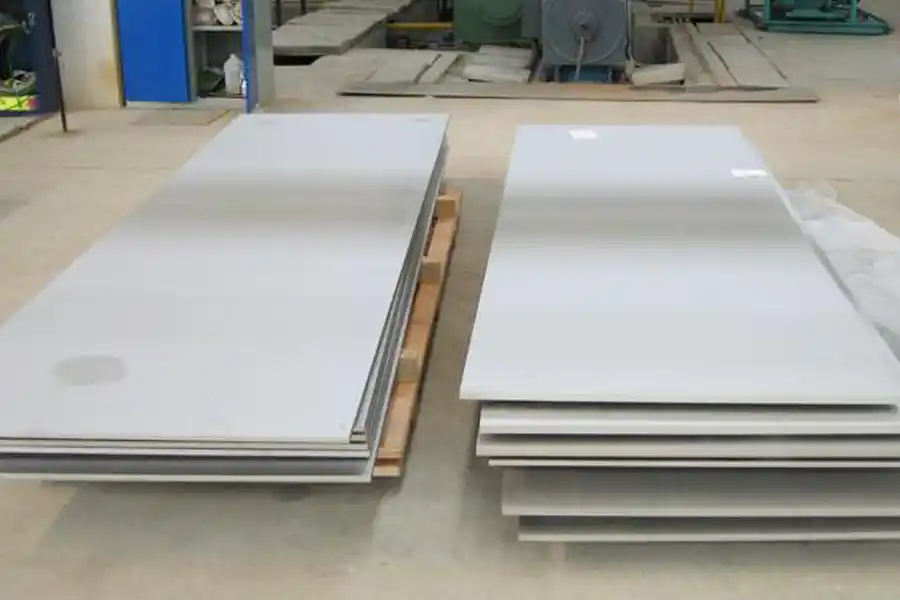
Under ASTM B265, flat titanium 4.75 mm (0.187 in.) thick or less and at least 610 mm (24 in.) wide is sheet. Material over 4.75 mm thick and over 254 mm (10 in.) wide is plate. Strip is the same thin gauge under 610 mm wide, in coil or cut lengths. The classification is not cosmetic: B265 tabulates thickness, flatness, width, length and weight tolerances by product form — the name on your purchase order decides which table your material is judged against.
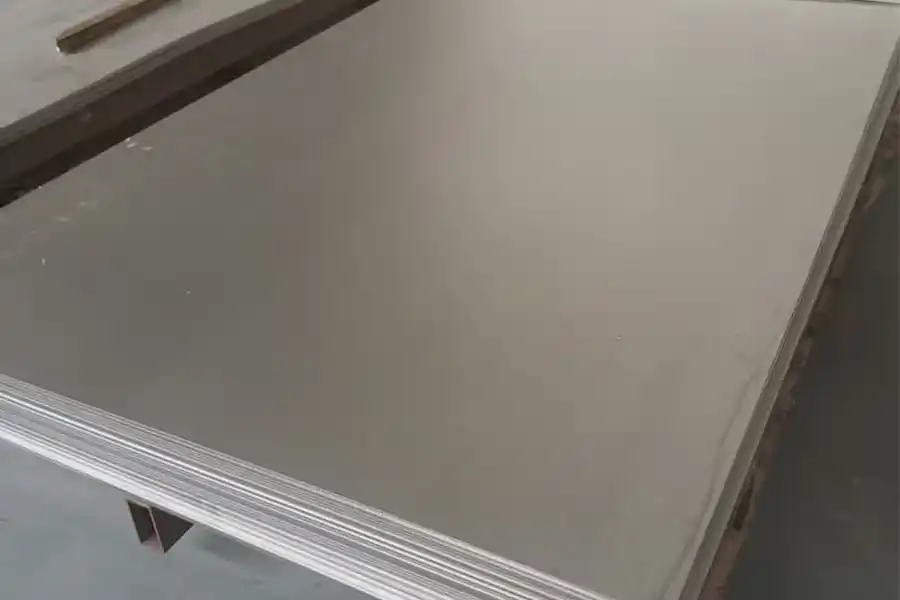
What you are buying
Titanium plate is specified by service condition, not by strength
Most rejected titanium orders trace to one of two omissions: naming a grade without naming the standard, or leaving the condition blank on an alpha-beta alloy. Both are avoidable, and both are settled before the plate is rolled.
Titanium resists corrosion through a passive titanium dioxide film. In oxidising and neutral chloride conditions that film reforms as fast as it is damaged, which is why unalloyed Grade 2 handles seawater indefinitely. In reducing acids, and inside tight crevices where the oxygen has been consumed, the film cannot repair itself and the metal corrodes actively. Every grade decision in the table below comes back to that single mechanism.
The commercially pure grades 1 through 4 contain no intentional alloy additions. What separates them is the permitted level of interstitial oxygen and nitrogen plus substitutional iron, which the standard allows on purpose because those elements raise strength. Read the oxygen row down and the elongation row across and the family makes sense: oxygen climbs from 0.18 to 0.40 percent, minimum tensile more than doubles, and elongation falls from 24 to 15 percent.
Grade 4 is not lower quality than Grade 1. It carries more oxygen and iron to buy strength, and pays for it in formability and weld ductility. The same logic runs through the palladium grades: Grade 7 is Grade 2 chemistry with 0.12 to 0.25 percent palladium added, and its mechanical minimums are identical to Grade 2 because the addition changes corrosion behaviour, not strength.
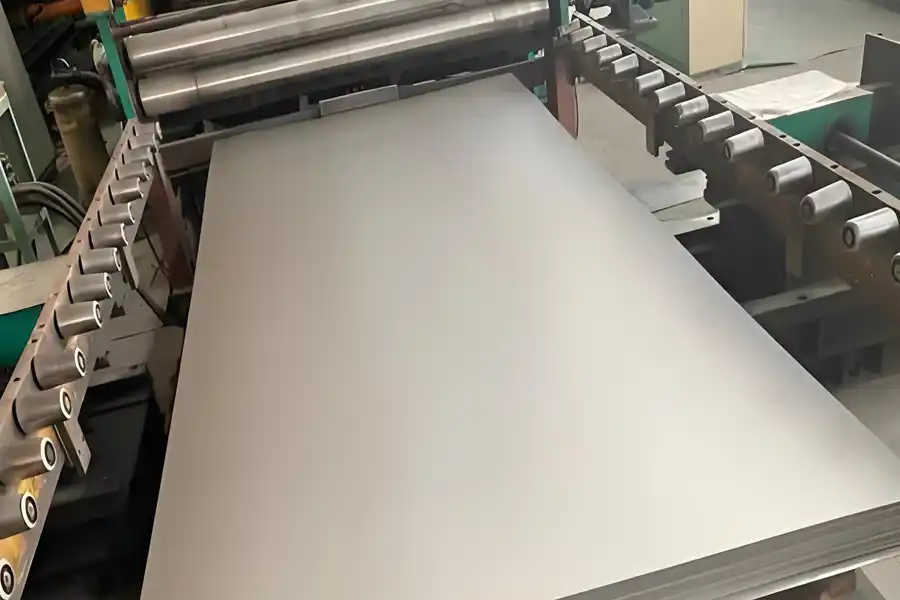
One correction worth carrying into your next RFQ
ASTM B265 specifies no minimum titanium percentage for the commercially pure grades. Titanium content is determined by difference. Figures such as “99.5% pure titanium” are arithmetic leftovers from summing the element maxima. They are not something a mill certifies. A certificate quoting a titanium minimum is reporting a value the standard never asked for.
Grades we supply
ASTM B265 grade table: chemistry, mechanicals and the reason to specify each one
Tensile, yield and elongation figures below are the annealed minimums required by ASTM B265 for strip, sheet and plate. Elongation is measured in 2 in. or 50 mm. Density is a nominal physical property, not an ASTM requirement, so it never appears on a mill certificate as a tested value.
Table 1: Titanium sheet and plate grades, ASTM B265 annealed minimums
| Grade | UNS | Nominal composition | Min UTS | Min yield (0.2%) | Min elong. | Density | Primary reason to specify |
|---|---|---|---|---|---|---|---|
| Grade 1 | R50250 | Unalloyed Ti · O 0.18 max · Fe 0.20 max | 240 MPa | 138 MPa | 24% | 4.51 | Deepest forming and drawing; anode substrate and loose lining stock |
| Grade 2 | R50400 | Unalloyed Ti · O 0.25 max · Fe 0.30 max | 345 MPa | 275 MPa | 20% | 4.51 | Seawater and general corrosion service; the default weldable grade |
| Grade 3 | R50550 | Unalloyed Ti · O 0.35 max · Fe 0.30 max | 450 MPa | 380 MPa | 18% | 4.51 | Pressure parts needing more strength than Grade 2 without alloying |
| Grade 4 | R50700 | Unalloyed Ti · O 0.40 max · Fe 0.50 max | 550 MPa | 483 MPa | 15% | 4.51 | Strongest unalloyed grade; dental and surgical instrument work |
| Grade 5 | R56400 | Ti-6Al-4V · Al 5.5 to 6.75 · V 3.5 to 4.5 | 895 MPa | 828 MPa | 10% | 4.43 | Load-bearing machined parts, shafts and fasteners |
| Grade 7 | R52400 | Grade 2 chemistry + Pd 0.12 to 0.25 | 345 MPa | 275 MPa | 20% | 4.51 | Reducing acids and crevice corrosion |
| Grade 9 | R56320 | Ti-3Al-2.5V · Al 2.5 to 3.5 · V 2.0 to 3.0 | 620 MPa | 483 MPa | 15% | 4.48 | Tube and formed parts that still cold-form at about 1.8× Grade 2 tensile |
| Grade 11 | R52250 | Grade 1 chemistry + Pd 0.12 to 0.25 | 240 MPa | 138 MPa | 24% | 4.51 | Grade 7 corrosion behaviour where deep forming is needed |
| Grade 12 | R53400 | Ti-0.3Mo-0.8Ni · Mo 0.2 to 0.4 · Ni 0.6 to 0.9 | 483 MPa | 345 MPa | 18% | 4.51 | Hot chloride brine and high-temperature crevice service |
| Grade 16 | R52402 | Grade 2 chemistry + Pd 0.04 to 0.08 | 345 MPa | 275 MPa | 20% | 4.51 | Grade 7 duty at roughly a third of the palladium |
| Grade 17 | R52252 | Grade 1 chemistry + Pd 0.04 to 0.08 | 240 MPa | 138 MPa | 24% | 4.51 | Grade 11 duty at roughly a third of the palladium |
| Grade 23 | R56407 | Ti-6Al-4V ELI · O 0.13 max · Fe 0.25 max | 828 MPa | 759 MPa | 10% | 4.43 | Fracture-critical parts, cryogenic service and surgical implant material |
Source: annealed minimums per ASTM B265 Table 2, chemistry limits per ASTM B265 Table 1. Note on Grade 23: as plate to ASTM B265 it is UNS R56407. As surgical implant material to ASTM F136 the same alloy is UNS R56401 with higher tensile minimums and different interstitial limits. Name the standard, not just the grade. Writing the wrong UNS is a common cause of rejected material.
Table 2: Chemistry limits and yield band for the commercially pure grades (wt%, max unless noted)
| Element | Grade 1 | Grade 2 | Grade 3 | Grade 4 | Why it matters |
|---|---|---|---|---|---|
| Oxygen | 0.18 | 0.25 | 0.35 | 0.40 | The main strength lever in unalloyed titanium |
| Iron | 0.20 | 0.30 | 0.30 | 0.50 | Substitutional strengthening; also a beta stabiliser |
| Nitrogen | 0.03 | 0.03 | 0.05 | 0.05 | Potent strengthener, tightly limited for ductility |
| Carbon | 0.08 | 0.08 | 0.08 | 0.08 | Fixed across all four grades |
| Hydrogen | 0.015 | 0.015 | 0.015 | 0.015 | Read this one on the certificate (see note below) |
| Residuals, each / total | 0.1 / 0.4 | 0.1 / 0.4 | 0.1 / 0.4 | 0.1 / 0.4 | Caps everything not listed individually |
| Min tensile | 240 MPa | 345 MPa | 450 MPa | 550 MPa | More than doubles across the family |
| Min yield | 138 MPa | 275 MPa | 380 MPa | 483 MPa | Tracks the oxygen limit upward |
| Max yield (B265) | 310 MPa | 450 MPa | 550 MPa | 655 MPa | Sheet above the band will not form to the shapes these grades are bought for |
| Min elongation | 24% | 20% | 18% | 15% | The price paid for the oxygen |
Source: ASTM B265 Table 1 (chemistry) and Table 2 (mechanical properties). B265 also specifies a maximum yield strength for the CP grades, which is unusual and often missed on purchase orders.
Hydrogen is the figure to read on the certificate
Hydrogen is held at 0.015 percent maximum across all four CP grades, and it is the limit that matters most when the plate will be coated later. Titanium hydride platelets embrittle the metal without moving the tensile numbers. A plate can pass a tensile test and still fail in service. The risk compounds during coating: MMO coatings are fired at 400 to 550 °C, and hydrides are least welcome at the interface between substrate and coating.
Grade selection
Read the grade from the service condition, not from the grade name
Work down this table in order. Confirm against the governing standard before quotation, because a grade is orderable in a given product form only if a standard covers that combination.
Table 3: Service condition to grade
| ondition | Grade the mechanism points to | Why |
|---|---|---|
| Seawater, brackish water, neutral chlorides | Grade 2 | The oxide film reforms as fast as it is damaged in oxidising and neutral chloride conditions |
| Reducing acids, or crevices under gaskets and deposits | Grade 7 or 16 on a Grade 2 base Grade 11 or 17 on a Grade 1 base | Palladium acts as a low-hydrogen-overvoltage cathode and shifts the corrosion potential back into the passive range |
| Hot chloride brine, geothermal, desalination | Grade 12 | Molybdenum and nickel raise the crevice corrosion threshold at temperature, with no palladium cost |
| Load-bearing machined part, shaft, fastener, or a drawing calling for Ti-6Al-4V | Grade 5, with condition stated | Alpha-beta alloy that responds to solution treatment and ageing; one UNS number covers annealed and aged material hundreds of MPa apart |
| Fracture-critical part, cryogenic service, medical implant | Grade 23: to ASTM F136 if it is an implant, to B265 or B348 if it is not | Extra-low-interstitial chemistry trades strength for fracture toughness |
| Tube that must bend, hold pressure and beat Grade 2 on strength | Grade 9 | A strength-to-weight upgrade, not a corrosion upgrade |
| Pressure part needing more strength than Grade 2 with unalloyed corrosion behaviour | Grade 3 or Grade 4 | Alloy-level strength from interstitials alone, keeping CP corrosion behaviour |
| Anode substrate to be coated with MMO or platinum | Grade 1 for formed anodes, Grade 2 for flat plate anodes | Selection follows forming and stiffness, not corrosion. See the substrate section below |
Two failure patterns worth naming. Defaulting to Grade 5 because it is the strongest is the first: it does not out-perform Grade 2 in seawater or acid, and costs more to buy, weld and machine. Treating Grade 9 as a corrosion upgrade is the second: it buys strength-to-weight, not corrosion margin.
Why palladium works in Grade 7
Palladium is not a coating on Grade 7. It is dissolved in the metal at 0.12 to 0.25 percent by weight, and it works as a cathode. Palladium has a low hydrogen overvoltage, so a few hundredths of a percent shift the corrosion potential of the whole plate upward into the range where titanium dioxide reforms on its own. In a reducing acid, that is the difference between a passive surface and an actively corroding one.
The mechanism explains two things buyers get wrong. First, why Grade 7 and Grade 2 share identical mechanical minimums. The addition is doing electrochemical work, not metallurgical work. Second, why Grades 16 and 17 exist: at 0.04 to 0.08 percent palladium, roughly a third of the Grade 7 content, they cover moderate duty at a fraction of the platinum-group metal cost. Palladium pricing is what created that tier.
Published corrosion-rate comparisons between Grade 2 and Ti-0.2Pd in hot dilute hydrochloric acid put the difference at roughly two orders of magnitude. Treat that as a direction, not a design number: the actual rate depends on acid concentration, temperature, aeration and velocity, and it belongs in a corrosion engineer’s calculation rather than a product table.
Why Grade 12 is the odd one out
Grade 12 carries no platinum-group metal at all, which is why it is the most misread grade in the system. Its 0.2 to 0.4 percent molybdenum and 0.6 to 0.9 percent nickel do two separate jobs: they lift the minimum tensile to 483 MPa, about 40 percent above Grade 2, and they push the crevice corrosion threshold to higher temperature and chloride concentration.
That combination is why Grade 12 is specified for hot brine in desalination and geothermal service rather than for cold acid. It is a near-alpha alloy, mostly alpha with a little beta from the molybdenum and nickel, so it cannot be strengthened by heat treatment and is supplied annealed.
The working rule
Reducing acid points to Grade 7 or Grade 16. Hot chloride points to Grade 12. When both apply, as in a hot reducing chloride solution, the choice needs a corrosion engineer rather than a table, and we would rather say that than quote you the wrong plate.
Why this page is on an anode manufacturer’s site
Titanium plate as an anode substrate
The coating decides how the anode performs.
The plate decides how long that performance lasts.We have been firing MMO coatings onto titanium since 2006, so we specify substrate from the coating side of the interface.
A titanium mill supplier sells you plate. We sell you plate that is going to be blasted, coated, fired at 400 to 550 °C through 10 to 20 cycles, welded to a bus bar and then run under current for years. Those are different specifications, and the differences show up in three places a conventional grade table does not mention.
1. Forming decides Grade 1 versus Grade 2
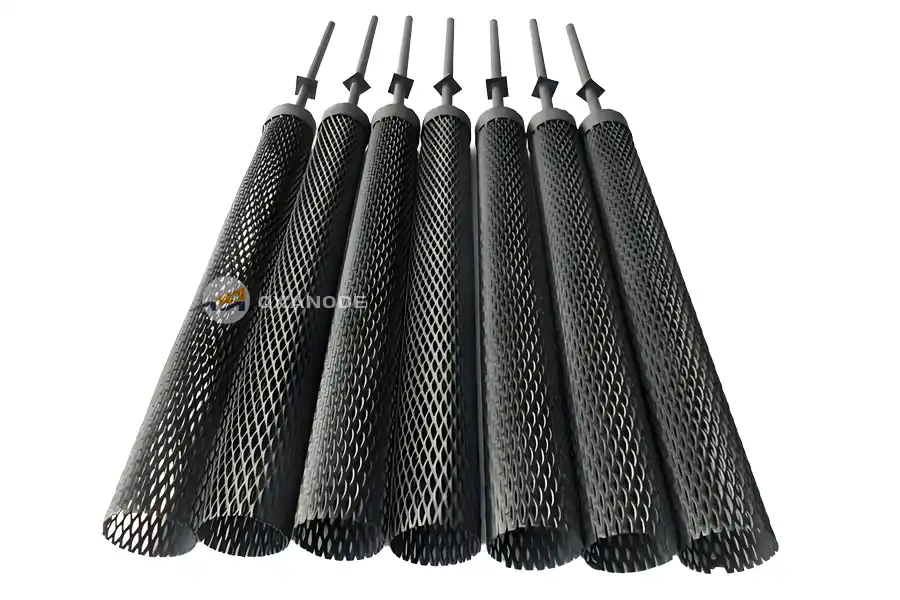
Grade 1 has a 138 MPa minimum yield, a 310 MPa maximum yield and 24 percent elongation. That band is what lets it draw into expanded mesh, ribbon anodes and irregular shapes without cracking at the corner radii. Grade 2 gives up 4 points of elongation for 137 MPa more tensile, and is specified where the anode is a flat plate that must stay flat under current and weld cleanly into a bus bar assembly. Neither is better. They are bought for different geometries.
2. Surface finish is part of the coating specification
For plate that will be coated, the surface is not a cosmetic choice. A mill-annealed pickled surface carries a stable, reproducible oxide. A blasted surface carries mechanical anchor points that a 5 to 20 µm coating can key into. A polished or mirror surface carries neither. It looks better in a photograph and holds a coating worse. If the plate is destined for acoated anode, tell us at the enquiry stage and we will supply it in the condition the coating process actually wants.
3. Hydrogen and reverse current are the two silent killers
Hydrogen is covered above: hydride platelets embrittle without moving the tensile numbers, and the interface between substrate and coating is the worst place to find them. The second is operational. Reverse or intermittent current reduces coating adhesion, so an anode that is periodically polarity-switched or frequently shut down under load loses coating life that no substrate grade can recover.
Fluoride attacks the substrate, not just the coating
Fluoride ions corrode titanium metal itself. This is not a coating-selection problem and no grade solves it, including the palladium grades. Baths with free fluoride, fluoride-complexed plating electrolytes and hydrofluoric pickling lines are the usual failures. Send the bath chemistry and operating temperature before ordering plate for that service.
Substrate selection at a glance
| Anode geometry | Substrate grade | Reason |
|---|---|---|
| Expanded mesh, ribbon, woven | Grade 1 | 24% elongation, 310 MPa yield ceiling, so it draws without cracking |
| Flat plate anode | Grade 2 | Stiffness to stay flat under current; the default weldable grade |
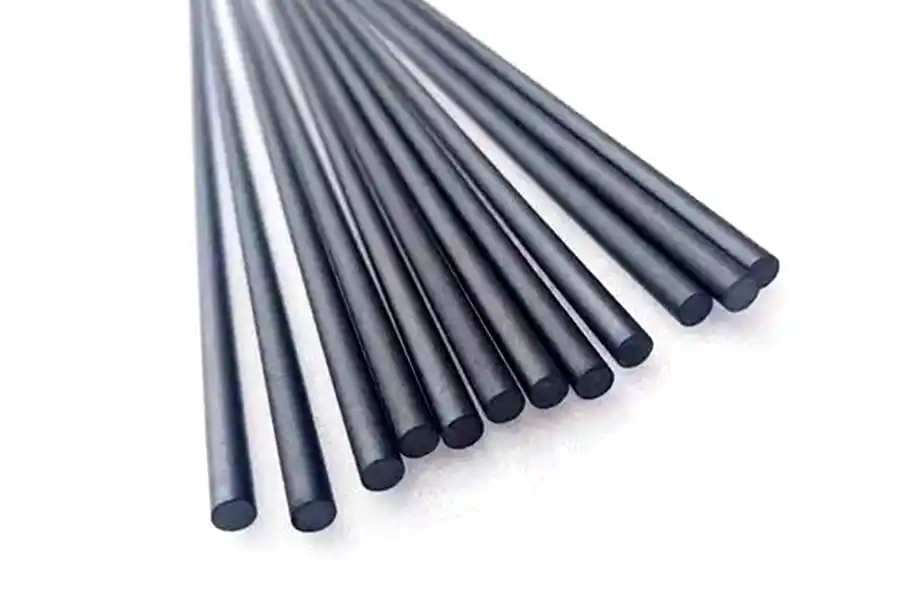
| Rod, tube anode | Grade 1 or 2 | Follow the forming route, not the corrosion table |
| Hot reducing-acid service | Grade 7 | Palladium holds the substrate passive where the film cannot self-repair |
| Hot brine, geothermal | Grade 12 | Higher crevice threshold at temperature |
Coating loading, thickness and sintering route are quoted separately with the anode, not with the plate.
If you want the coating side of this decision rather than the substrate side, read The Titanium Anode Guide or compare Ru-Ir (chlorine evolution) against Ir-Ta (oxygen evolution).
Thickness, width and length ranges
These are typical industry ranges for flat-rolled titanium, not a stock list. Available width, length and tolerance class depend on grade and mill route, and every quotation states what is actually available for your order.
Table 4: Typical dimensional ranges, ASTM B265 flat product
| Product form | Thickness | Width | Length | Usual route |
|---|---|---|---|---|
| Foil | 0.025 to 0.10 mm | up to 600 mm | coil | Cold rolled, Gr1 / Gr2 |
| Strip (coil) | 0.10 to 3.0 mm | 10 to 600 mm | coil | Cold rolled, slit to width |
| Sheet | 0.3 to 4.75 mm | up to 1500 mm | up to 3000 mm | Cold rolled, mill annealed |
| Plate | 4.75 to 60 mm | up to 2500 mm | up to 4000 mm | Hot rolled, mill annealed |
| Heavy plate | 60 to 100 mm | on request | on request | Hot rolled / forged, limited grades |
| Cut-to-size blank | as above | to your drawing | to your drawing | Sheared, waterjet or sawn |
Typical industry ranges. Confirm available width, length, tolerance class and flatness for your specific grade in the quotation. ASTM B265 tables permissible tolerances for thickness, width, length, weight variation and flatness separately for strip, sheet and plate; the tolerance class belongs on the order line alongside the dimension.
Condition codes
Titanium flat product is supplied in three conditions, and the condition must appear on the order line. For the CP and palladium grades, condition is effectively fixed. They are single-phase alpha, cannot be strengthened by heat treatment, and are supplied annealed. For Grade 5, 9 and 23, one grade number covers annealed and aged material hundreds of megapascals apart, so leaving the condition blank means the grade name alone does not define the part.
M: mill annealed (default) | R: hot rolled | Y: cold worked
Which grades exist in which form
A grade is orderable in a form only if a standard covers the combination, and the gaps catch people out. All twelve grades in Table 1 are covered by ASTM B265 for strip, sheet and plate. The gaps appear in other standards: ASTM B338 for condenser tube does not list Grade 4, 5 or 23, and the pipe standards B861/B862 do not list Grade 4.
Also note: grade numbers 8, 10 and 22 are not assigned in the ASTM B-series. Grade 6 does exist: Ti-5Al-2.5Sn, UNS R54520.
From titanium sponge to certified plate, and which stage sets which property
Every number on your certificate was fixed at one particular stage of the mill route. Chemistry was fixed at the melt. Strength was fixed by the oxygen level and by how much cold reduction the plate took. Flatness was fixed at the leveller. The hydrogen figure was fixed on the pickling line. When a value comes back wrong, naming the stage tells you which one to argue with the mill about.
ASTM B265 states what the plate must be.
It does not state how the plate became that.
Two mills can reach the same 345 MPa minimum tensile in Grade 2 by different routes, and the routes stop being interchangeable the moment the plate is formed, welded or coated.
1. Charge calculation and electrode pressing
Sponge titanium, alloying additions and a controlled proportion of clean revert are weighed to the grade chemistry and pressed into electrodes. The charge calculation is where the oxygen level is committed, and for the commercially pure grades oxygen is the main strength lever the mill has. Nothing downstream can move it.
sponge + master alloy + revert → pressed electrode
2. Melting, normally two or three passes
The electrode is melted in a vacuum arc remelting furnace, usually twice or three times, because one melt does not homogenise the additions. Where the specification calls for it, melting runs through an electron beam cold hearth furnace instead. The cold hearth lets dense inclusions such as tungsten or molybdenum fragments settle out before the metal reaches the mould. Those inclusions are fatigue crack origins rather than cosmetic defects.
VAR two or three melts, or EBCHM on specification
3. Ingot conditioning and forging to slab
The ingot is homogenised and forged down to slab. For the unalloyed and palladium grades the deformation route is kept inside the alpha field, below the 882 °C beta transus of pure titanium. Crossing the transus coarsens the prior beta grain, and no later heat treatment repairs it, because a single-phase alpha alloy has no transformation left to work with.
alpha field, held below 882 °C for CP grades
4. Hot rolling
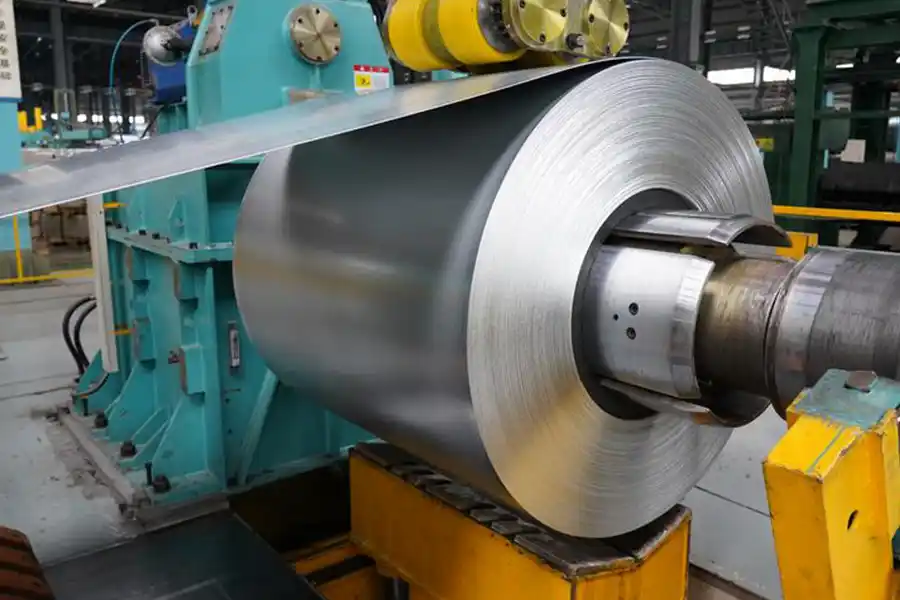
The slab is rolled to intermediate thickness in a reversing mill over several passes. Hot rolling is what makes wide and heavy product possible at all: it is the only route to plate above roughly 4.75 mm at widths a cold mill cannot take. The surface leaves this stage carrying mill scale, which is titanium dioxide over an oxygen-enriched alpha case.
reversing mill, multi-pass, scaled surface
5. Descaling and pickling
Scale is removed mechanically first, then chemically. Titanium pickling solutions are nitric and hydrofluoric based, and the fluoride is what actually dissolves the oxide. The same fluoride attacks the substrate, which makes this the stage where hydrogen enters the metal. That is covered in the note below, and it matters more than any other step on this list if the plate is going to be coated.
HF and HNO₃ pickling, then rinse and dry
6. Cold rolling with intermediate anneals
Cold reduction brings the plate to final gauge and final dimensional tolerance. Commercially pure titanium work hardens quickly, so the route alternates reduction with annealing rather than taking the whole deformation in one pass. Cold work is the second strength lever for the CP grades, and it is reversible: the next anneal takes it back out.
reduce, anneal, reduce, to final gauge
7. Mill annealing and levelling
Cold reduction brings the plate to final gauge and final dimensional tolerance. Commercially pure titanium work hardens quickly, so the route alternates reduction with annealing rather than taking the whole deformation in one pass. Cold work is the second strength lever for the CP grades, and it is reversible: the next anneal takes it back out.
condition M is set here, then leveller
8. Finishing, inspection and certification
Edges are trimmed and the plate is sheared, sawn or waterjet cut to size. Tensile specimens are taken to ASTM E8 or E8M, chemistry to the methods in Table 6, and ultrasonic examination to AMS 2631 or GB/T 5193 where the order calls for it. The EN 10204 3.1 certificate is issued against the heat number that has been carried through every stage above.
heat number carried end to end, MTC issued
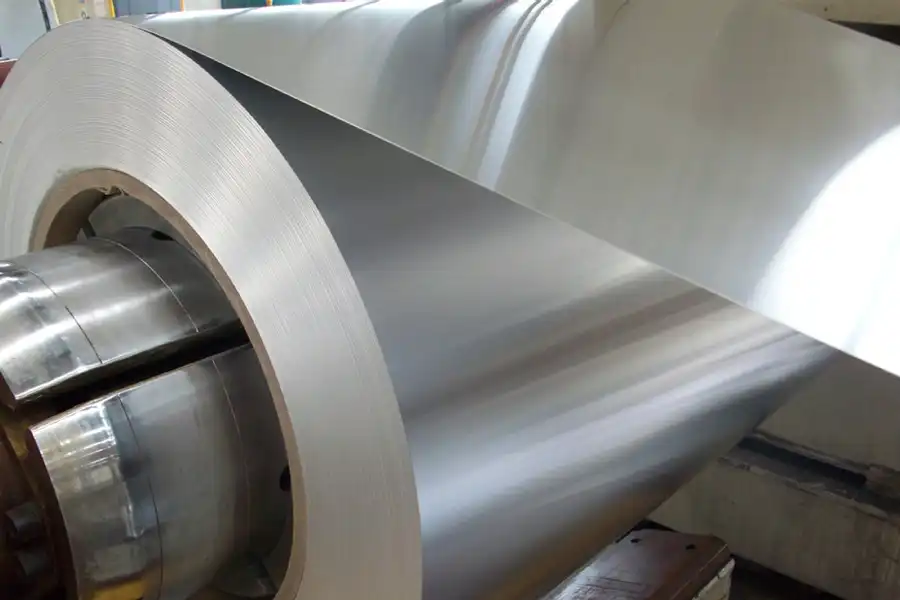
The pickling line is where hydrogen enters the plate
Titanium pickling uses hydrofluoric and nitric acid. The fluoride dissolves the scale and attacks the metal at the same time. This is the same mechanism that makes fluoride baths a corrosion problem in service rather than only a cleaning problem, and it is why the substrate section of this page treats fluoride as a compatibility question instead of a coating question.
Hydrogen taken into solution during pickling can precipitate as titanium hydride platelets on cooling. Hydrides embrittle the plate without moving the tensile numbers, so a plate can pass every test B265 requires and still make a poor anode substrate. The control is a dehydrogenation anneal in vacuum or inert gas after pickling, plus holding the 0.015 percent hydrogen maximum on the certificate.
If the plate will be coated and fired at 400 to 550 °C, ask at which stage the hydrogen figure was measured. A value taken before the final anneal says nothing about the plate you receive.
Table 5: Process parameters and the documents that name them
| Stage or parameter | Value or method | What it controls |
|---|---|---|
| Beta transus, unalloyed titanium | 882 °C (1620 °F) | Ceiling of the alpha-field route used for the CP and palladium grades |
| Beta transus, Ti-6Al-4V | about 995 °C | Where Grade 5 and Grade 23 change deformation behaviour and microstructure |
| Recrystallisation, cold rolled CP titanium | about 700 to 750 °C | The final anneal that sets condition M and removes cold work |
| Annealing range, Ti-6Al-4V sheet | 704 to 899 °C (1300 to 1650 °F), AMS 4911 | Annealed condition on the aerospace-route alloy |
| Ultrasonic examination, wrought titanium | AMS 2631, 6.4 mm (0.25 in) and over | Internal soundness: laminations, inclusions, voids |
| Ultrasonic examination, Chinese route | GB/T 5193-2020, cross-section 6 to 500 mm | Equivalent method quoted on GB/T 3621 orders |
| Tensile testing | ASTM E8 / E8M | How the yield and tensile minimums were generated |
| Rounding of results | ASTM E29 | Whether a borderline figure passes, by a stated rule |
Basis: beta transus values are phase transformation temperatures for the nominal compositions, not B265 acceptance limits. Recrystallisation and annealing temperatures are process ranges from published literature and product specifications. AMS 2631 is titled for bar, billet and forging, so name it explicitly on the order if you want it applied to plate. The mill route used for your order is confirmed in writing with the quotation.
One standard number worth getting right
ASTM B548 is Ultrasonic Inspection of Aluminum-Alloy Plate for Pressure Vessels. Its scope lists aluminium alloys such as 3003, 5052 and 6061, and it does not cover titanium. ASTM B265 does not invoke it. A number of supplier pages quote B548 for titanium plate anyway, which is the kind of error that only surfaces during an inspection dispute after delivery. For titanium the methods are AMS 2631, GB/T 5193, or a method named and agreed on the purchase order.
Why the condition code is effectively fixed for CP grades
Unalloyed titanium and the palladium grades are single-phase alpha from room temperature up to the 882 °C transus. Nothing transforms, so nothing can be strengthened by quenching and ageing. Two levers are left. Oxygen and the other interstitials are set in the charge calculation and cannot be changed afterwards. Cold reduction is set on the rolling mill and is erased by the next anneal.
That is why M, R and Y on a commercially pure grade describes a processing route rather than a heat treatment state, and why an annealed Grade 2 plate from any competent mill lands in the same narrow band.
Lever 1: chemistry, fixed at the melt. Lever 2: cold work, fixed at the mill, erased by annealing.
Why Grade 5, 9 and 23 behave differently
These are alpha-beta or near-alpha alloys. Grade 5 responds to solution treatment and ageing, and the aged condition sits hundreds of megapascals above the annealed one under the same UNS number R56400. Grade 23 is the extra-low-interstitial version, supplied annealed, chosen where fracture toughness rather than strength governs. Grade 9 is a near-alpha alloy strengthened by cold work for tube and formed sections.
For all three the condition belongs on the order line, because the grade name alone does not define the part.
Gr5, UNS R56400: annealed and aged material, one number, different properties.
Surface finishes, and what each one is actually for
Finish affects weld preparation, coating adhesion, cleaning behaviour and price. Specify it by name rather than by appearance.
Mill annealed & pickled
Hot or cold rolled, annealed, then acid pickled to remove scale. Grey-blue, slightly matt, uniform. The standard supply condition and the right choice for further forming, welding or coating.
Hot rolled
Scale left on, or lightly descaled. Darker and rougher than pickled. Cheapest route into heavy plate, and the starting point when the scale is going to be removed by your own process.
Sand blasted
Uniform matt texture with raised surface area. The finish that gives a thermal-sprayed or fired coating something to key into mechanically. Specify grit and target roughness if the plate is going to be coated.
Ground / brushed
Directional abrasion to a defined grit. Removes light surface defects and gives a consistent appearance for visible parts, without the reflectivity of a polish.
Polished bright
Progressive abrasion to a low roughness. Chosen for cleanability and appearance in food, pharmaceutical and architectural service. Note the trade-off: a smoother surface holds a fired coating less well.
Mirror
The highest reflectivity available, produced by fine mechanical polishing. Specified for optical, decorative and jewellery work where the surface is the product.
Welding note
All twelve grades in Table 1 weld, but not with the same tolerance for error. The CP and palladium grades weld readily with standard GTAW practice and argon shielding. Grade 5 and Grade 23 need tighter control, and Grade 5 in particular should have its heat treatment condition stated on the order. Weld a solution-treated-and-aged plate without knowing it and the heat-affected zone will not match the parent metal.
Applications by grade
The same plate becomes a very different component depending on the grade. These are the duties we ship to most often.
- Electrochemical and anode work: Grade 1 and 2 substrate for MMO, platinised and PbO₂ anodes; backing plates, bus bar tie-ins and tank linings in electroplating, electrowinning and cathodic protection.
- Seawater and marine: Grade 2 for heat exchanger plate, condenser waterboxes, ballast water treatment and desalination internals. Grade 12 where the brine runs hot.
- Chemical processing: Grade 2 for oxidising and neutral media; Grade 7 or 16 for reducing acids, including dilute sulphuric and hydrochloric service under gaskets and deposits where crevice attack starts.
- Aerospace and structural: Grade 5 (Ti-6Al-4V) for load-bearing machined parts, brackets and fasteners; Grade 23 where fracture toughness or cryogenic behaviour governs.
- Medical and surgical: Grade 23 to ASTM F136 for implant stock; Grade 4 for surgical instruments, where the highest unalloyed strength is useful and deep forming is not.
- Power and geothermal: Grade 12 for hot chloride brine, geothermal brine handling and high-temperature crevice service.
What comes with the plate, and how each number was produced
A grade table gives limits. It does not say how a value was produced, and two certificates quoting the same figure by different methods are not answering the same question.
Every shipment carries an EN 10204 3.1 mill test certificate with heat-number traceability as standard. The certificate reports chemical composition and mechanical properties against the governing standard named on your order. Where a buyer’s specification calls for additional tests such as ultrasonic examination, bend testing, hardness, or product analysis rather than heat analysis, state them in the RFQ and they are quoted as a document scope, not added silently.
One distinction decides how the figures are read. The limits in Tables 1 and 2 are heat analysis limits taken at the melt. A product analysis run later on the finished plate carries its own permissible tolerance and does not widen the grade. A certificate that does not say which one it reports is ambiguous.
Standard document package
EN 10204 3.1 MTC · heat-number traceability · packing list · commercial invoice · certificate of origin. Third-party inspection (SGS, TÜV, BV, Lloyd’s) arranged on request.
Table 6: Test methods named by the ASTM B-series
| What is determined | Method | What naming it settles |
|---|---|---|
| Oxygen and nitrogen | ASTM E1409 | Inert gas fusion. The interstitial figures have a stated basis |
| Hydrogen | ASTM E1447 | The element with the tightest limit, determined by a named method |
| Carbon | ASTM E1941 | Combustion, rather than an unstated in-house technique |
| Alloy composition | ASTM E539 / E2371 | XRF and plasma emission spectrometry |
| Tensile properties | ASTM E8 / E8M | How yield and tensile were generated, including strain rate |
| Rounding of values | ASTM E29 | Whether a borderline figure passes, by a stated rule not by judgement |
Naming a method settles how a value was produced. It does not add an examination stage the order did not ask for, and it does not make two different determinations interchangeable.
Frequently asked questions
What is the difference between titanium sheet and titanium plate?
ASTM B265 sets the boundary at thickness. Material 4.75 mm (0.187 in) thick or less and at least 610 mm (24 in) wide is sheet. Material over 4.75 mm thick and over 254 mm (10 in) wide is plate. Strip is the same thin gauge supplied under 610 mm wide, usually in coil.
The distinction matters on a purchase order because B265 tables tolerances for thickness, flatness and camber separately for strip, sheet and plate. Ordering “plate” at 2 mm gets you sheet tolerances whether or not anyone notices.
Which titanium grade should be used in seawater?
Grade 2 (UNS R50400) is the baseline for seawater, brackish water and neutral chloride service. Titanium passes through a surface titanium dioxide film that reforms as fast as it is damaged in oxidising and neutral chloride conditions, which is why unalloyed Grade 2 handles seawater indefinitely.
Grade 5 (Ti-6Al-4V) is chosen in seawater only where the part carries mechanical load. It is not more corrosion resistant than Grade 2, and it costs more to buy, weld and machine.
What is the difference between Grade 7 and Grade 2 titanium?
Grade 7 is Grade 2 chemistry plus 0.12 to 0.25 percent palladium. The mechanical properties are identical: the same 345 MPa minimum tensile and 275 MPa minimum yield. The palladium changes corrosion behaviour in reducing acids and inside crevices, where the oxide film cannot repair itself. Grade 2 corrodes actively in those conditions; Grade 7 stays passive.
Grade 16 carries the same duty at 0.04 to 0.08 percent palladium, roughly a third of the content, for moderate service where full Grade 7 palladium is not justified.
Is Grade 12 titanium a palladium grade?
No. Grade 12 (Ti-0.3Mo-0.8Ni) contains no platinum-group metal. It carries 0.2 to 0.4 percent molybdenum and 0.6 to 0.9 percent nickel, which raise the minimum tensile to 483 MPa and lift the temperature and chloride concentration at which crevice corrosion starts.
Grade 12 is specified for hot brine in desalination and geothermal service, not for cold acid. Reducing acid points to Grade 7 or Grade 16; hot chloride points to Grade 12.
What does 99.5 percent pure titanium mean on a certificate?
It is arithmetic, not a certified value. ASTM B265 specifies no minimum titanium percentage for the commercially pure grades. Titanium content is determined by difference from the listed element maxima. Figures such as 99.5 percent are leftovers from adding up the oxygen, iron, nitrogen, carbon and hydrogen limits.
A certificate that quotes a titanium minimum is reporting something the standard does not require. Read the oxygen and hydrogen figures instead. Those are the ones that actually govern behaviour.
Which grade is used as a titanium anode substrate?
Grade 1 and Grade 2 are both used, and the choice follows forming rather than corrosion. Grade 1 has a 138 MPa minimum yield, a 310 MPa maximum yield and 24 percent elongation, so it draws and expands into mesh, ribbon and irregular anode shapes without cracking. Grade 2 is specified where the anode is a flat plate that must stay flat under current and weld cleanly into a bus bar assembly.
Both carry the same 0.015 percent maximum hydrogen limit, which is the figure that matters most for a plate that will later be coated and fired at 400 to 550 °C.
Can titanium plate be used in fluoride-containing solutions?
Not without a compatibility check. Fluoride ions attack the titanium substrate itself rather than only the surface film, and this applies to every grade including the palladium grades.
Baths containing free fluoride, fluoride-complexed plating electrolytes and hydrofluoric acid pickling lines are the usual failure cases. Send the bath chemistry and operating temperature before ordering plate for that service.
How is titanium plate manufactured from sponge to finished sheet?
Eight stages. Charge calculation and electrode pressing, vacuum arc remelting in two or three passes, ingot homogenisation and forging to slab, hot rolling in a reversing mill, descaling and pickling, cold rolling with intermediate anneals, mill annealing and levelling, then finishing, inspection and certification. The heat number is carried through every stage and appears on the EN 10204 3.1 certificate.
For the unalloyed and palladium grades the deformation route is kept inside the alpha field, below the 882 °C beta transus of pure titanium. Crossing it coarsens the prior beta grain, and no later heat treatment repairs that in a single-phase alloy. Melting through an electron beam cold hearth furnace is specified where dense inclusions have to be removed, because those inclusions are fatigue crack origins.
Does the manufacturing route affect the hydrogen content of titanium plate?
Yes, and pickling is the stage that sets it. Titanium pickling solutions are hydrofluoric and nitric based, and the fluoride that dissolves the mill scale also attacks the substrate, so hydrogen can enter the metal there. Hydrogen taken into solution can precipitate as titanium hydride platelets on cooling, which embrittle the plate without moving the tensile numbers. A plate can pass every test ASTM B265 requires and still make a poor anode substrate.
The control is a dehydrogenation anneal in vacuum or inert gas after pickling, plus holding the 0.015 percent hydrogen maximum that B265 requires for every commercially pure grade. If the plate will be coated and fired at 400 to 550 °C, ask at which stage the hydrogen figure was measured. A value taken before the final anneal says nothing about the plate you receive.
Which ultrasonic testing standard applies to titanium plate?
AMS 2631 or GB/T 5193, not ASTM B548. B548 is Ultrasonic Inspection of Aluminum-Alloy Plate for Pressure Vessels, and its scope lists aluminium alloys such as 3003, 5052 and 6061. It does not cover titanium, and ASTM B265 does not invoke it.
AMS 2631 applies from 6.4 mm (0.25 in) and is written for bar, billet and forging, so it has to be named explicitly on the purchase order to be applied to plate. GB/T 5193-2020 covers wrought titanium products with a cross-section from 6 to 500 mm and is the method quoted on GB/T 3621 orders. Where neither fits, the method is named and agreed on the order line.
What is the minimum order quantity, and how long does delivery take?
MOQ depends on grade and form. Standard-size Grade 2 sheet ships in small quantities; non-standard widths, palladium grades and heavy plate are mill-routed and carry a higher minimum. Lead time follows the same logic. Stock-adjacent sizes ship in days, a rolled-to-order heat takes weeks.
Send the seven order fields above with a quantity and we will return both figures in the same quotation, normally within 12 hours.
Send a drawing or a specification. We will quote within 12 hours.
Include the grade, standard, dimensions, quantity and the service medium. If the grade is still open, send the medium, temperature and concentration instead and we will specify it with you. Drawings in PDF are welcome. Mark critical dimensions, sealing faces and inspection points.