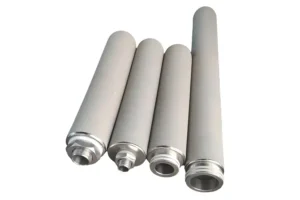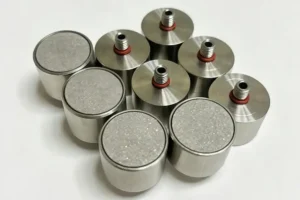
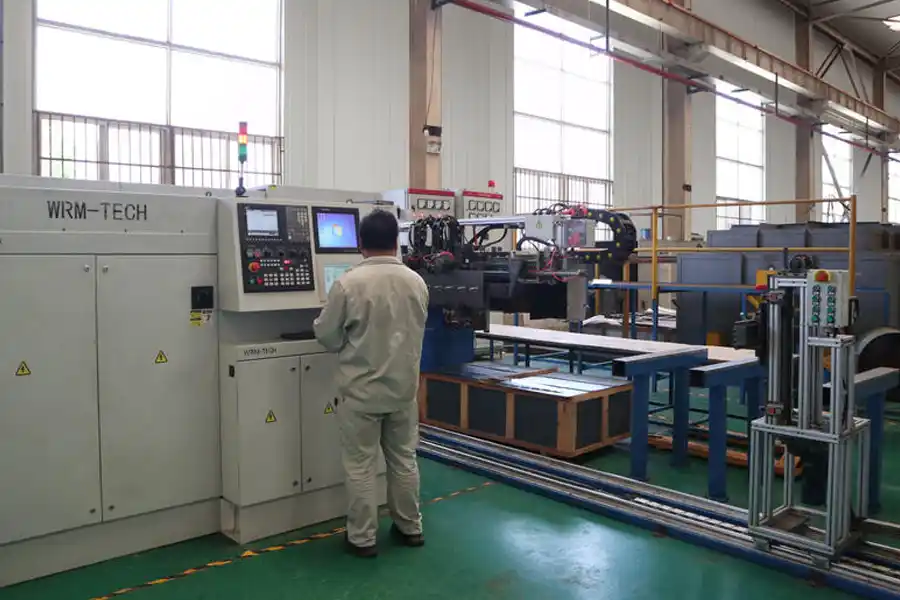
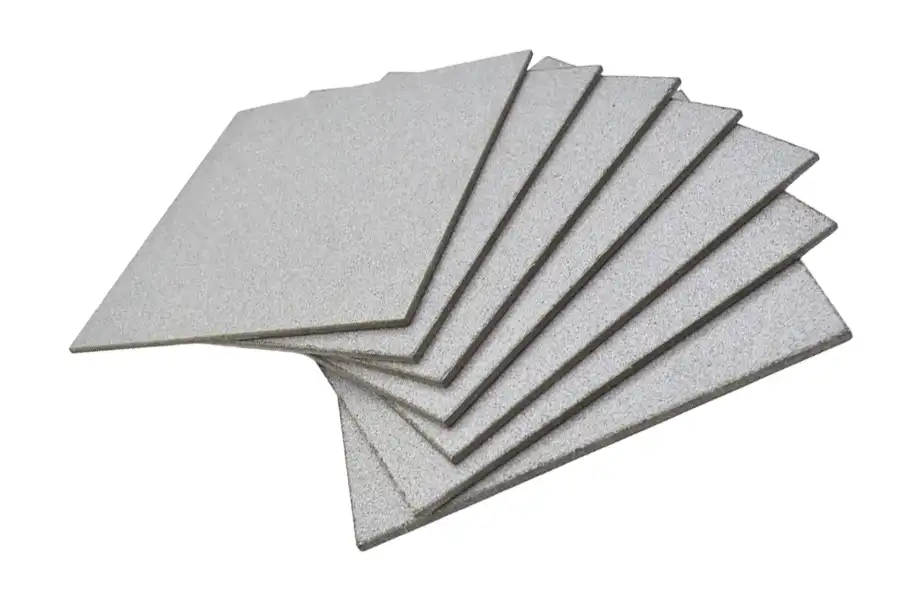
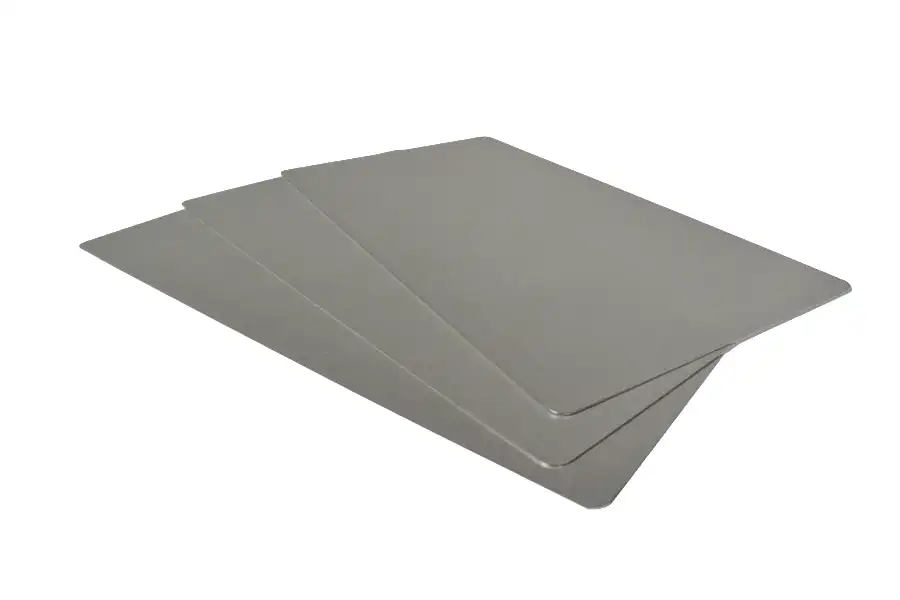
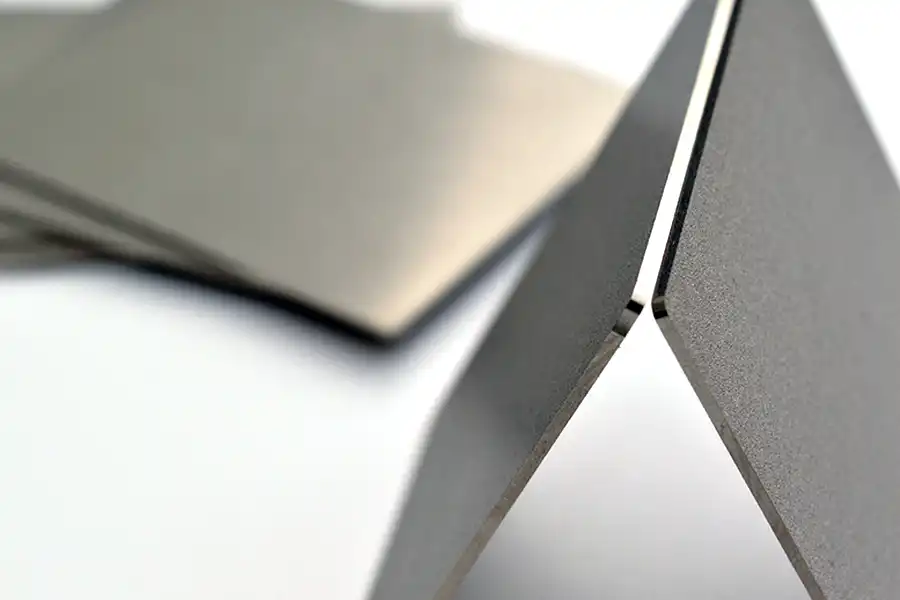
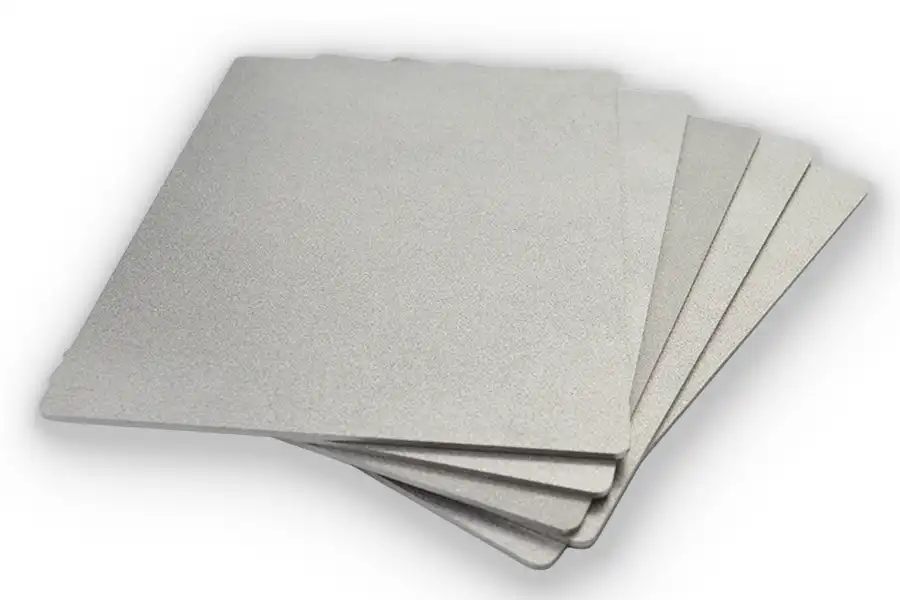
A sintered titanium filter plate is a rigid porous metal disc or sheet made by pressing Grade 1 titanium powder and bonding it in a vacuum furnace. The pores are part of the metal. There is no membrane to rupture, no fibre to shed and no binder to dissolve, so the plate keeps its rating through high temperature, strong acid and repeated cleaning. Standard ratings run from 5 μm to 80 μm, custom grades from 0.22 μm to 100 μm, and continuous service reaches 300 °C.
The powder sets the pores. The sintering schedule sets the strength. Everything else on this page follows from those two variables.
Key specifications at a glance
- Material: Grade 1 commercially pure titanium powder, Chinese designation TA1, titanium content 99.4% minimum
- Filtration rating: 5 μm to 80 μm standard, 0.22 μm to 100 μm custom
- Porosity: 25% to 45%, up to 50% on request
- Thickness: 0.5 mm to 30 mm
- Forms: round disc up to 800 mm diameter, square and rectangular sheet, machined profiles
- Continuous service temperature: 300 °C, short excursions to 600 °C
- Maximum working pressure: 0.6 MPa
- Regenerable by backwash, ultrasonic cleaning, acid soak and re-sintering
- Governing product standard: GB/T 6887-2019, plate type B1
- Manufacturer: ISO 9001 certified, established 2006 in Baoji, Shaanxi, exporting to more than 25 countries
Table 1: Technical specifications
| Parameter | Value | Note |
|---|---|---|
| Material | Grade 1 commercially pure titanium, TA1 | Ti content 99.4% minimum. Chemistry to YS/T 654. |
| Filtration rating, standard | 5 μm to 80 μm | Rated at 98% retention per GB/T 18853 |
| Filtration rating, custom | 0.22 μm to 100 μm | Sub-micron grades carry a permeability penalty |
| Porosity | 25% to 45% | Up to 50% on request |
| Thickness | 0.5 mm to 30 mm | Thin plates need a support ring |
| Maximum disc diameter | 800 mm | Larger plates supplied as welded sections |
| Specific surface area | 10 cm²/cm³ to 40 cm²/cm³ | Rises as rating falls |
| Permeability | 3 m³/(m²·h·kPa) to 800 m³/(m²·h·kPa) | Inversely related to rating |
| Pressure resistance | 2.0 MPa to 3.0 MPa | See the note on rating definitions below |
| Maximum working pressure | 0.6 MPa | Higher on request, subject to thickness |
| Continuous temperature | 300 °C | In air. Higher in inert or reducing atmospheres. |
| Short term temperature | 600 °C | Excursion only, not a design point |
| Regeneration recovery | Over 90% of initial permeability | Depends on foulant type. See the regeneration section. |
| Sample lead time | 10 to 15 working days | |
| Bulk order lead time | 15 to 25 working days |
On the rating figures. Values above are our standard production range. Where a figure depends on the powder lot, the pressing schedule or the sintering cycle, the datasheet issued with your quotation governs. Ask us which test produced a number before you compare it against a competitor datasheet.
Pressure resistance is not compressive strength. GB/T 6887-2019 specifies a minimum pressure resistance for each grade, and sets a lower requirement for welded assemblies than for a monolithic plate. A bulk compressive strength figure from a tensile machine measures something different. Two suppliers quoting 2.0 MPa may be quoting different tests. Specify the test when you compare.
How the plate is made
Four steps decide every number in Table 1.
1. Powder selection and screening
Grade 1 titanium powder is screened into narrow size fractions. The particle size distribution sets the pore size distribution. A narrow fraction gives a narrow pore spread and a sharp retention curve. A wide fraction packs tighter, gives smaller pores and lower permeability, and produces a less predictable rating. We sieve before pressing rather than blending to an average, because the fines migrate during pressing and end up concentrated in one face of the plate.
2. Cold isostatic pressing
The screened powder is loaded into an elastomer tool and pressed from all directions at room temperature. Isostatic pressure gives uniform green density through the thickness, which is why the plate filters evenly across its whole face. Uniaxial die pressing produces a density gradient and a plate that blinds first at its densest zone. Pressing pressure sets the starting porosity: more pressure, less pore volume, more strength.
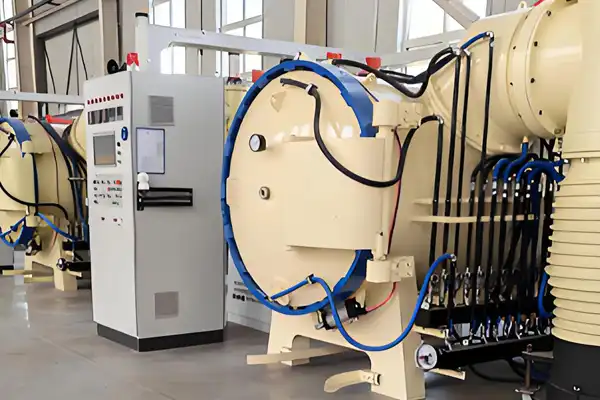
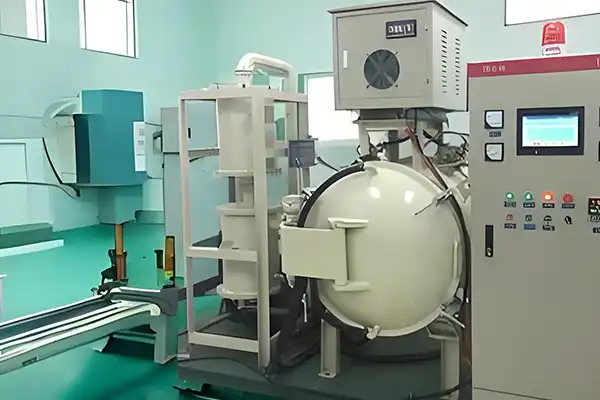
3. High temperature vacuum sintering
The green plate is fired under high vacuum, well below the 1,668 °C melting point of titanium. Particles bond at their contact points through solid state diffusion. Those bonds are called necks, and neck growth is the whole game.
More heat and longer hold produce bigger necks. Bigger necks mean higher strength and lower porosity, and the pores round off and shrink. Less heat leaves smaller necks, higher porosity, higher permeability and lower strength. You cannot specify maximum porosity and maximum strength in the same plate. Any supplier who says otherwise is selling one of them. The vacuum is not decorative either: it removes adsorbed gases and prevents the oxygen pickup that embrittles titanium.
Our sintering schedule is set per order against the target rating and porosity. Tell us the medium, the differential pressure and the required flow, and we will pick the schedule. We do not publish a single temperature because there is not one.
4. Finishing
The sintered plate is machined to final dimensions. It can be cut, drilled, welded, chamfered and surface ground, and it accepts a flange, a threaded boss or a sealing face. This is a real difference from a polymer cartridge, which is a finished article and cannot be modified without destroying it.
How filtration actually happens in a sintered plate
This section matters more than the specification table, because it explains why the plate behaves as it does in service.
A sintered titanium plate is a depth filter, not a screen. The pores are tortuous channels, not straight holes. A particle has to find a path through the thickness of the plate, and most particles do not find one.
Three mechanisms run at once:
- Surface straining. Particles larger than the pore opening stop at the face and build a cake.
- Depth capture. Particles smaller than the opening enter the channels, contact a wall, and stay there. Inertia and interception do this work, not size exclusion.
- Cake filtration. Once a cake forms, the cake becomes the primary filter medium and the plate becomes the support for it.
Cake filtration has a consequence most datasheets omit. The effective rating of a plate in service is usually finer than its dry laboratory rating, because the cake is finer than the pores. That is useful for clarity. It is harmful for pressure drop. A plate run to full cake loading shows a steep differential pressure rise and needs cleaning, and the cleaning interval is set by the cake, not by the plate.
The practical rule: size the plate for the initial clean differential pressure plus the allowance for the cake you are willing to carry. Do not size it for the clean rating alone, or you will be cleaning it every shift.
Table 2: Stock dimensions and ratings
| Item | Standard range |
|---|---|
| Disc diameters | 50 mm, 100 mm, 150 mm, 200 mm, 300 mm, 500 mm |
| Sheet sizes | 100 × 100 mm, 150 × 150 mm, 200 × 200 mm, 300 × 300 mm, 800 × 350 mm |
| Thicknesses | 0.5 mm, 1.0 mm, 1.5 mm, 2.0 mm, 3.0 mm, 5.0 mm |
| Pore ratings | 10 μm, 20 μm, 30 μm, 50 μm, 80 μm, 100 μm |
| Maximum machined diameter | 800 mm |
| Thickness range on request | Up to 30 mm |
Thickness selection is not free. A 0.5 mm plate has low residence volume and low pressure drop, but it needs a perforated support behind it or it will deflect under differential pressure. A 5.0 mm plate is self-supporting and holds more solids, but it costs more powder and cleans more slowly. Most installations land between 2.0 mm and 3.0 mm.
Table 3: Titanium plate against other filter media
| Requirement | Polymer membrane or cartridge | Sintered stainless steel | Ceramic | Sintered titanium plate |
|---|---|---|---|---|
| Chloride and seawater service | Varies with polymer | Pits in chlorides | Good | Excellent |
| Oxidising acids | Limited | Limited | Good | Excellent |
| Continuous temperature | Usually below 100 °C | Above 400 °C | High | 300 °C |
| Mechanical shock | Low | High | Brittle, low | High |
| Particle shedding | Fibres and fragments possible | Low | Possible on cracking | None, metallurgically bonded |
| Machinability after sintering | Not machinable | Good | Poor | Good |
| Regeneration cycles | Few, often single use | Many | Few, brittle | Many |
| Purchase price | Low | Low to medium | Medium | Highest |
| Cost per campaign | High | Low | Medium | Low |
The honest summary. Buy a polymer cartridge if the duty is cold, clean and short, and replacement is cheap and easy. Buy stainless if the medium is not chloride-bearing and cost is the constraint. Buy sintered titanium when the medium attacks both of those, or when the plate must be machined into an assembly, or when the element has to survive steam, ozone and repeated chemical cleaning.
Chemical compatibility, including where titanium fails
Titanium is not universally corrosion resistant. It is protected by a titanium dioxide film that forms spontaneously and repairs itself when oxygen or water is present. Remove the conditions that maintain the film and titanium corrodes fast. Every supplier page lists the acids titanium survives. Very few list the ones that destroy it. Here are both.
Where a sintered titanium plate performs
- Nitric acid across a wide concentration range, including hot and concentrated
- Chromic acid
- Seawater, brine and chloride solutions, with no pitting and no chloride stress corrosion cracking
- Wet chlorine gas and hypochlorite, where titanium outperforms zirconium, Hastelloy C and Monel
- Alkaline solutions, stable below roughly 50% sodium hydroxide or potassium hydroxide at moderate temperature, and better than nickel or zirconium if chlorides are present
- Ferric chloride, cupric chloride and other oxidising salt solutions
- Most organic solvents and organic acids at moderate temperature, including acetic, oxalic and citric
- Ozone in both gas and dissolved form
Where you must not use it
- Hydrofluoric acid and fluoride-bearing solutions below pH 7. Fluoride destroys the oxide film outright. There is no concentration that is safe.
- Dry chlorine gas. Titanium burns in it. Moist chlorine passivates titanium; dry chlorine reacts violently. Maintain water content in the gas stream or choose another material.
- Red fuming nitric acid with low water content. Below roughly 0.7% water with nitrogen dioxide above about 6%, titanium is at risk of stress corrosion cracking and pyrophoric reaction. This has caused documented vessel failures.
- Strong reducing acids at high concentration and temperature. See hydrochloric acid below.
- Anhydrous methanol and similar oxygen-free organic systems. No water means no film repair.
The hydrochloric acid question
This is the mistake we see most often in filter specification. Supplier pages list hydrochloric acid as a compatible medium without qualification. It is not, unless you state concentration, temperature and oxidiser content together.
| Hydrochloric acid concentration | Room temperature | Boiling |
|---|---|---|
| 1% | Negligible attack | About 0.35 mm per year |
| 5% | Low attack | About 6.5 mm per year |
| 10% | About 0.18 mm per year | About 41 mm per year |
Read the trend, not the digits. Attack rises with concentration and rises much faster with temperature. Boiling 10% hydrochloric acid consumes a titanium plate. Room temperature dilute acid does not.
The variable that changes everything is an oxidiser. Adding a small amount of ferric chloride, cupric chloride, nitric acid or dissolved chlorine to hydrochloric acid re-establishes the passive film and can cut the corrosion rate by an order of magnitude or more. This is why titanium works well in many real pickling and etching liquors that are nominally hydrochloric, and fails in clean laboratory acid of the same concentration.
If your medium contains hydrochloric or sulphuric acid, send us the concentration, the temperature, the aeration state and the full ionic composition. We will tell you whether Grade 1 is adequate or whether you need Grade 7 or Grade 12, which carry palladium and molybdenum additions for exactly this duty. Palladium-stabilised grades can be supplied on request.
Where the plate belongs in a filter train
This section corrects a claim that appears on most supplier pages, including earlier versions of our own.
A sintered titanium plate is not a sterilising grade filter.
Sterilising grade is a defined regulatory status, not a pore size. Under ASTM F838, a filter earns it by producing sterile effluent when challenged with at least 10⁷ colony forming units per square centimetre of Brevundimonas diminuta ATCC 19146, the smallest bacterium used for this test. A 0.22 μm rating on its own confers nothing. The rating describes a nominal pore characteristic; sterilising grade describes a demonstrated bacterial retention result on a validated device.
Sintered titanium is a depth filter with a broad pore size distribution. It cannot be integrity tested by bubble point in the way a membrane can, so it cannot be validated for a sterilising claim in service. Its correct and well-established role in pharmaceutical and food processing is upstream:
- Decarbonisation filtration after activated carbon treatment, which is the single most common duty for sintered titanium in pharmaceutical plants
- Coarse and intermediate filtration ahead of a membrane
- Pre-filtration ahead of reverse osmosis
- Catalyst and precious metal recovery, where the solids are the product
- Venting, sparging and gas distribution, where sterile gas is required downstream of a validated membrane
Specifying a sintered titanium plate as the terminal sterilising filter will fail a GMP audit. Specifying it as the carbon trap upstream of a validated 0.2 μm membrane gives you the long life, the steam tolerance and the chemical resistance that made you look at titanium in the first place, and it protects the membrane from carbon fines, which is what carbon does to membranes.
The material is still biocompatible, non-toxic and non-magnetic, and it sheds nothing into the filtrate. Those properties qualify it for high purity service. They do not qualify it for sterility.
Regeneration and service life
A sintered titanium plate is bought once and cleaned many times. The cleaning method depends entirely on what fouled it.
| Foulant | Method | Detail |
|---|---|---|
| Loose particulate, surface cake | Backwash | Reverse flow at about 1.5 times operating pressure for 5 to 10 minutes |
| Carbonates, iron hydroxide, mineral scale | Acid soak | 5% to 10% citric acid, or 2% to 5% hydrochloric acid, 30 to 60 minutes, then rinse |
| Organics, oils, biological slime | Alkaline soak | Dilute sodium hydroxide, then rinse to neutral |
| Deep pore loading | Ultrasonic cleaning | Effective, but see the caution below |
| Severe or sintered-in fouling | Re-sintering | Return to us. Vacuum firing burns off organics and restores pore structure. |
| Steam sterilisation | Autoclave or in-place steam | Repeated cycles cause no deformation |
Never use hydrofluoric acid or fluoride-containing cleaners. This includes many commercial descalers and glass-cleaner formulations. It also rules out some pickling pastes used for stainless steel weld cleaning. Fluoride attacks the titanium itself, not just the fouling.
Be careful with ultrasonics on thin plates. Ultrasonic cleaning works well on thicker elements. On a plate below about 1 mm the cavitation energy is concentrated in a small mass and can loosen surface material over many cycles. If your plates are thin, backwash and chemical soak first, and reserve ultrasonics for a controlled trial.
Track differential pressure rather than elapsed time. A gradual rise over weeks means fouling and calls for scheduled cleaning. A sudden rise means mechanical blockage or a seal failure, and cleaning will not fix it.
On service life: in our works testing, plates recovered over 90% of initial permeability after backwash and ultrasonic cleaning, and ran for several times the campaign life of the disposable media they replaced. Both figures depend on the fouling mechanism. A plate blinded by irreversible chemical scale or by a polymer that has cured inside the pores will not recover, and no cleaning regime will save it. Tell us what you are filtering and we will give you a realistic expectation rather than a number.
Standards and testing
Filter element specifications are frequently quoted against the wrong standard. This is worth knowing when you compare suppliers.
- GB/T 6887-2019, Sintered metal filter elements. The Chinese national standard for this product. Published 4 June 2019, in force 1 January 2020, replacing GB/T 6887-2007. It covers sintered titanium and sintered nickel and nickel alloy elements made by powder metallurgy for gas and liquid purification. Elements are classified per GB/T 18853 by the particle size retained at 98% filtration efficiency, and titanium grades carry a TG designation followed by that particle size, so a TG010 element retains 10 μm particles at 98% efficiency. Tube types are A1 to A4, and the plate type is B1. The standard also fixes minimum pressure resistance per grade, with a lower figure for welded assemblies.
- YS/T 654. The titanium chemistry specification referenced for the material.
- GB/T 5249. The bubble point method used to verify pore size on permeable sintered metal.
- ISO 4003 and ISO 4022. The international equivalents: ISO 4003 covers bubble point determination on permeable sintered metal materials, ISO 4022 covers permeability.
- ASTM F316. Frequently cited for sintered metal filters and cited wrongly. Its scope is membrane filters with maximum pore sizes from 0.1 μm to 15.0 μm. It is not written for coarse permeable sintered metal. If a supplier quotes ASTM F316 for a 50 μm titanium plate, ask what they actually ran.
- ASTM F838. The bacterial retention test behind a sterilising grade claim. Discussed above.
We can supply bubble point data, permeability data and a certificate of conformity against GB/T 6887-2019 with your order. State which test results you need on the enquiry, because the acceptance test differs from the routine production check.
Applications
Pharmaceutical and fine chemicals
Decarbonisation of medicinal liquids after activated carbon treatment. Recovery of precious metal catalysts, where the retained solid is the valuable stream. Clarification of intermediates. Filtration of alkaline carbonate solutions. The plate survives repeated steam sterilisation and does not adsorb active ingredients the way a polymer membrane can.
Water and wastewater treatment
Pre-filtration ahead of reverse osmosis in ultrapure water lines. Filtration after ozone sterilisation and in ozone sparging contactors, where titanium is one of very few materials fully compatible with high concentration ozone. Recovery of solids from acidic or alkaline industrial effluent, including electroplating, textile and pharmaceutical waste streams.
Food and beverage
Clarifying filtration of wine, beer, juice and dairy streams. Removal of yeast, pulp and particulate without stripping flavour. Edible oil polishing to remove impurities and particulate matter. The plate is biocompatible and sheds nothing.
Electrolytic and electrochemical service
This is where our background as a titanium anode manufacturer is directly relevant. The same sintered porous body used as a filter is used as a gas distribution medium in electrolytic cells, as a sparger, and as a porous current collector and electrode substrate. Gas distribution needs uniform pore size across the whole face, which is exactly what isostatic pressing delivers and what uniaxial pressing does not. If your duty is gas evolution or gas distribution rather than solids removal, tell us, because the rating and porosity targets differ and we will specify differently. Ourtitanium powder sintered aeration diffuseris the same process built for fine bubble duty.
Petrochemical and gas
Terminal filtration of petroleum products. Removal of dust, oil mist and liquid droplets from process gases including hydrogen and nitrogen. High pressure air filtration. Catalyst recovery in cracking and hydrogenation service.
Plate or tubular element: how to choose
We make both, and buyers often ask for the wrong one.
| Condition | Choose | Reason |
|---|---|---|
| Plate and frame filter press | Plate | Direct fit, no adapter |
| Housing already in service | Element | Standard cartridge lengths drop in |
| Very high flow, low differential pressure | Plate | Area scales with plate size |
| High solids loading | Element | More depth per unit footprint |
| Gas distribution or sparging | Plate or disc | Flat face gives uniform bubble or gas release |
| Inline pipeline filtration | Element | Cartridge housings are the standard fitment |
| Custom assembly, machined into a fixture | Plate | Can be cut, drilled, welded and chamfered |
| Vacuum or suction filtration | Plate | Nutsche and pan filter fitment |
For tubes, candles and cartridges, see oursintered titanium filter element page. Material, ratings and temperature limits are identical. Only the geometry and the mounting differ.
Customisation
Every parameter in Table 1 can be moved:
- Filtration rating from 0.22 μm to 100 μm
- Porosity from 25% to 50%
- Outline dimensions, including disc, square, rectangle and profiled shapes to drawing
- Thickness from 0.5 mm to 30 mm
- Surface finish: as sintered, ground, or polished
- Machining: cutting, drilling, tapping, chamfering, welding of flanges, bosses and nozzles
- Coating: platinum, ruthenium or iridium plating where the plate also has to work as an electrode
- Material upgrade to Grade 2, Grade 7 or Grade 12 for reducing acid service
Send a drawing or a dimensioned sketch. If you do not have one, send the medium, the temperature, the pressure, the flow rate and the particle size you need to remove, and we will propose the specification.
Why buy from us
We are a titanium manufacturer in Baoji, Shaanxi, the centre of China’s titanium industry, established in 2006 and ISO 9001 certified. Porous metal filters have been a dedicated line here for more than fourteen years.
What that means in practice:
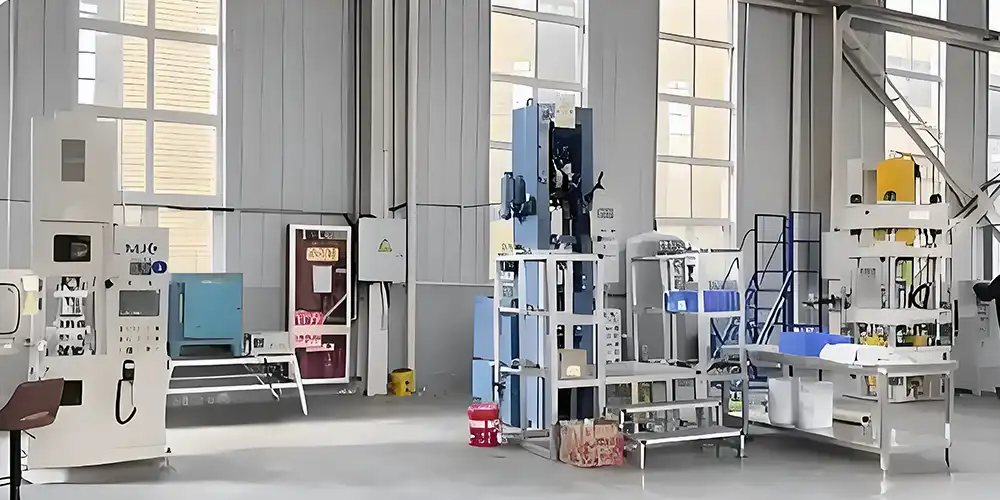
- We press and sinter in house. Cold isostatic pressing and vacuum sintering are done on our own equipment, so the rating you order is the rating you receive.
- We are also a coated titanium anode manufacturer. Titanium metallurgy, passivation behaviour and electrochemical service are our core business, not a sideline.
- We machine to drawing. Cutting, drilling, welding and chamfering are in-house operations.
- More than 300 customers in over 25 countries, including Germany, the United States and South Korea.
- More than ten granted patents.
- We export directly, and we handle the documentation.
What we will not do is quote a pore rating we have not tested, or claim a chemical compatibility we cannot support. If your medium is wrong for titanium, we will say so on the enquiry rather than after the failure.
Frequently asked questions
What is a sintered titanium filter plate?
A rigid porous metal plate made from Grade 1 commercially pure titanium powder. The powder is screened, cold isostatically pressed into shape, then fired under high vacuum so the particles bond metallurgically at their contact points. The result is a monolithic body with a three dimensional network of interconnected pores. There is no binder, no glue and no fibre, so nothing sheds into the filtrate and the pore structure survives high temperature and chemical cleaning.
What filtration rating should I order?
Start from the particle size you must remove, then add the cake effect. Because a sintered plate is a depth filter, its effective rating in service is usually finer than the dry rating, since the retained cake becomes part of the filter medium. Our standard range is 5 μm to 80 μm and our stock ratings are 10, 20, 30, 50, 80 and 100 μm. Custom grades run from 0.22 μm to 100 μm. Send us the medium, the particle size distribution, the flow rate and the allowable differential pressure, and we will recommend a rating rather than guess one.
Can a sintered titanium filter plate be used as a sterilising grade filter?
No. Sterilising grade is a validated status under ASTM F838, requiring demonstration of sterile effluent against a challenge of at least 10⁷ colony forming units per square centimetre of Brevundimonas diminuta ATCC 19146. A nominal 0.22 μm rating does not confer it, and a sintered depth filter cannot be integrity tested in service the way a membrane can. The correct role for a sintered titanium plate is decarbonisation, coarse and intermediate filtration, pre-filtration ahead of a membrane, and catalyst recovery. Use a validated membrane for the terminal sterilising step.
What temperature can a sintered titanium filter plate take?
Continuous service to 300 °C, with short excursions to 600 °C and no loss of pore structure or strength. That is far beyond any polymer cartridge, most of which are limited below 100 °C. The plate also survives repeated steam sterilisation and autoclaving without deformation. Note that the temperature limit in air is set by oxidation of the titanium surface. In an inert or reducing atmosphere the practical limit is higher.
Which chemicals will damage a titanium filter plate?
Hydrofluoric acid and any fluoride-bearing solution below pH 7, which destroy the protective oxide film at any concentration. Dry chlorine gas, in which titanium can react violently, though wet chlorine is entirely safe. Red fuming nitric acid with low water content and high nitrogen dioxide, which risks stress corrosion cracking and pyrophoric reaction. Concentrated hot reducing acids, particularly hydrochloric and sulphuric acid above roughly 5% at elevated temperature, unless an oxidiser such as ferric chloride is present to maintain passivation. Anhydrous oxygen-free organic systems, which prevent film repair. Send us the full composition and we will confirm suitability.
Is titanium resistant to hydrochloric acid?
Only under stated conditions. Titanium survives dilute hydrochloric acid at low temperature and is attacked rapidly by concentrated hot acid. Published immersion data puts boiling 10% hydrochloric acid at roughly 41 mm per year of metal loss, which is not a usable service. The presence of an oxidiser such as ferric chloride, cupric chloride, nitric acid or dissolved chlorine restores the passive film and can reduce attack by an order of magnitude or more, which is why titanium performs well in many real pickling and etching liquors. Never specify on acid name alone. We need concentration, temperature, aeration and the full ionic composition.
Can the plate be cleaned and reused?
Yes. Backwashing at about 1.5 times operating pressure removes surface cake. Citric acid at 5% to 10% or hydrochloric acid at 2% to 5% removes mineral scale. Dilute alkali removes organics and biological slime. Ultrasonic cleaning handles deep pore loading on thicker plates. Severely fouled plates can be returned to us for vacuum re-sintering. In our works testing, plates recovered over 90% of initial permeability. Recovery depends on the foulant: irreversible chemical scale or cured polymer inside the pores will not come out. Avoid hydrofluoric acid and fluoride cleaners entirely.
How long does a sintered titanium filter plate last?
It depends on the fouling mechanism, not on the material. The titanium itself does not degrade in a compatible medium. In our works testing, plates ran several times the campaign life of the disposable media they replaced. A plate handling a clean, well-characterised stream with scheduled backwashing can run for years. A plate blinded by scale or cured organics may be lost in one campaign. We would rather discuss your actual medium than quote a service life figure that means nothing out of context.
What standard governs sintered titanium filter elements?
In China, GB/T 6887-2019, Sintered metal filter elements, published 4 June 2019 and in force since 1 January 2020. It classifies elements per GB/T 18853 by the particle size retained at 98% filtration efficiency, designates titanium grades with a TG prefix followed by that particle size, defines tube types A1 to A4 and plate type B1, and sets minimum pressure resistance per grade. Pore size is verified by the bubble point method under GB/T 5249, with ISO 4003 and ISO 4022 as the international equivalents. ASTM F316 is often quoted in error, since its scope is membrane filters from 0.1 μm to 15.0 μm and not coarse permeable sintered metal.
Why does porosity conflict with strength?
Both are set by the same sintering step. Higher temperature and longer hold grow the metallurgical necks between particles, which raises strength and lowers porosity, shrinking and rounding the pores in the process. Lower temperature leaves finer necks, higher porosity, higher permeability and lower strength. You cannot specify maximum porosity and maximum strength together. Tell us whether your duty is strength limited or flow limited and we will set the schedule accordingly.
What is the difference between a filter plate and a filter element?
Geometry and mounting, not material or performance. A plate is a flat disc or sheet for plate and frame presses, nutsche filters, suction pans, gas distribution faces and machined assemblies. An element is a tube, candle or cartridge for standard housings and inline filtration. Both are Grade 1 titanium powder, cold isostatically pressed and vacuum sintered, with identical rating and temperature ranges. See our sintered titanium filter element page for tubular forms.
What information do you need for a quotation?
The medium and its full composition, including concentration, temperature and pH. The particle size to be removed and its concentration. Required flow rate and allowable differential pressure. Plate dimensions, or the housing it must fit. Quantity. A drawing if you have one. With that we will specify the rating, the porosity, the thickness and the material grade, and quote within 12 hours. If the medium is wrong for titanium we will tell you at that stage.
Request a quotation
Send us your drawing or your process conditions. We will recommend the rating, porosity, thickness and titanium grade, and quote within 12 hours.
Email info@mmo-anode.com or reach us on the contacts listed on our company page.