
Titanium Flanges
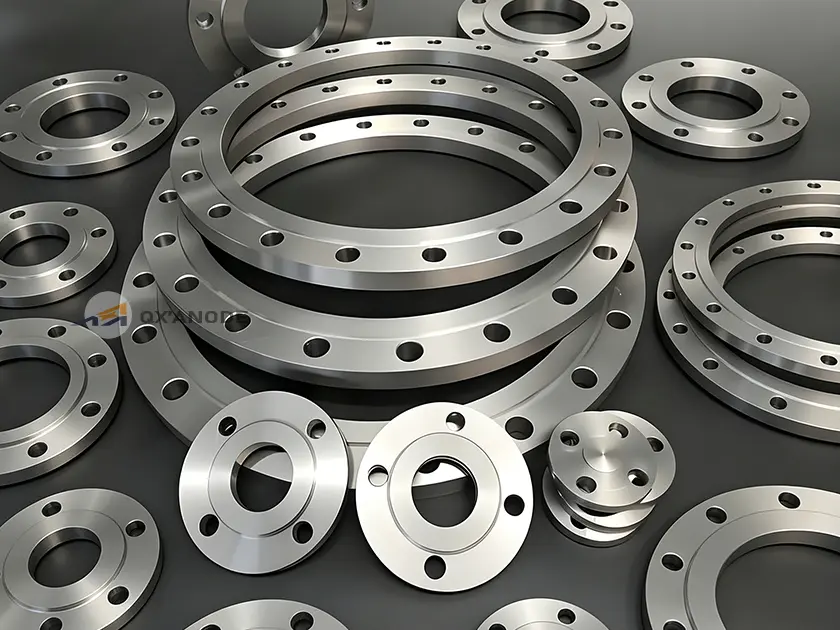
Forged and CNC-machined titanium flanges to ASME B16.5 / B16.47, MSS SP-44 and API 6A, certified to ASTM B381 in Grades 1–12. Manufactured in-house by Qixin Titanium since 2006, with third-party inspection (SGS, BV, TÜV, DNV) available on request.
Key Specifications at a Glance
What We Manufacture
Dimensional Standards
ASME B16.5 (1/2″ – 24″) · ASME B16.47 Series A/B (26″ – 48″) · MSS SP-44 · API 6A
Material Standards
ASTM B381 forgings, Grades 1, 2, 3, 4, 5, 7, 12 · ASTM B265 plate · ASTM B348 bar
Pressure Ratings
Class 150 – 2500 (ASME B16.5) · 2,000 – 20,000 psi (API 6A)
Flange Types
Weld Neck · Slip-On · Blind · Socket Weld · Threaded · Lap Joint
Facings
RF · FF · RTJ · Male & Female · Tongue & Groove
Testing & Certification
EN 10204 3.1 / 3.2 · PMI (XRF) · UT · PT · RT · ET · Hydrostatic 1.5 × design pressure
Quality System
ISO 9001 certified · Third-party inspection (SGS, BV, TÜV, DNV) on request
Lead Time & MOQ
Quotation within 48 hours · MOQ and lead time confirmed per drawing / specification
Product Overview
What Is a Titanium Flange?
A titanium flange is a forged or machined ring fitting that joins pipes, valves, pumps and pressure vessels with a bolted, demountable connection. It performs the same mechanical job as a steel or stainless steel flange — the difference is the material.
Titanium forms a self-healing TiO2 passive film in oxidizing environments, so it resists chloride corrosion at roughly half the density of steel. In chloride-rich service such as seawater, brine, hypochlorite and wet chlorine, a Grade 2 titanium flange routinely outlasts 316L stainless steel in the same duty.
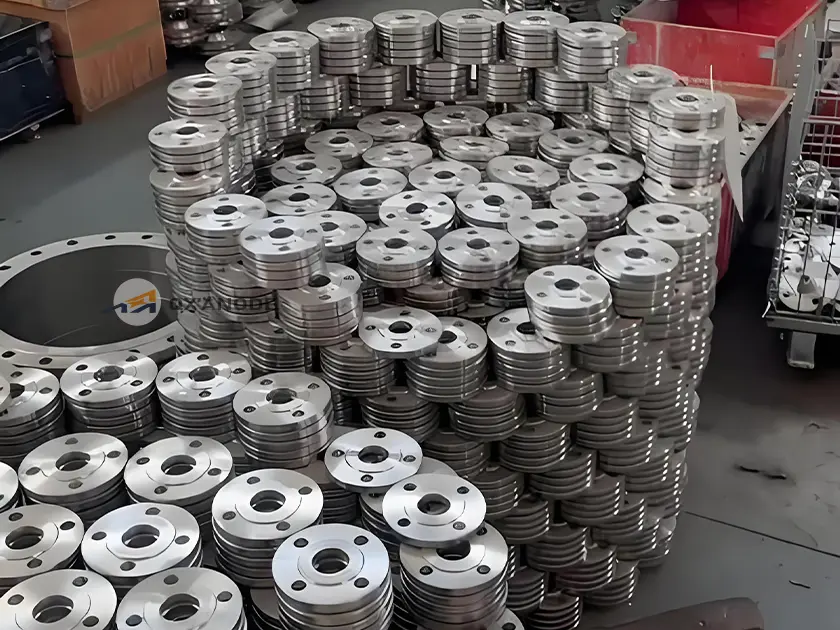
That is why titanium is the default flange material for desalination, chlor-alkali and offshore systems — and why we have forged and machined them in our Baoji plant since 2006, from 1/2″ instrumentation lines to 48″ seawater headers.
Why buy direct from Qixin?
In-house forging, heat treatment and CNC machining under one roof, with every heat traceable to its mill test certificate. Send us the medium, design pressure, size and grade — our engineering team confirms manufacturability and returns a quotation within 48 hours.
Where They Are Used
Applications That Justify Titanium
Titanium is specified when the medium or environment makes stainless steel uneconomical or unsafe:
Chemical Processing
Chlor-alkali cells, hydrochloric acid recovery, organic acid reactors, bromine production.
Seawater & Desalination
RO high-pressure piping, heat-exchanger water boxes, offshore firewater and cooling systems.
Oil & Gas
High-chloride produced water, sour service, subsea manifolds and wellhead (API 6A) duty.
Pulp & Paper
Bleach plant piping — chlorine dioxide and hypochlorite lines, digester liquor lines.
Medical & Pharma
Pure-steam and WFI systems where leachable metal ions must be minimized.
Power Generation
FGD scrubbers and condenser water boxes in coastal plants; aerospace ground-support systems.
Raw Material
Titanium Grades and Specifications
Every heat of forging stock we use arrives with a Mill Test Certificate (MTC) to EN 10204 3.1 or 3.2 showing chemical composition and mechanical properties, and is verified by PMI (XRF) before forging begins — a low-cost step that prevents an entire batch being made from the wrong grade.
Commercially Pure (CP) Grades
| Grade | UNS No. | Typical UTS | Density | Primary Use |
|---|---|---|---|---|
| Grade 1 | R50250 | 240 MPa min | 4.51 g/cm³ | Deep-drawn, highly formed parts |
| Grade 2 | R50400 | 345 MPa min | 4.51 g/cm³ | Standard chemical and marine piping |
| Grade 3 | R50550 | 450 MPa min | 4.51 g/cm³ | Higher-strength CP applications |
| Grade 4 | R50700 | 550 MPa min | 4.51 g/cm³ | Highest-strength CP, aerospace |
Grade 2 is our standard recommendation. It balances formability, weldability and corrosion resistance, and is the default specification for flanges in chemical plants, desalination trains and offshore systems.
Alloyed Grades
| Grade | UNS No. | Composition | UTS | Use Case |
|---|---|---|---|---|
| Grade 5 | R56400 | Ti-6Al-4V | 895 MPa min | High-pressure, high-strength joints |
| Grade 7 | R52400 | Ti-0.15Pd | 345 MPa min | Reducing-acid service (crevice corrosion) |
| Grade 12 | R53400 | Ti-0.3Mo-0.8Ni | 483 MPa min | Higher-temperature reducing media |
Grade selection guidance
Grade 5 (Ti-6Al-4V) delivers nearly three times the strength of Grade 2 but is harder to machine and less forgiving under welding — specify it only when pressure class or weight savings demand it. Grade 7 adds 0.15% palladium, closing the crevice-corrosion gap that CP titanium can suffer in hot, stagnant chloride solutions.
In-House Production
Manufacturing Process
A titanium flange for pressure-boundary service must be forged, not cut from plate and drilled. Forging aligns grain flow with the flange geometry and closes internal porosity inherited from the ingot. Every flange leaving our Baoji workshop follows this controlled route:
Billet Prep & Heating
PMI-verified billet cut to weight; heated in controlled-atmosphere furnaces — 900–1,050 °C for CP grades, 900–970 °C for Grade 5 — with calibrated, logged pyrometers.
Open- / Closed-Die Forging
Upset, pierced or ring-rolled with a reduction ratio of 3:1 or greater; ring rolling gives a seamless ring with circumferential grain flow for WN and large diameters.
Heat Treatment
Grade-specific cycles: stress relief 540–650 °C, annealing 700–850 °C, STA for Grade 5 (solution 900–970 °C, aging 480–595 °C) — documented time-at-temperature.
Alpha-Case Removal
Oxygen-enriched surface layer removed by machining, grinding or HF/HNO₃ pickling before final machining — never shipped on a finished flange.
CNC Machining
Hub, bore, bolt circle and sealing face machined with cobalt/carbide tooling; RF faces flat to 0.05 mm, RTJ grooves to 0.01 mm, Ra 1.6–3.2 µm on gasket faces.

Key controlled dimensions
- Sealing-face flatness: 0.05 mm or better for RF; 0.01 mm for RTJ grooves in critical service.
- Bolt-hole position tolerance: ±0.8 mm (ASME B16.5), verified by CMM or template.
- Surface finish Ra 1.6–3.2 µm on the gasket contact face; smoother for RTJ metal-to-metal seals.
- Chamfers and radii per drawing to avoid stress concentrations at the hub-to-disc transition.
Titanium has low thermal conductivity (≈21 W/m·K for Grade 2), so heat concentrates at the cutting edge — our drilling and turning parameters are tuned for titanium, never for steel.
Product Range
Flange Types, Facings and Pressure Ratings
Common Types
| Type | Best For | Notes |
|---|---|---|
| Weld Neck (WN) | Critical, cyclic or high-pressure service | Strongest and most fatigue-resistant; tapered hub transfers stress away from the weld. |
| Slip-On (SO) | General utility | Lower cost, easier alignment; not for cyclic or high-fatigue duty. |
| Blind (BL) | Line ends and vessel nozzles | Solid disk that must withstand full pressure with no bore reinforcement. |
| Socket Weld (SW) | Small-bore (4″ and under) high-pressure lines | Pipe inserts into a socket before welding. |
| Threaded (THD) | Where welding is impractical or prohibited | NPT or BSPT thread. |
| Lap Joint (LJ) | Frequent disassembly with a titanium stub end | Backing flange can be a lower-cost material if galvanic isolation is maintained. |
Facings
- Raised Face (RF) — the most common facing; 1.6 mm raised face for Class 150/300 and 6.4 mm for Class 400+, serrated finish to grip the gasket.
- Flat Face (FF) — full-face contact for brittle mating flanges (cast iron) or full-face gaskets.
- Ring Type Joint (RTJ) — metal-to-metal seal with an oval/octagonal ring (soft iron or 316L); Class 600 and above.
- Male & Female / Tongue & Groove — self-aligning, gasket-retaining faces for high-integrity service.
Pressure and Size Range
- Pressure classes: 150, 300, 600, 900, 1500, 2500 (ASME B16.5); API 6A 2,000–20,000 psi for wellhead service.
- Sizes: 1/2″ to 24″ per B16.5; 26″ to 48″ per B16.47.
Engineering note
Titanium is not listed in the ASME B16.5 pressure-temperature tables. Ratings are derived from allowable stresses in ASME BPVC Section II, Part D and confirmed by our engineers for each service condition — include the design temperature with your inquiry.
Quality Assurance
Testing and Quality Control
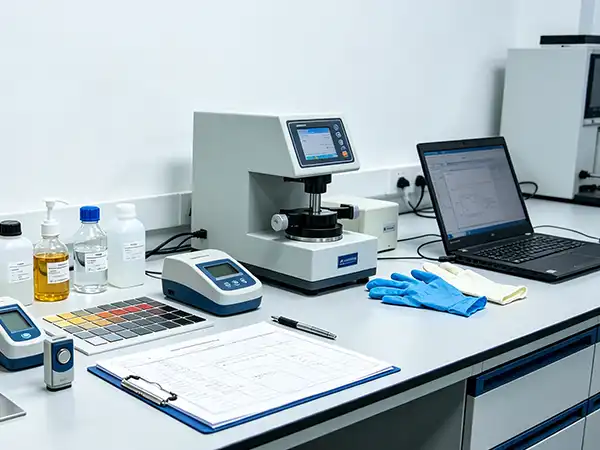
A titanium flange is only as reliable as its test record. The following inspections are standard on every pressure-boundary flange we ship; critical-service orders add third-party witness.
Chemical & Mechanical
OES/XRF per heat · tensile per ASTM E8 · hardness across the body · Charpy V-notch when specified.
Non-Destructive Testing
100% UT per ASTM A388/B594 · 100% PT on machined faces · RT on welds · ET on high-volume runs.
Dimensional & Hydrostatic
CMM/template inspection of OD, bolt circle, bore and flatness · hydrostatic at 1.5 × design pressure, 10-min hold, zero leakage.
Documentation
EN 10204 3.1/3.2 · heat-number traceability report · NDT reports with ASNT Level II technician certification.
Independent verification
Third-party inspection by SGS, BV, TÜV or DNV is available on request, with witness points agreed in advance. Inspection reports and material certificates are issued before shipment, so your receiving inspection is a formality.
Field Guidance
Installation and Usage Precautions
A correctly manufactured titanium flange can still fail in service if installed without regard for titanium’s specific behavior. These precautions come from our field experience.
Galvanic corrosion — the most common failure mode
Titanium is noble in the galvanic series. Bolted directly to carbon steel, stainless steel or copper alloy in an electrolyte, the other metal becomes the anode and corrodes — often rapidly, while the titanium flange looks pristine.
- Use insulating gasket kits (PTFE or phenolic facing, insulating sleeves and washers) whenever titanium joins a dissimilar metal.
- If insulation is impractical, use all-titanium bolting and protect the mating steel flange with coating or cathodic protection.
- Keep the joint dry and drained; do not use graphite-based gaskets in direct contact with titanium in oxidizing chloride service.
Gasket selection
- PTFE (modified or expanded) — best general-purpose choice for chemical service.
- Spiral-wound with titanium inner ring and 316L/Inconel outer ring — high-temperature, high-pressure RF flanges.
- Flexible graphite with tanged metal reinforcement — steam and high-temperature service.
- RTJ metal ring — soft iron, 316L or Inconel, never titanium (titanium-on-titanium RTJ surfaces gall under bolt load).
Bolt torque and tightening sequence
Titanium’s modulus of elasticity is about 110 GPa — roughly half that of steel — so titanium flanges deflect more under bolt load and over-torquing can permanently yield the hub or strip threads.
- Use a calibrated torque wrench (±3–5% for critical service); tighten in a star pattern in three passes: 30%, 70%, then 100% of target torque.
- Calculate torque from the bolt material’s proof load — not from a steel flange table; Grade 5 titanium bolts typically preload to 60–70% of proof load.
- Re-torque after 24 hours on PTFE-gasketed joints; never use impact wrenches for final torque on titanium.
Alignment, surface protection and service limits
- Parallelism 0.2 mm or better per 100 mm of diameter; never lever flanges into alignment — titanium is notch-sensitive.
- Keep iron contamination off titanium; use dedicated stainless/titanium tools and run a ferroxyl test if contamination is suspected.
- Continuous service above ~315 °C in air causes progressive oxidation; reducing acids (HCl, H₂SO₄ at low pH, HF) attack titanium — HF is incompatible with all grades.
- Dry chlorine/bromine can ignite; maintain >150 ppm H₂O for chlorine. Crevice corrosion in hot (>70 °C) stagnant chloride — use Grade 7 or 12.
Storage and welding
- Store indoors, dry, separated from carbon steel inventory; keep sealing faces covered; avoid road salt and de-icing fluids.
- Weld by GTAW (TIG) with 100% argon/helium on both sides; air contamination above ~50 ppm embrittles the weld. CP Grade 2 welds autogenously; Grade 5 needs ERTi-5 filler and post-weld stress relief. Silver/straw weld color is acceptable — blue, purple or grey means contaminated.
Specification Checklist
How to Choose the Right Titanium Flange
- Process medium and temperature? Chloride, seawater, hypochlorite or oxidizing acid justifies titanium. Reducing acid or HF → Grade 7/12, or a different alloy.
- Pressure class and pipe size? ASME B16.5 (24″ and under) or B16.47 (above 24″), then class 150–2500 from design pressure and temperature.
- Grade 2 or Grade 5? Default to Grade 2; move to Grade 5 only when weight, space or pressure class demands the extra strength.
- Flange type? Critical/cyclic/high-pressure → WN; general utility → SO; line closure → BL; small-bore high-pressure → SW.
- Facing? General service → RF; Class 600+ → RTJ; brittle mating flange → FF.
- Dissimilar-metal joint? Specify an insulating gasket kit and confirm bolting material.
The fastest way to a correct quote
Send us: process medium · design pressure and temperature · pipe size and class · grade · quantity · applicable drawing or standard. Our engineering team in Baoji confirms manufacturability and returns a quotation within 48 hours.
Frequently Asked Questions
Common Questions, Straight Answers
What standard are titanium flanges made to?
Grade 2 is commercially pure titanium with a minimum UTS of 345 MPa. It is easy to form and weld, and it is the standard choice for chemical and marine service. Grade 5 is Ti-6Al-4V with a minimum UTS of 895 MPa — nearly three times stronger but harder to machine and weld. Use Grade 5 only when pressure or weight demands it.
Can a titanium flange be bolted to a steel flange?
Yes, but galvanic corrosion will attack the steel side unless the joint is electrically isolated. Use an insulating gasket kit (PTFE or phenolic facing with insulating bolt sleeves and washers), or specify all-titanium bolting with a coated steel flange. A direct bolted joint without isolation is not safe in wet service.
What is the maximum pressure for a titanium flange?
Pressure rating depends on size, class, grade and temperature. ASME B16.5 flanges are produced through Class 2500, and API 6A flanges reach 20,000 psi. Because titanium is not in the B16.5 pressure-temperature tables, the actual allowable pressure must be calculated from the allowable stresses in ASME Section II, Part D and confirmed by the manufacturer or a licensed engineer.
How do I prevent titanium flange leaks?
Keep flange parallelism within 0.2 mm per 100 mm of diameter, use the correct gasket for the medium, tighten bolts in a star pattern in three passes with a calibrated torque wrench, and re-torque PTFE-gasketed joints after 24 hours. Inspect the sealing face for scratches and iron contamination before assembly.
What causes titanium flange failure?
Field experience points to five recurring causes. The most common is galvanic corrosion of dissimilar-metal mating parts when insulation is missing. Next are over-torquing that yields the hub or strips bolts, crevice corrosion in hot stagnant chloride service, alpha case or iron contamination left on the surface, and weld contamination from inadequate inert-gas shielding. All five are preventable with the installation practices in Section 07.
Can you manufacture flanges to our drawing or special specification?
Yes. We routinely produce flanges to customer drawings, non-standard dimensions, special facings and alternative testing requirements. Send the drawing or specification together with your service conditions, and our engineering team will confirm manufacturability and pricing within 48 hours.
Request a Quotation
Need Titanium Flanges Quoted to Your Specification?
Send us the process medium, design pressure and temperature, pipe size and class, grade, quantity and any applicable drawing. Our engineering team in Baoji will confirm manufacturability and return a quotation within 48 hours.