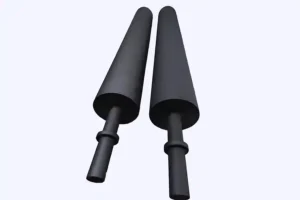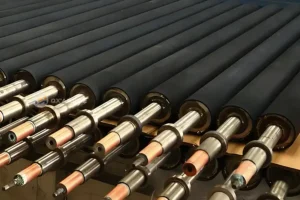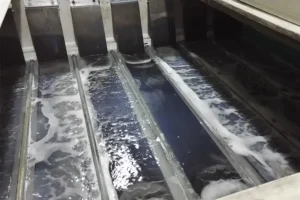
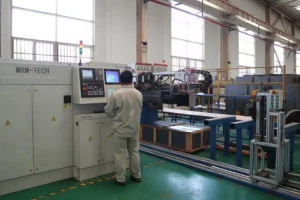
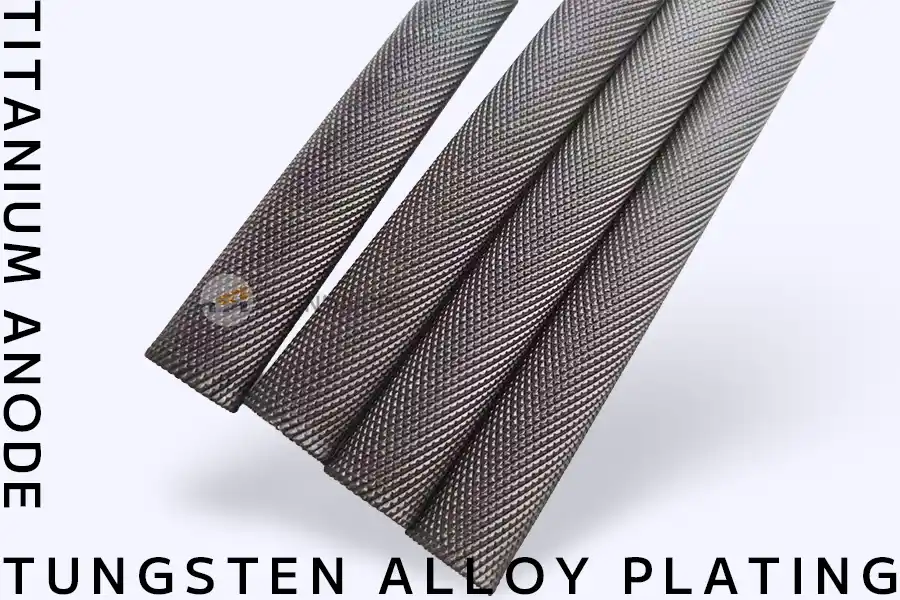
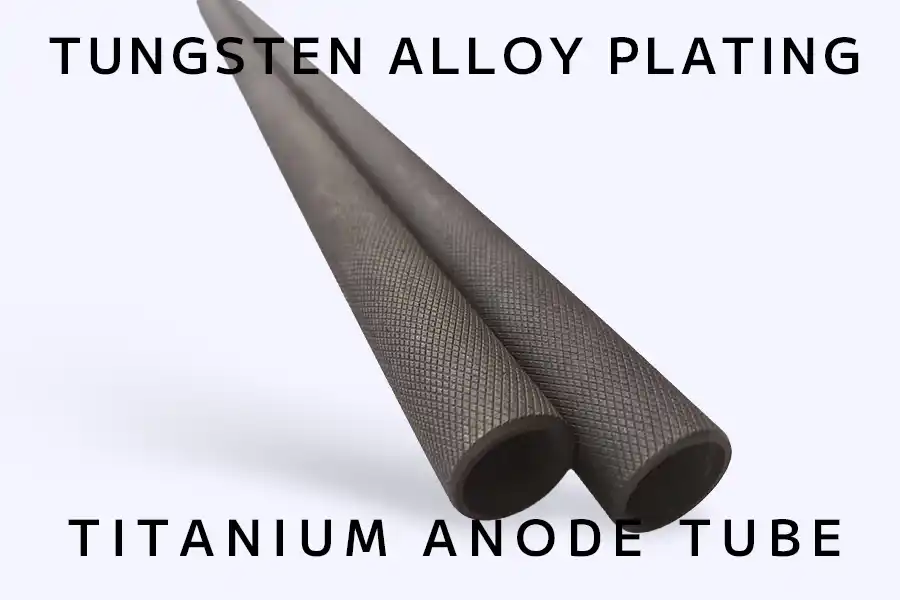
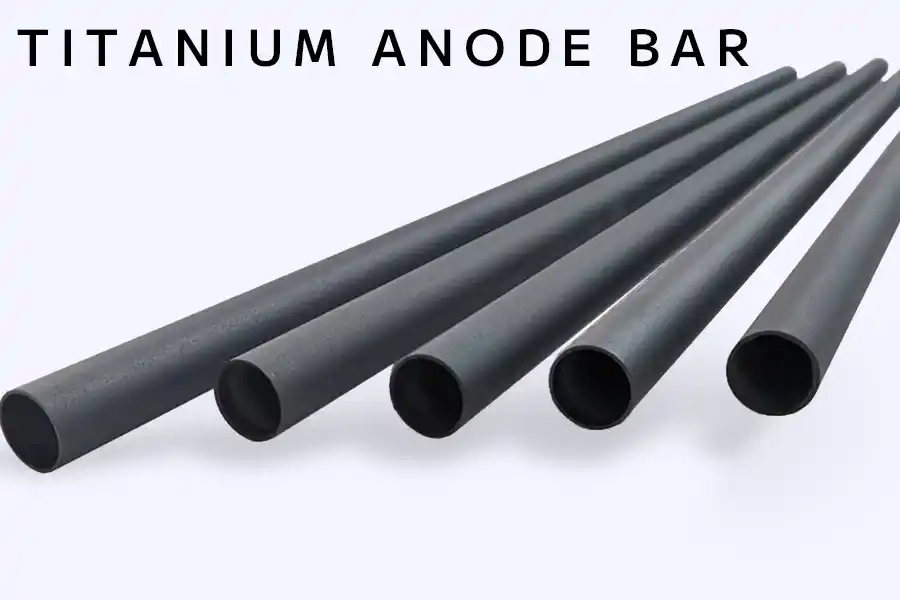
Titanium anode for tungsten alloy plating of tubing, casing, and drill pipe
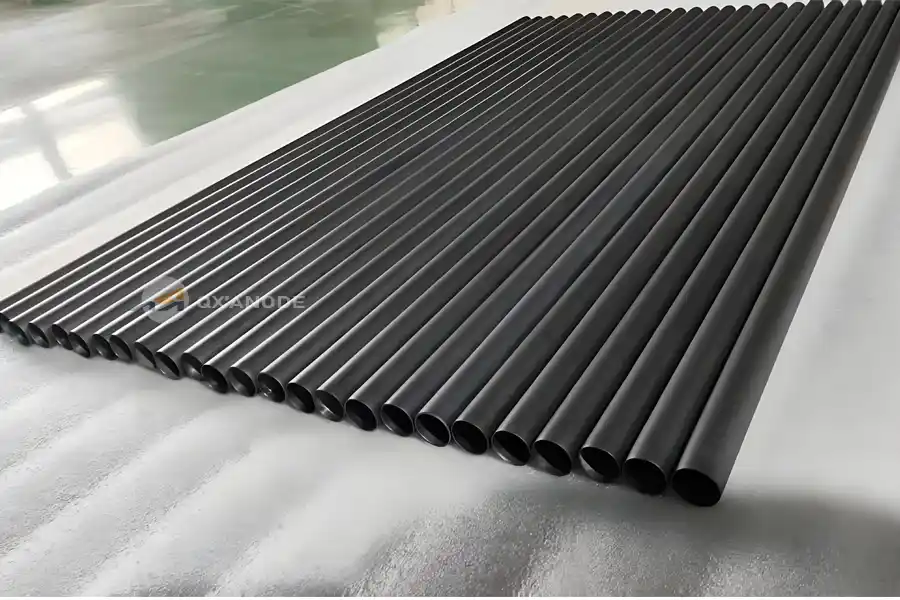
Suspended down the center of the pipe, the tube governs coating distribution along 9 to 13 meters of bore: it determines where the deposit builds thick, where it runs thin, and how many joints must be stripped and re-run. Each tube is therefore built to the pipe actually in service, in Grade 1 or Grade 2 titanium bar, with a coating matched to your nickel-tungsten bath and an active length up to 12.9 m.
Quick answer
What a titanium anode tube does in a tungsten alloy plating line
A titanium anode tube for tungsten alloy plating is an insoluble, dimensionally stable anode suspended inside oilfield tubing, casing, or drill pipe while a nickel-tungsten layer is electrodeposited on the bore. It is the counter-electrode of the cell: it carries the anodic reaction, oxygen evolution, and it sets how evenly current reaches the wall over 9 to 13 m of pipe.
The tube is specified by four numbers: tube diameter, active length, coating load, and current density. Those four decide coating uniformity, cell voltage, and how much charge the coating can pass before it needs recoating.
- Product
- Coated titanium anode tube, insoluble and dimensionally stable
- Substrate
- Titanium Grade 1 (UNS R50250) or Grade 2 (UNS R50400) tube
- Coating
- Iridium-tantalum MMO, 8 to 25 g/m², verified by XRF
- tube diameter
- 16 to 48 mm, sized to the nominal bore
- Pipe sizes served
- Nominal ID 50.7 to 124.3 mm, from 2-3/8 in. tubing to 5-1/2 in. casing
- Active length
- Up to 12.9 m in one piece; longer strings built in sections
- Construction
- Solid bar to about 4 m; copper-cored or two-end feed above
- Quotation
- 12 hours from a pipe spec or drawing
The anode is the part of the cell you cannot fix later
Process attention usually falls on bath chemistry, applied current, and plating time. In practice, coating distribution along a twelve-meter bore is governed by the titanium tube suspended down its center.
Tungsten alloy plating, often shortened to W-alloy plating, electrodeposits a nickel-tungsten layer, typically with micron-scale carbide particles co-deposited, to form a hard, corrosion-resistant alloy surface on the steel substrate. For tubing, casing, and drill pipe, the layer is applied to the inner wall because that is the surface exposed to downhole attack: CO₂ and H₂S in the produced fluid, chloride brine, and, in tube-pumped wells, the continuous abrasion of a coupling traveling the same nine meters of pipe day after day.
The cell itself is a simple assembly: a steel tube 9 to 13 meters long, a bath tank, a rectifier, and an anode suspended on a hanger down the center of the tube. Yet almost everything that governs coating quality is determined by that last component, and by how squarely it sits within the bore.
Consider 2-7/8 in. tubing, 6.5 lb/ft, with a 62.0 mm nominal ID and a 20 mm tube. Centered, the tube leaves a 21 mm gap on every side. Displace it 10 mm off center and one side must be bridged by 31 mm of electrolyte while the other is reduced to 11 mm: the near side plates heavy, the far side runs thin, and the joint fails the thickness check, with the same bath, the same rectifier, and the same plating time.
Annular gap in millimeters for the same pipe, tube, and bath. A 10 mm centering error leaves one gap nearly three times the other; the thickness check finds the shortfall at the far end of the joint.
-
REASON 01
Throw and gap
Current leaves the tube, crosses the electrolyte, and lands on the wall, with path resistance rising as both the gap width and the distance from the current feed increase. On a 12 m joint, the far end therefore always plates leaner than the head end; the effect is compensated for by adjusting active length or tube diameter, or by adding a second feed at the bottom.
-
REASON 02
Gas that will not leave
In an acidic Ni-W electrolyte the anodic reaction is oxygen evolution. Bubbles that stay attached to the coating remove active area from the circuit and push current into the adjacent patch. This is one mechanism behind banded deposits: full thickness at the head end, thin rings wherever gas was trapped.
-
REASON 03
Geometry that does not move
A soluble nickel anode dissolves into a shape no one designed, and the annular gap changes with it. A coated titanium anode holds its diameter for the life of the coating, so the gap set on day one is still the gap on day four hundred. That dimensional stability is why dimensionally stable anodes (DSA) became the standard in this type of cell.
-
REASON 04
The bath, not the well
The tube must first survive the bath. Depending on the complexing system, Ni-W electrolytes range from strongly acidic to mildly alkaline, and any pinhole in the coating becomes a pathway to the underlying titanium. Once the substrate is exposed, it passivates, cell voltage rises, and the tube has to come out and be stripped.
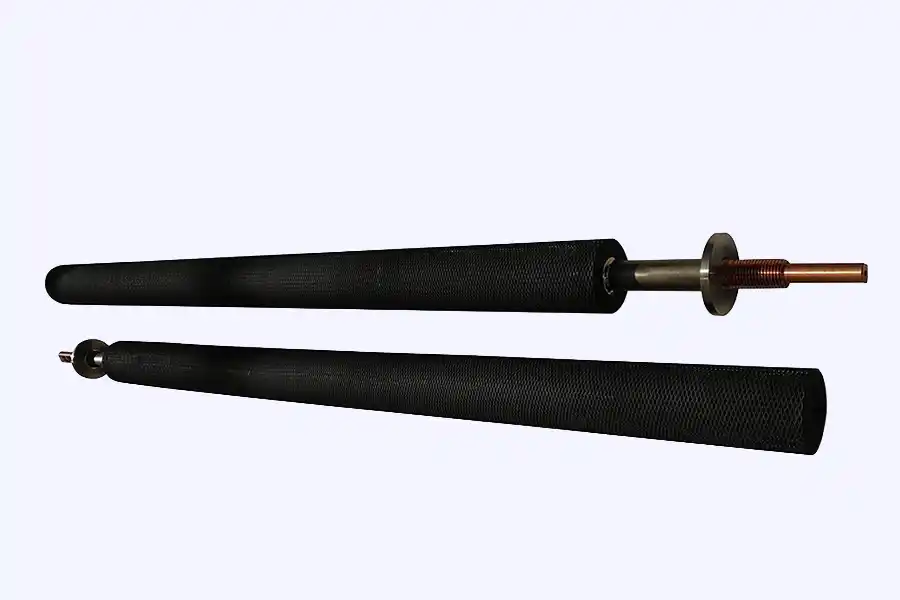
Five parameters remove the guesswork: pipe ID, joint length, bath pH and chloride concentration, target coating thickness on the wall, and the rectifier current rating. With those supplied, the tube is sized rather than estimated. Our guide to choosing coated titanium electrodes covers the coating side of the same decision.
Sizing a tube to a bore
Nominal API dimensions and the starting tube diameter for each size. Treat the resulting gap as a starting point rather than a fixed rule.
| Tubular | OD (mm) | Nominal ID (mm) | Tube OD (mm) | Gap per side (mm) |
|---|---|---|---|---|
| Tubing 2-3/8 in., 4.7 lb/ft | 60.3 | 50.7 | 16 to 20 | 15.4 to 17.4 |
| Tubing 2-7/8 in., 6.5 lb/ft | 73.0 | 62.0 | 20 to 25 | 18.5 to 21.0 |
| Tubing 3-1/2 in., 9.3 lb/ft | 88.9 | 76.0 | 25 to 30 | 23.0 to 25.5 |
| Casing 4-1/2 in., 12.6 lb/ft | 114.3 | 100.5 | 32 to 38 | 31.2 to 34.2 |
| Casing 5-1/2 in., 17 lb/ft | 139.7 | 124.3 | 40 to 48 | 38.1 to 42.1 |
| Drill pipe 2-7/8 in., 10.40 lb/ft | 73.0 | 54.6 | 18 to 22 | 16.3 to 18.3 |
| Drill pipe 3-1/2 in., 13.30 lb/ft | 88.9 | 70.2 | 24 to 28 | 21.1 to 23.1 |
| Drill pipe 5 in., 19.50 lb/ft | 127.0 | 108.6 | 34 to 40 | 34.3 to 37.3 |
Nominal dimensions per API 5CT and API 5DP. Confirm the actual ID from the mill certificate for the joints on your line: wall tolerance shifts the bore, so a heavy-wall joint will not accept the same tube as the standard-weight joint listed above.
What moves the number
- Bath conductivity. A lean or cold bath develops a higher voltage drop per millimeter of gap, and therefore calls for a larger tube or a shorter active length.
- Rectifier headroom. When the supply is already near its voltage limit, more tube area delivers more benefit than more current.
- Rated current density of the coating. A tube oversized for the applied current runs below its rated band and wastes coating metal; an undersized tube running above it fails early.
- Suspension method. A hanger that secures the top while letting the bottom sag produces a tapered gap, whatever the drawing says.
What we need from you
- Pipe: OD, wall, grade, range length, end finish.
- Bath: chemistry family, pH, chloride, temperature.
- Electrical: rectifier rating, amps per joint, one-end or two-end feed.
- Target: coating thickness on the wall, and whether the pin end is masked.

How the tube is built
The same shop and the same sequence apply whether the order is a 600 mm bench tube or a 12.9 m string for Range 3 casing.
Bar stock and machining
Grade 1 bar is selected where conductivity and formability are critical; Grade 2 where the tube must withstand rack handling. The bar is turned, straightened, and cut to the active length plus a dead zone at each end. Threads, studs, flats, and cable cavities are all machined before coating, because machining a coated tube afterwards would expose bare titanium exactly where damage does the most harm.
Solid or copper-cored
Solid bar is used up to roughly 4 m. Beyond that length, longitudinal resistance begins to concentrate current at the fed end. A copper core inside a welded titanium sheath flattens the voltage profile along the full length; two-end feed reaches the same result with a solid bar and a second cable.
Surface preparation
Degreasing, blasting, and pickling determine adhesion on titanium; the coating booth cannot correct deficiencies at this stage. A tube handled with bare hands after blasting will develop a coating that lifts at the first thermal cycle.
Coating application
Precursor solution is applied along the active length and calcined, pass after pass, until the specified load is reached. Threads, studs, and joint faces are masked so the coating stops where the hardware begins. Coating loads range from 8 to 25 g/m² depending on duty.
Inspection
Coating weight is verified by XRF against the certificate, dimensions are checked, adhesion is assessed by bend or tape-pull testing, and an accelerated life test is run in an electrolyte matching the customer bath. Results ship with the tube.
Packing for a long tube
Tubes over 6 m ship in wooden crates with internal supports, capped ends, and wrapped coatings. Straightness on arrival matters more than most packing specifications admit.
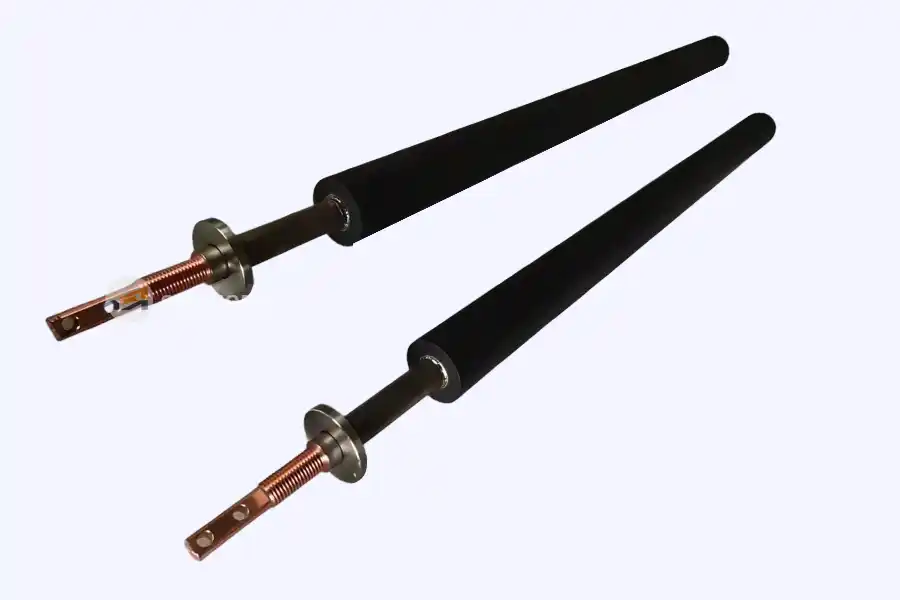
Centering spacers in PTFE, PVDF, or titanium, sized to the bore and spaced so the tube cannot sag into the wall; bottom guides for vertical suspension; and cable assemblies potted in epoxy with the copper conductor kept out of the bath.
If your line already has bare titanium bars, we strip, re-blast, and recoat them. Details are on our manufacturing services page, and the laboratory behind the coating certificates is described under R&D and testing.
For formats other than tube, see titanium tube anodes, which give more surface area per meter on long strings.
The coating: iridium-tantalum (Ir-Ta) MMO, and only that
In tungsten alloy plating of oilfield tubulars, anode tubes are coated with iridium-tantalum mixed metal oxide (Ir-Ta MMO). The other coating families sold for titanium anodes, Ru-Ir, platinized titanium, and PbO2, are not used in this application.
Why Ir-Ta is the coating specified for this cell
The reaction at the anode in an acidic nickel-tungsten electrolyte is oxygen evolution. Ir-Ta MMO is the oxygen-evolution coating: iridium oxide supplies the catalytic activity and tantalum oxide stabilizes it against the aggressive bath. On a tungsten alloy plating line it delivers the combination the process needs, namely a low and stable overpotential, dimensional stability for the life of the coating, and no metal ions released into the electrolyte.
The other three coating families are not used here, for reasons specific to this cell. Ru-Ir MMO is a chlorine-evolution coating; in a low-chloride plating bath it adds little and burns back at the tube ends. Platinized titanium suits short campaigns or pilot cells where voltage headroom is the binding constraint, not continuous production. PbO₂ works well in strong acid but raises dissolved-lead contamination concerns for the deposit on the pipe wall. None of the three is specified for tungsten alloy plating of tubing, casing, or drill pipe.

| Property | Value |
|---|---|
| Active catalyst | Iridium oxide (IrO2) stabilized with tantalum oxide (Ta2O5) |
| Governing reaction | Oxygen evolution (OER) in the acidic Ni-W electrolyte |
| Coating load | 8 to 25 g/m², matched to duty |
| Service criterion | Charge passed (amp-hours), not calendar time |
| End of life | Strip and recoat the same titanium bar |
Coating load is verified by XRF against the certificate shipped with each tube. If OER is a new term, the anode glossary defines it in a paragraph.
What the finished coating does for the well, and what it does not
Most readers of this page buy the tube in order to coat the pipe. Here is a frank account of what the layer delivers downhole.
What it does
What it does not do
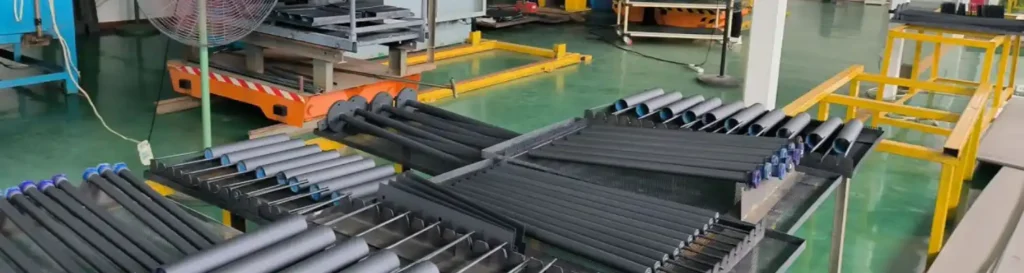
Where the tube sits in your line
The sequence most coating plants follow, and the two points at which the anode decision shows up in the scrap count.
-
STEP 01
Incoming pipe
Drift, straightness, and ID gauging. A joint that is already oval will coat unevenly whatever tube goes into it.
-
STEP 02
Degrease
Alkaline soak followed by electro-cleaning. Mill oil and rust preventive must be gone before any later step.
-
STEP 03
Rinse and pickle
Acid activation followed by rinsing to neutral. Adhesion is settled at this stage.
-
STEP 04
Hang the tube
Center the tube and check the gap at both ends with a feeler gauge before energizing the rectifier. A tube centered at the head but sagging at the bottom will coat one side of the joint while passing inspection on the other.
-
STEP 05
Plate
Current applied, gas cleared from the tube, bath in motion. Watch cell voltage: a step change mid-run usually means coating loss, not a bath problem.
-
STEP 06
Drag-out rinse
Recover the solution carried out on the joint; this protects the bath and keeps rinse water inside discharge limits.
-
STEP 07
Neutralize, rinse, and dry
Bring the joint into the pH window of the process specification, rinse to the required conductivity, and dry. The plated layer is complete at this stage; the inspection that follows is the acceptance gate.
-
STEP 08
Inspect and protect
Thickness, adhesion, hardness, and pinhole checks, then thread caps and a mill tag; bundle the joints and keep them off bare ground.
What ships with each tube
Every tube ships with a certificate that ties each value to its test method, rather than a pass stamp alone.
| Check | Method | What it catches |
|---|---|---|
| Coating load | XRF, reported in g/m² | Under-loaded bands that fail months early while the rest of the tube is still sound |
| Adhesion | Bend test, tape pull | Surface preparation that looked clean but was not |
| Dimensions | OD, length, straightness | A tube that will not center, or will not enter the bore at all |
| Continuity | Visual and electrical check along the active length | Exposed bare titanium, which passivates on first contact with current |
| Service life | Accelerated run in the target electrolyte | A coating system mismatched to your bath, found before a year of service is committed |
The failure modes behind these tests are covered in MMO coating failure and maintenance, which is worth reviewing before you specify a recoat interval.
Ordering a tube
Send the pipe specification and bath data; you get a sized tube, a coating recommendation, and a price, usually within 12 hours.
- Tubular drawing or specification sheet. OD, wall, grade, range length, end finish, and whether the joint is tubing, casing, or drill pipe.
- Bath data. Chemistry family, pH, chloride concentration, operating temperature, and agitation method.
- Electrical data. Rectifier rating, amps per joint, and single-end or two-end feed.
- Coating target. Wall thickness target, coating system if already specified, and which ends are masked.
- Handling. How the tube is suspended and withdrawn, and whether it returns to a rack or a crate.
A sized tube drawing, a coating recommendation with its reasoning, a certificate schedule, and a unit price. If a tube anode or a segmented string suits your line better than a single tube, the reply says so.
tubes are manufactured in Baoji and shipped worldwide. Lead time is quoted with the drawing, because a 12.9 m tube is as much a freight decision as a manufacturing one.
Send your drawing through the contact form or email info@mmo-anode.com.
Questions we get on these tubes
Straight answers, including the ones that end with us telling you not to buy something.
Can a coated titanium tube be used in a nickel-tungsten plating bath?
Yes. An insoluble coated titanium anode is the usual choice when fixed geometry and a bath free of anode sludge are required. Nickel is replenished as salt rather than from a dissolving anode, so bath analysis has to carry the nickel balance. If the process depends on a soluble nickel anode to hold nickel concentration, keep the soluble anode and use titanium only where geometry matters more than metal balance.
What is tungsten alloy plating?
Tungsten alloy plating is the electrodeposition of a hard, corrosion-resistant nickel-tungsten layer, typically with micron-scale carbide particles co-deposited, onto the inner wall of oilfield tubing, casing, and drill pipe. The titanium anode tube suspended inside the pipe is the counter-electrode; it controls how evenly the layer deposits along the 9 to 13 meters of bore.
Why is iridium-tantalum (Ir-Ta) the only coating used on anode tubes for tungsten alloy plating?
Because the reaction at the anode in the acidic nickel-tungsten electrolyte is oxygen evolution, and Ir-Ta MMO is the oxygen-evolution coating. Ru-Ir is a chlorine-evolution coating that adds little in this bath and burns back at the tube ends; platinized titanium is kept for short campaigns with tight voltage headroom; and PbO2 raises dissolved-lead contamination concerns for the deposit. Ir-Ta is therefore the coating specified for anode tubes in tungsten alloy plating of oilfield tubulars.
How long does the tube last in a plating line?
Service life is a function of charge passed, not calendar time; it depends on coating load, current density, and how often the tube runs dry or gets scratched. Load is sized against actual operating hours, and once the coating is spent the same bar is stripped and recoated. The titanium substrate itself does not wear out.
What is the longest tube you can make?
12.9 m in one piece, which covers Range 3 tubing and most Range 3 casing; drill pipe at 9.14 m or 9.45 m falls well inside this limit. Above 12.9 m, a two-section tube is built with a masked joint kept outside the bath, because an uncoated joint inside the active length is exactly where coating failure starts.
Solid bar or copper-cored?
Solid Grade 2 bar is standard to about 4 m. Beyond that, longitudinal resistance skews current toward the fed end, and a copper core flattens the profile. With two-end feed, a solid bar stays viable longer than most people expect. Both options are quoted on the same drawing so the trade-off is visible.
Can you recoat tubes we already own?
Yes, provided the substrate is sound. We strip, re-blast, re-pickle, and recoat, and we will tell you when a bar is too pitted to justify recoating. Recoating usually costs less than a new tube and always takes less lead time.
What kills these tubes fastest?
Three factors, roughly in order of frequency: exposed titanium from handling damage, operation above the rated current density of the coating, and a bath whose chloride or fluoride level the coating was never selected for. All three show up as a rising cell voltage before they show up as coating defects, which is why the voltage log matters more than visual inspection.
Do you also supply the coated pipe?
No. We make the anode, the titanium hardware, and the anode coating; pipe coating is done by tubular service companies. We quote tubes against their line drawings or yours, and we will say plainly when a different anode format suits the cell better.
Keep reading
The pages that answer the next question, in the order people usually ask it.
- The Titanium Anode GuideSubstrate, coating, service life, from first principles.
- How to choose coated titanium electrodesMatching a coating to a duty cycle instead of a catalog page.
- MMO coating failure and maintenanceHow coatings die, and when recoating is the cheaper answer.
- Handling and operating precautionsWhat not to do to a coated anode between the crate and the tank.
- All titanium anode typesRod, tube, plate, wire and mesh, side by side.
- Anodes for electroplatingThe wider plating catalog this tube belongs to.
Send the pipe spec. We will size the tube.
One drawing and five parameters are enough to return a tube diameter, a coating system, and a price. If the data point to a different format, we say so.