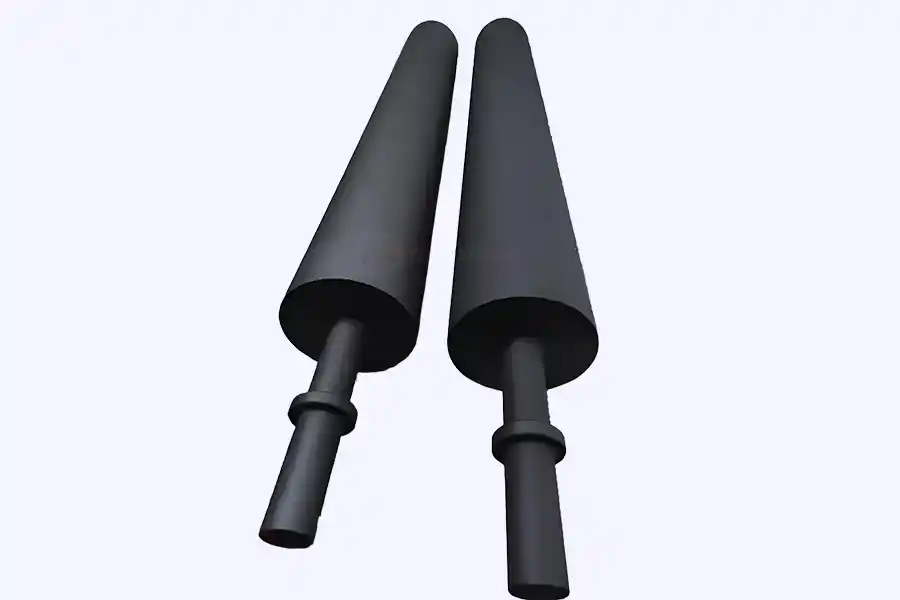
Cathodic electrodeposition · anode cells
IrO₂–Ta₂O₅ on Grade 1 titanium, built for the acidic, oxygen-rich anolyte inside a CED anode cell. Plates, tubes and mesh panels made to your drawing, with coating loading matched to the current density your tank actually runs.
10 to 40 g/m²
Coating loading
10–40 g/m²Coating loading20–30 g/m² is the usual band for CED duty
10 to 30 A/m²
Design current density
Continuous; 40 A/m² short-term
1 to 3 years
Typical service life
In a maintained cell with fluoride controlled
12 hours
Quote turnaround
Drawing or spec sheet in, priced offer out
Overview
What a titanium anode does in an e-coat tank
In cathodic electrophoretic coating the car body is the cathode. Paint particles carry a positive charge, migrate to the body and deposit there. The anodes hang in cells along the tank walls and close the circuit.
The reaction at the anode is water oxidation: 2H₂O → O₂ + 4H⁺ + 4e⁻. Oxygen leaves, acid stays. That is why the anolyte in a CED line sits at pH 2 to 4, and why the anode works in a harsher environment than anything else in the tank.
An MMO titanium anode is a dimensionally stable anode. The titanium substrate carries current to the surface; the mixed metal oxide coating does the electrochemistry. Titanium is not consumed by the reaction. The coating is, slowly, for as long as the anode is energized. Nearly every specification decision, from coating chemistry and loading to current density and geometry, comes back to that one fact.
- Substrate
- Grade 1 titanium (ASTM B265, GB/T 3621); 1 to 3 mm sheet or 0.8 to 1.5 mm tube wall
- Coating
- IrO₂–Ta₂O₅, 70:30 molar, applied in multiple thermal decomposition passes
- Loading
- 10 to 40 g/m² of iridium and tantalum; 20 to 30 g/m² typical for CED
- Formats
- Plate, tube, mesh and rod, made to drawing
- Connection
- Titanium stem or hanger; copper core for high-current rods
- Service life
- 1 to 3 years typical, set by current density, fluoride and cell maintenance
Cell design
An anode is only as good as the cell around it
Most premature failures we are asked to diagnose are cell problems that show up on the anode. These are the parts that decide whether a five-year plate reaches five years.
The membrane
A cation-exchange membrane separates anolyte from paint. Acid made at the anode stays inside the cell; phosphate and fluoride dragged in from pretreatment stay out of the bath. A torn membrane usually shows up as falling paint pH and a run of defects on the body weeks before anyone looks at the anode.The anolyte loop
Circulated, filtered and cooled. Most lines hold pH 2 to 4 and conductivity below 700 µS/cm. Log both, and log fluoride separately: it is the most common reason a titanium anode dies years early.Anode-to-body distance
200 to 400 mm is the working range. Closer improves throw into cavities but concentrates current on the nearest panel. Further out evens film build and asks more voltage from the rectifier. Both ends of that trade-off are visible in film thickness surveys.Insulation and busbars
Stems, hangers and busbars are insulated from the frame. A stray earth path steals current and turns one plate into a hot spot; that plate usually fails first, at the hanger end, where the coating is hardest to keep intact.Coverage
Anodes on both sides, and on some lines along the floor, so roof rails and rocker panels see current. Uneven anode spacing is a routine cause of thin film in door apertures and wheel arches.Retrofit geometry
Replacing graphite or lead in an existing cell? Match the frame before anything else. Send the old drawing or the box dimensions. Mounting is usually the part that decides whether a retrofit fits without cutting the tank.
Coating selection
Why IrO₂–Ta₂O₅, and not ruthenium oxide
Ruthenium oxide is a chlorine catalyst. It belongs in chlor-alkali and hypochlorite plants, where the anode reaction is chloride to chlorine. An e-coat cell runs the other reaction.
There is almost no chloride in a CED anolyte. The reaction is oxygen evolution in acid, and ruthenium oxide dissolves quickly under it. Iridium oxide is stable in that duty, and tantalum oxide holds the iridium in a fine-grained matrix that slows the coating loss which eventually ends the anode’s life.
Loading is the other half of the specification. More grams per square metre buys more years, but past roughly 40 g/m² the gain flattens and each extra layer adds bake cycles that can introduce mud-cracking. For 10 to 30 A/m² CED duty, 20–30 g/m² is the band that balances life against cost.
Coating options for an e-coat anode cell, compared on the reaction they are built for.
| Coating | Reaction it suits | Anolyte it tolerates | Fit for CED | What to watch |
|---|---|---|---|---|
| IrO₂–Ta₂O₅ | Oxygen evolution | pH 2–4, sulfate, phosphate | Standard choice | Coating loss at high current density; fluoride attack through pores |
| RuO₂–IrO₂ | Chlorine evolution, some oxygen | Chloride-rich, near neutral | Not recommended | Ruthenium dissolves quickly under oxygen evolution |
| Pt/Ti | Oxygen or chlorine | Mild acid, neutral | Small cells, touch-up work | Platinum migrates at high oxygen-evolution potential; cost per square metre |
| PbO₂ | Oxygen evolution | Strong acid | Legacy installations | Lead in the paint shop; being phased out on most new lines |
| Graphite / 316L | — | — | Legacy | Sludge, dimensional wear, iron and carbon contamination of the bath |
Specifications
What we build, and the tolerances we hold
The values below describe what we make most often for CED lines. They are starting points, not a catalogue limit: loading and geometry are set per order against your line data.
Typical build for an automotive electrophoretic coating anode. Confirm final values on the quotation drawing.
| Parameter | Typical value | Notes |
|---|---|---|
| Substrate | Grade 1 titanium (ASTM B265, GB/T 3621) | Grade 2 on request; 1 to 3 mm sheet, 0.8 to 1.5 mm tube wall |
| Surface preparation | Degrease, blast, oxalic acid etch | Etch depth and rinse conductivity recorded per batch |
| Coating | IrO₂–Ta₂O₅, 70:30 molar | Multi-pass thermal decomposition, each pass baked |
| Coating loading | 10 to 40 g/m² | 20 to 30 g/m² typical for 10 to 30 A/m² CED duty |
| Current density | 10 to 30 A/m² continuous | 40 A/m² short-term; confirm against rectifier capacity |
| Cell voltage | 200 to 400 V DC | Set by line design and paint, not by the anode |
| Bath temperature | 25 to 45 °C | CED baths usually run 28 to 32 °C |
| Anolyte pH | 2 to 4 | Up to 6 on some lines; fluoride must be controlled either way |
| Formats | Plate, tube, mesh, rod | Slotted, tabbed or drilled to suit your frame |
| Connection | Titanium stem or hanger | Copper core for high-current rods; leak tested before coating |
| Tolerance | ±0.5 mm on plate; ±0.2 mm on hole position | Measured on a sample from every batch |
| Expected life | 1 to 3 years | Driven by current density, fluoride and cell maintenance |
Most common
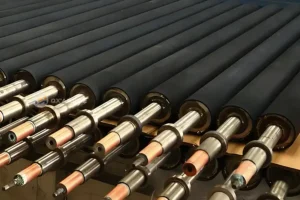
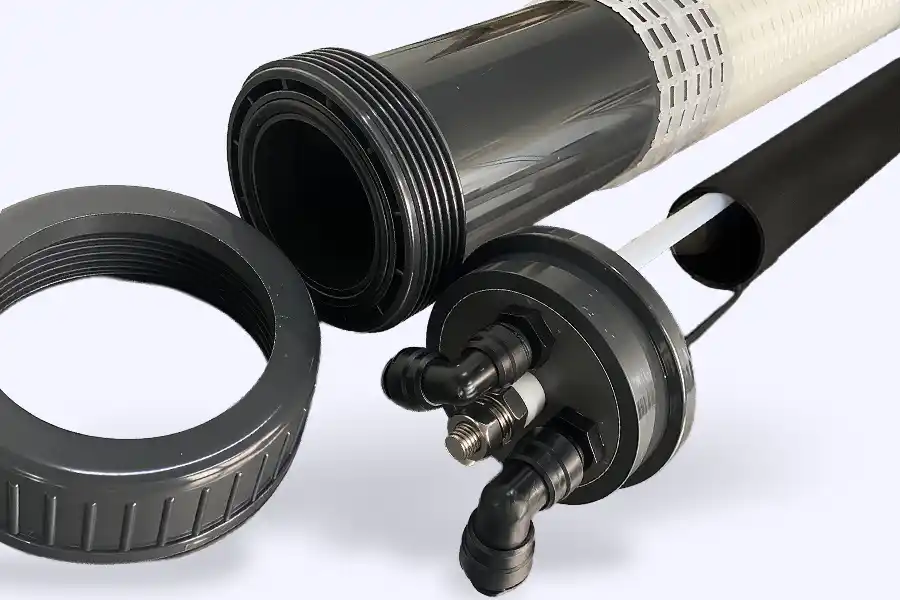
1 to 3 mm sheet, typically 300 to 1000 mm wide and up to 2000 mm long. Slotted or tabbed to drop into an existing frame. The default for car bodies and large panels.
Confined zones
Ø32, 50 or 60 mm, 2 to 3 mm wall. Used for roof and floor anodes, narrow cells, and lines where a flat plate would foul the conveyor.
High area
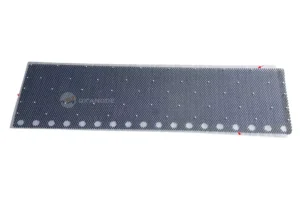
Expanded or woven titanium. More geometric area in the same footprint, so real current density drops. Chosen for wide flat panels and where weight matters.
Interior
Solid or copper-cored. Auxiliary anodes for cavities, interior anodes, and pilot cells. Copper-cored versions are pressure tested before coating.
Service life
What actually shortens anode life
Anodes rarely fail from old age. They fail from one of five things, and four of them leave a trace in the cell log before the plate comes out.
Fluoride in the anolyte
Zirconium and titanium conversion coatings, and some pretreatments, drag fluoride into the cell. It attacks titanium through pores in the coating, and it can take a plate out in a fraction of its expected life. If fluoride is climbing, fix the rinse before blaming the anode.Running above design current density
Coating consumption follows charge passed, and the rate accelerates as current density rises. A plate designed for 30 A/m² pushed to 45 buys throughput and pays for it in coating life.Mechanical damage
A scratch through to bare titanium becomes a corrosion pit, and the coating around it lifts. Most of this happens during installation and handling, not in service. Edge protection in packing is cheaper than recoating.Membrane and cell faults
A torn membrane or a blocked anolyte line shifts pH and current distribution. One plate in the box ends up doing the work of three, and it fails long before its coating should.Paint solids and dry-out
Plates pulled for maintenance and left wet with paint solids bake an insulating film onto the coating. Voltage climbs, hot spots form, and the damage is permanent. Rinse and dry before storing.
What to log, and how often
- Weekly: cell voltage at fixed current. A 10% rise at constant current is the earliest warning you get.
- Monthly: anolyte pH, conductivity and fluoride. Trend them, do not just check the limit.
- Every shutdown: visual inspection of plates, hangers and membrane frames. Photograph and date.
- Always: keep one spare plate per cell. Swapping a plate takes half an hour; recoating takes weeks.

Quality and ordering
What we test, and what we need from you
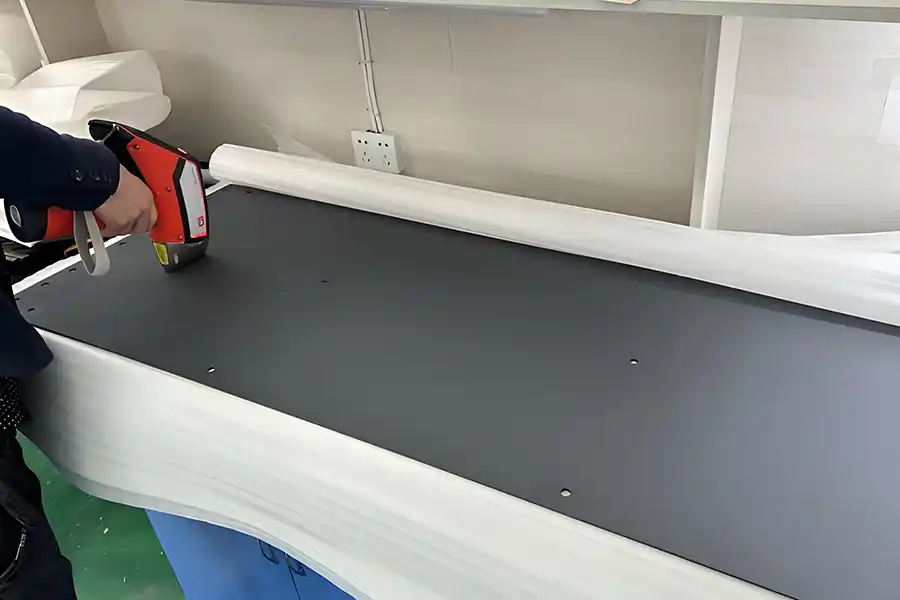
Coating loading is invisible on a finished plate, so it is checked by instrument and recorded by batch. Every anode leaves with a batch number that traces back to its coating run.
Checks on every batch
What we need to quote
Questions
Answers for paint shop and purchasing teams
Which coating should I specify for a cathodic e-coat line?
IrO₂–Ta₂O₅, at 20 to 30 g/m² for a line running 10 to 30 A/m². The anode reaction in a CED cell is oxygen evolution in acid, and iridium oxide is the coating that survives it. Ruthenium-based coatings are built for chlorine evolution and are consumed quickly in this duty.
How long will the anodes last?
One to three years is the typical range, and a well-maintained cell with fluoride under control can push a plate toward five. The spread comes from current density, coating loading, anolyte chemistry and how often the cell is inspected. Two lines with identical anodes can differ by years on those four variables alone.
Can these replace graphite or lead anodes in an existing cell?
Yes, and it is usually a straightforward swap. The constraints are mechanical, not electrical: the plate has to fit the frame you have, and the rectifier has to have enough voltage headroom for a dimensionally stable anode. Send the old drawing or the box dimensions and we will match the mounting.
Do you supply the anode boxes, membranes and anolyte loop?
We make the anode and its current collector to fit your existing frame. Membrane boxes, anolyte pumps and circulation pipework normally come with the tank or the line integrator, so we work to their dimensions rather than replacing them.
What information do you need to price a set?
A drawing or the frame dimensions, the number of plates per cell, rectifier voltage and current, and the anolyte chemistry if you have it.
A photo of the failed plate tells us more than you might expect: coating loss patterns tell us whether the problem was current density, fluoride or a cell fault.
Do you make single replacement plates?
Yes. Single plates for a pilot cell or a maintenance swap are quoted the same way as full tank sets. Tell us the quantity with the drawing and we will confirm price and lead time together.
How is coating loading verified?
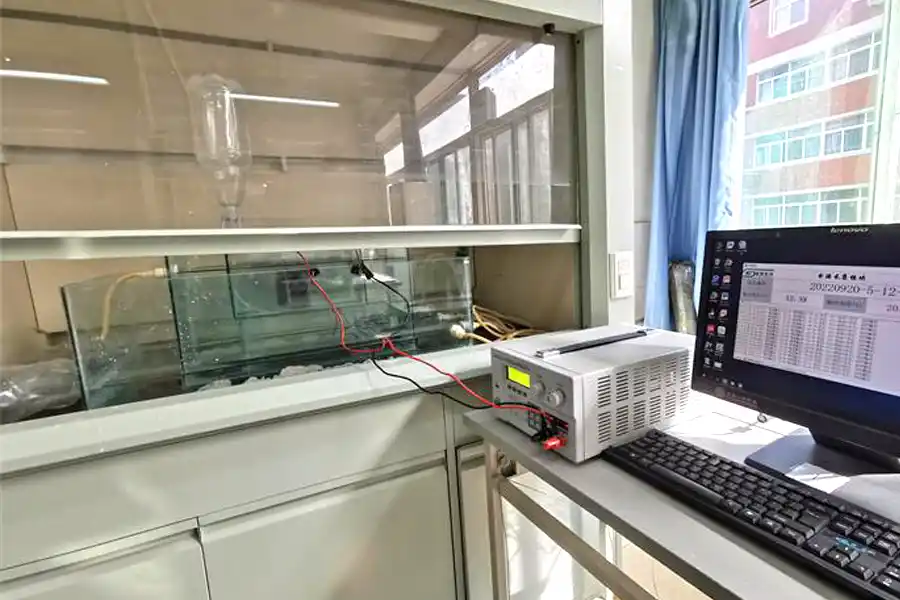
By X-ray fluorescence on both faces, sampled at several points across each plate, and recorded against the batch. A coupon from the same coating run goes into an accelerated electrolysis test, which gives a comparative life figure for that batch.
Do you ship to Europe and North America?
Yes. We have supplied anodes to more than 25 countries, including Germany, the United States and South Korea. Plates are packed with edge protection and shipped on pallets or in crates, with export documentation prepared for the destination.
Typical values on this page describe common automotive CED practice and are not a performance guarantee. Final coating loading, geometry and life expectations are confirmed against your line data on the quotation drawing.
Send a drawing, get a price in 12 hours
Tell us the tank, the rectifier and what the last set of anodes did before it failed. We will come back with a loading recommendation and a price, not a catalogue page. Drawings in DWG, DXF, PDF or a photo of the old plate all work.