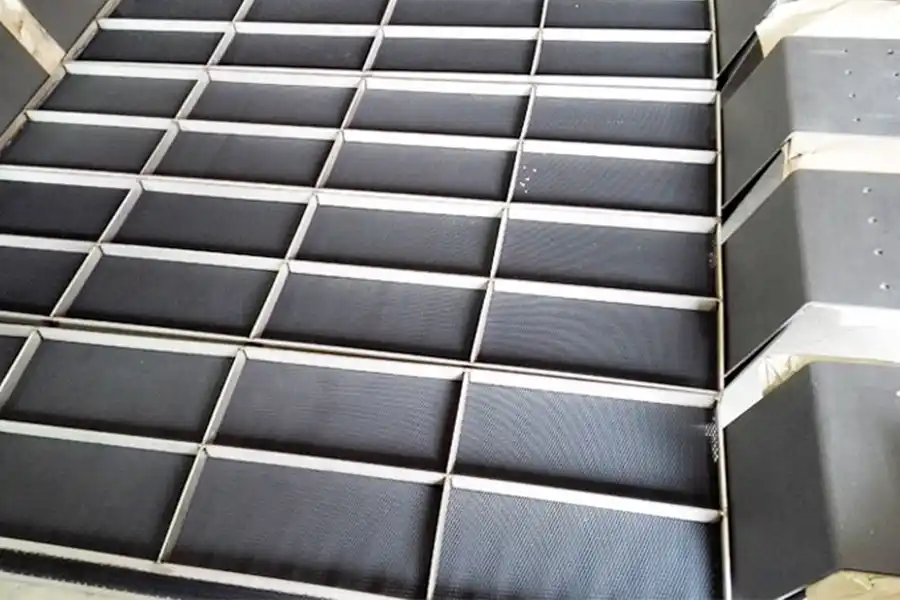
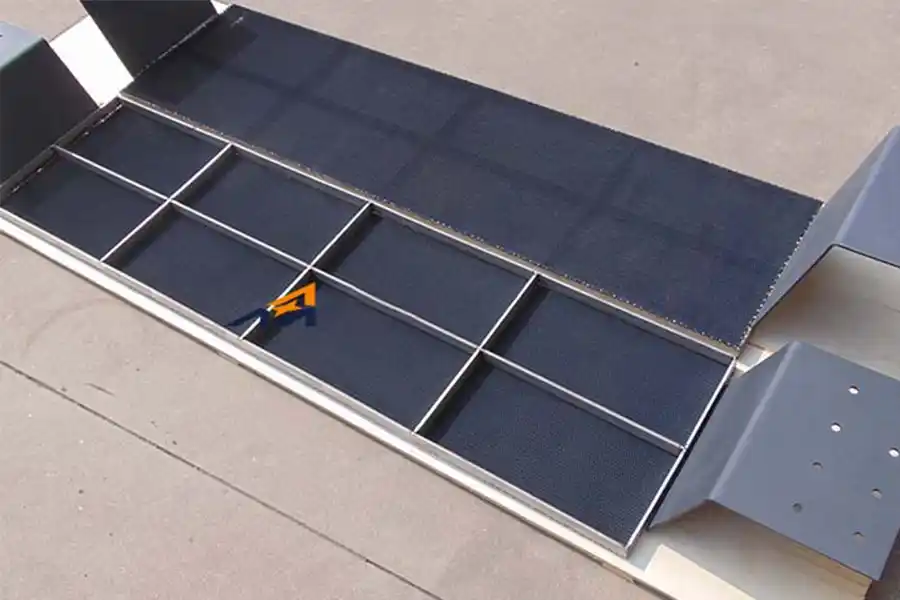
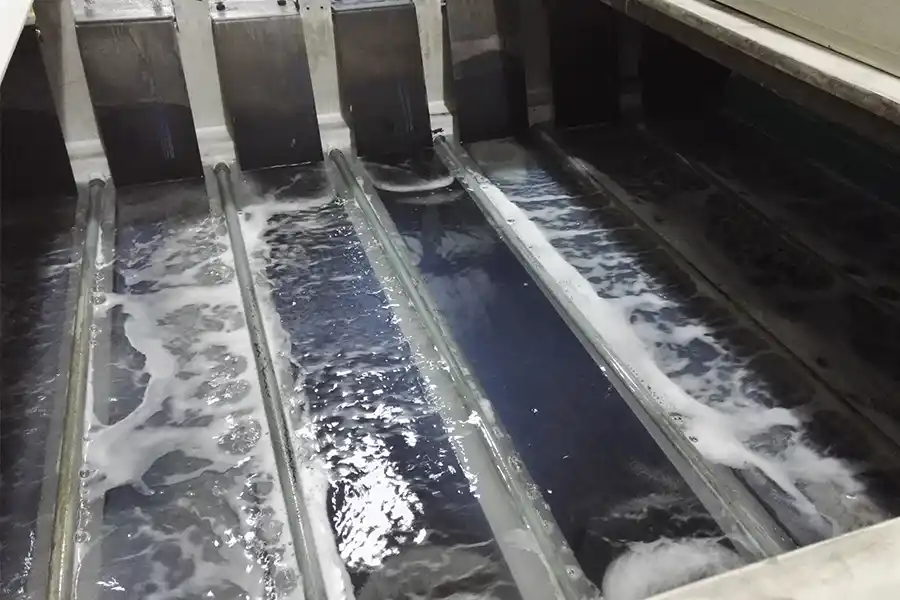
PS plate production treats an aluminum web twice before any photopolymer goes on. First an electrochemical graining stage builds the surface profile. Then a sulfuric acid anodizing stage grows the aluminum oxide layer the plate prints from. Both stages need insoluble electrodes that hold their gap, keep cell voltage flat, and stay out of the bath chemistry. Qixin builds them in Grade 1 titanium with an iridium-tantalum oxide coating matched to your acid, cut to your cell drawing.
In short: Ir-Ta coated titanium electrodes for the graining and anodizing stations of a PS plate line. Grade 1 titanium substrate, dimensions cut to your cell drawing. Reported service in PS plate anodizing duty runs to 1.2 to 1.5 million m² of plate per electrode before the coating is spent.
At a glance
| Substrate | Grade 1 titanium to ASTM B265, 1.0 to 3.0 mm sheet |
| Coating | Ir-Ta mixed metal oxide, oxygen evolution duty; bare titanium for cathodic positions |
| Coating loading | 8 to 25 g/m², set by current density and target coating life |
| Coating thickness | 8 to 15 µm |
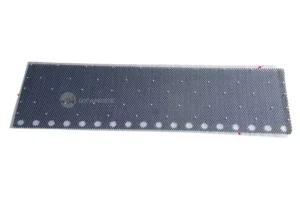
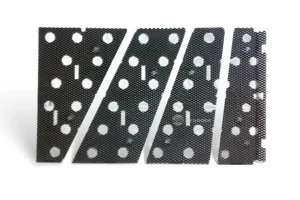
| Electrode form | Flat plate, expanded mesh, curved plate, rod, or tube |
| Size | Cut to drawing; single plates commonly up to 1,000 × 2,000 mm |
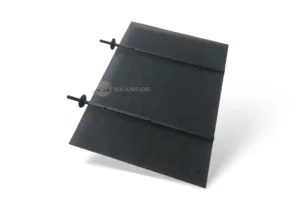
| Connection | Welded titanium tab, copper-cored tab, or threaded titanium stud |
| Internal cooling | Optional water channel for cells running at high current density |
| Recoating | Substrate stripped, re-etched, and recoated for a second service cycle |
| Quotation | Drawing or duty conditions answered within one business day |
Plate and mesh are the usual forms in a PS plate cell, both cut from the same Grade 1 stock to the same drawing tolerance: see titanium anode plate and MMO titanium mesh anode. If your line uses a different profile, the same coated surface is available on rod and tube stock.
Where the electrode sits in a PS plate line
A presensitized plate starts life as a thin aluminum coil. Before the photosensitive coating goes on, the web passes through two electrochemical stages, and the electrodes in those stages decide the surface the plate will print from.
Electrochemical graining. The degreased web runs through a mixed acid bath, usually hydrochloric acid with nitric acid, at 5 to 20 g/L and 20 to 60 °C. Alternating current or direct current dissolves aluminum from the surface and opens a fine, even grain. That grain carries the photosensitive layer and lets the non image area hold a water film during printing. Coarse grain holds water better, fine grain reproduces halftone dots better, and the line operator tunes the balance through current density and bath chemistry. Current density in this stage runs from 20 to 200 A/dm².
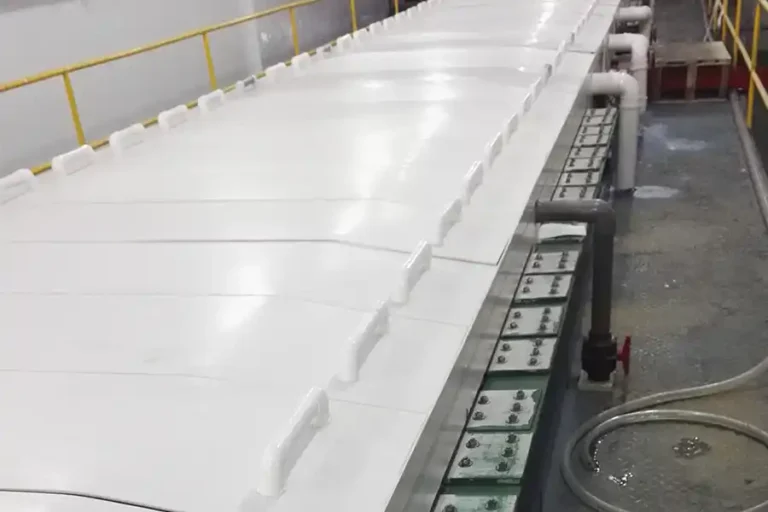
Anodizing. After a desmut and a rinse, the grained web runs through sulfuric acid and becomes the anode of the cell. Aluminum oxide grows on the surface to a controlled thickness. That oxide layer sets plate run length. More oxide prints longer, but an oxide that is too thick turns brittle and cracks under the blanket at press speed, which scums the plate. Most lines hold it inside a narrow window. Reported PS plate anodizing conditions sit near 30% sulfuric acid by mass at about 40 °C, with 7,000 to 10,000 A/m² at the plate.
Aluminum coil
0.15 to 0.30 mm web
Degrease
Alkali, then rinse
Graining
HCl + HNO₃, 20 to 60 °C
Desmut
Acid rinse
Anodizing
H₂SO₄, ~40 °C
Sealing
Hydrophilic finish
Photopolymer
Sensitized coating
Two electrochemical stages, marked in blue, are where coated titanium electrodes run.
The titanium electrode does two different jobs along this line, and they do not take the same surface treatment.
Electrode role by station
| Station | Electrode role | Reaction on the titanium | Surface |
|---|---|---|---|
| Graining | Anode facing the moving web | Chlorine and oxygen evolution, with polarity reversal on AC lines | Ir-Ta oxide |
| Anodizing | Cathode, with the aluminum web as the anode | Hydrogen evolution | Bare titanium |
One point is worth stating plainly, because it trips up a large share of anode inquiries. In the anodizing bath the anode is the aluminum web, not the titanium. The titanium electrode in that tank is the cathode, and it does not need a precious metal oxide coating to survive there. Coated titanium earns its cost in the graining cell, where the surface sits under oxygen and chlorine evolution at high current density and the coating is what holds cell voltage flat. Ask which electrode in the cell is actually anodic before you pay for a coating, and ask us for both positions if you want a single source.
Why the line runs Ir-Ta, not a ruthenium coating
A question that comes up on almost every PS plate inquiry: the graining bath is acidic and carries chloride, so why not a ruthenium based coating, which costs less per square metre and is more active for chlorine evolution? The answer is that a PS plate line is not a clean chlorine duty, and the failure shows up inside the first campaign.
Surface treatment by station in a PS plate line
| Station | Reaction at the titanium | Surface | Reason |
|---|---|---|---|
| Graining, mixed acid | Chlorine and oxygen evolution, with polarity reversal on AC lines | Ir-Ta oxide | Iridium oxide is the stable phase when oxygen evolution runs alongside chlorine and when the electrode swings into cathodic polarity. It holds the duty for years. |
| Anodizing, sulfuric acid | Hydrogen evolution, the web is the anode | Bare titanium | Titanium is already an excellent cathode in this chemistry. A coating here adds cost without adding life. |
| Any bath with free fluoride | Substrate attack | Not suitable | Free fluoride above roughly 50 mg/L attacks the titanium substrate itself under anodic load, whatever the coating. Platinized niobium is the substitute. |
Three things sink a ruthenium oxide layer in this application. Under oxygen evolution the ruthenium phase over-oxidizes and dissolves, and ruthenium loss from a mixed oxide runs well ahead of iridium loss, so the coating sheds activity as it goes. Under the polarity reversal of alternating current graining, ruthenium oxide is reduced and lost from the surface, and electrode life in periodically reversed duty comes out at a fraction of its life under steady anodic load. And in a mixed hydrochloric and nitric acid bath the two reactions run side by side, so the coating has to handle oxygen evolution even in the graining cell.
Iridium oxide holds through all three. The tantalum oxide in the layer is not there for activity; it binds the coating together and slows the wear rate over a multi year campaign. The practical result is that a PS plate line is specified with Ir-Ta on every coated position: one formulation, one recoat interval, one spare part to stock. See ourIr-Ta titanium anodepage for how the layer is built and which loading suits this duty.
If you have been quoted a cheaper ruthenium based electrode into a PS plate position, ask for the reference installations in this application before you commit. It is the one substitution in this line that reliably costs more over a campaign than it saves on the invoice.
Why lines are moving off graphite and lead
Graining and anodizing cells ran on graphite and lead alloy for decades, and plenty still do. Both cost the printer in ways that never appear on the electrode invoice.
Electrode material compared over a full campaign
| MMO coated titanium | Graphite | Lead alloy | |
| Gap over the campaign | Fixed, the electrode does not wear | Widens as the electrode erodes | Creeps and erodes, gap drifts |
| Cell voltage | Low and flat | Rises as the electrode wears | Higher oxygen overpotential |
| Contamination | None, the coating is inert | Carbon fines and sludge | Lead can deposit on the web and soil the print |
| Service life | Years, then the substrate is recoated | Weeks to months | Months |
| Handling | Rigid plate or mesh, reused many times | Brittle and easy to break | Soft, deforms in the tank |
Carbon still has a place. In some direct current graining cells carbon remains the reference cathode, and there is no reason to change it. The shift to coated titanium belongs to the anodic positions, where a stable gap and a stable voltage are what protect the grain quality on the web.
How we build the electrode
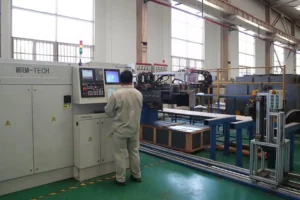
The short version is below. The full process walkthrough, from mill sheet to finished electrode, is on thetitanium anode manufacturing page.
Substrate and forming
Mill sheet in Grade 1 titanium arrives in the thickness the drawing calls for. The outline is cut by laser, waterjet, or shear, and the edges are deburred. Bends, stiffening flanges, and hanger details are formed before coating, because a coated surface cannot be reworked mechanically afterwards without destroying it.
Welding
Tabs, hangers, and stiffeners are joined by argon shielded TIG welding with titanium filler. Seams that carry current are welded to full penetration so joint resistance stays low and heat does not concentrate at a partial weld. On high current electrodes the tab is often a titanium clad copper strip, because solid titanium carries current at roughly one twentieth the conductivity of copper.
Surface preparation
Coating adhesion is decided here, not in the coating room. The electrode is degreased, sandblasted to a controlled roughness, then pickled in a hydrofluoric and nitric acid bath to strip the native oxide and activate the metal. Rinsing is in deionized water, and the electrode is not touched by hand after this point.
Coating and calcination
The active layer goes on as a solution of iridium and tantalum chlorides in an alcohol carrier. Each coat is brushed on, dried, and calcined at 420 to 450 °C, where the salts break down into a cracked oxide with a high surface area. A full loading builds over 8 to 20 passes, with weight gain tracked after every pass. A final anneal stabilizes the layer.
Inspection
Finished electrodes are checked for total coating weight, color and surface uniformity, adhesion by thermal shock and bend testing, and joint resistance at the tab. For critical duty we run a sample electrode in the customer’s own electrolyte at elevated current density and confirm the formulation before the batch ships.
What we need to quote
Any of the following is enough to open a quotation:
- The existing electrode drawing, or the cell dimensions with electrode count and spacing
- Bath composition and acid concentration
- Bath temperature
- Line speed and web width
- Rectifier current, and the current density at the electrode
- Target coating life in m² of plate, or the recoat interval you work to
If all you have is a worn electrode, send it. We measure the profile, sheet thickness, tab arrangement, and remaining coating loading, then quote a replacement on the same basis.
Frequently asked questions
How long does a titanium anode last in a PS plate line?
Reported service in PS plate anodizing duty runs to 1.2 to 1.5 million m² of plate per electrode before the coating is spent. Real life tracks current density, acid concentration, and temperature more closely than any catalogue figure. Send your operating conditions and we will estimate for your cell. Background on how coatings are selected in the first place is in the titanium anode guide.
Which coating do PS plate lines use?
Ir-Ta oxide, on every coated position. The graining electrodes run iridium-tantalum mixed metal oxide, the same formulation is used across the set, and the anodizing tank electrode is bare titanium because it works as the cathode there. One formulation across the line means one recoat interval and one spare part to stock.
Can a cheaper ruthenium based coating be used instead?
No, and it is an expensive way to save money. Ruthenium oxide is more active for chlorine evolution and costs less per square metre, but a PS plate line is not a clean chlorine duty. Under oxygen evolution the ruthenium phase over-oxidizes and dissolves, and under the polarity reversal of alternating current graining it is reduced and lost from the surface. Electrode life in periodically reversed duty comes out at a fraction of its life under steady anodic load.
My anodizing tank electrode is bare titanium. Is that wrong?
No. In the anodizing bath the aluminum web is the anode and the titanium electrode is the cathode, so the reaction on the titanium is hydrogen evolution and no precious metal coating is needed. Adding one there raises cost without raising life.
Can you copy an electrode we already run?
Yes. Send one worn electrode or a dimensioned drawing. We measure the profile, sheet thickness, tab arrangement, and coating loading, then quote a replacement. The original substrate can usually be stripped, re-etched, and recoated for a second cycle.
Do you supply both the anode and the cathode positions?
Yes. Anodic positions take an Ir-Ta coated electrode, cathodic positions take bare titanium, and both are cut from the same drawing set so the two sides of the cell line up.
What is the fluoride limit for a titanium electrode?
Free fluoride above roughly 50 mg/L attacks the titanium substrate under anodic load, independent of the coating. Tell us before you specify if your bath carries fluoride, because the answer may be a niobium substrate with a platinized surface instead of titanium.
How fast can you quote?
A drawing or a set of operating conditions is answered within one business day. Production timing depends on coating passes and quantity, and we confirm the date with the quotation.
Specify your electrode
Send the drawing, the bath chemistry, and the current. Our sales engineers reply within one business day with a coating recommendation and a price, or use our contact page to send a drawing with your inquiry.
Email info@mmo-anode.com | WhatsApp +86 150 0927 2266