
MMO / DSA anode · wire phosphating lines
Electrolytic phosphating puts the steel wire at the cathode and an inert titanium anode in the bath. Current splits water at the wire surface, the film touching the steel turns alkaline, and zinc phosphate crystallizes where you want it: on the wire, not in the sludge pit. This page covers the anode half of that cell. Which coating survives an acidic bath, how the anodes should be laid out, and what we need to size a set.
- Grade 1 substrate to ASTM B265, mill certificate with every lot
- ISO 9001 plant. Drawings quoted within 12 hours
- Coating thickness measured and recorded per part
- Cell role
- Inert oxygen-evolving anode; wire is the cathode
- Why it matters
- No iron dissolves, so no iron phosphate sludge
- Wire range
- 2.5–4.0 mm semi-finished, in-line dry drawing
- Line speed
- 6–8 m/s on direct-draw machines
- Film thickness
- Set by current density, not by dwell time
- Bath control
- Total : free acid ratio 5–8; zinc is the main lever
- Coating build
- Dense, uniform deposit; no needle growth
- Maintenance
- Keep wet, keep polarity right, watch chloride
What the anode actually does in a phosphating cell
Two electrodes, two different jobs. The wire makes the film. The anode just has to close the circuit for years without joining the reaction.
The wire is the cathode. Your rectifier pushes electrons into it, water at the steel surface takes them, and hydrogen comes off. That consumption of hydrogen ions is the whole trick. The boundary layer touching the wire climbs in pH, the zinc phosphate that was perfectly soluble in the bulk bath can no longer stay dissolved, and it drops out as a crystal layer on the steel.
The anode sits in the same bath, at the same 70–85 °C, and gives off oxygen:
Cathode 2H₂O + 2e⁻ → H₂ + 2OH⁻
One electrode builds the film. The other has to sit in the same acid bath, at temperature, and do nothing except pass current and release gas.
No iron goes into solution. No iron phosphate sludge comes out.
Three requirements follow from that, and they are the only three that matter when you specify the electrode. It must not dissolve. It must not shed coating into a bath you are trying to keep in balance. And it must not change shape, because the gap between anode and wire is what decides whether the coating goes on evenly around the wire or only on the side facing the plate.
A soluble anode fails all three. It puts metal into the bath and drifts the chemistry as it runs. A titanium anode with a noble-metal oxide coating does not: the titanium passivates, the oxide layer does the electrochemistry, and nothing leaves the electrode except oxygen.
Why there is no sludge
In conventional phosphating the steel itself is part of the reaction. Acid attacks the wire, iron goes into solution, and iron phosphate drops out as the sludge that gets dredged out of immersion tanks and paid for by the ton. In an electrolytic cell the wire is cathodic. It is being protected, not attacked. No iron enters the bath, so no iron phosphate sludge forms.
That single difference is usually what gets a project approved. Bath solids, drag-out salts and zinc scale still need filtration (we are not going to pretend the tank stays spotless), but the sludge handling, the downtime to dig it out, and the disposal cost disappear from the line.
Electrolytic, in-line conventional, or immersion
Same phosphate chemistry, three different ways of getting it onto the steel. Which one fits depends on what happens to the wire next.
| Parameter | Immersion (coiled rod) | In-line conventional | In-line electrolytic |
|---|---|---|---|
| Film formation | Chemical attack on the steel; iron goes into solution first | Same chemistry, continuous strand | Cathodic; hydrogen evolution raises interfacial pH, phosphate precipitates |
| Time to film | Around 12 min at 70 ± 5 °C | Minutes, line-speed dependent | Seconds. Film builds as the wire passes. |
| Crystal habit | Slow, needle-like growth | Slow, needle-like growth | Fast nucleation, dense uniform deposit |
| Coverage | Good on rod, shadowing on tight coils | Good; edge effects at strand ends | More complete coverage around the circumference |
| Thickness control | Bath chemistry and dwell time | Bath chemistry and dwell time | Current density — a dial, not a wait |
| Iron phosphate sludge | Yes, substantial | Yes | None; the wire never dissolves |
| Bath discipline | Acid ratio 5–8, temperature, iron build-up | Acid ratio and temperature | Tighter: zinc balance and current density both have to hold |
| Best fit | Rod for direct-draw machines | 1.5–2.5 mm semi-finished, water-tank drawing | 2.5–4.0 mm semi-finished, in-line dry drawing |
Electrolytic phosphating is the newest of the three and the least forgiving. The coating thickness follows current density almost directly, which is exactly why operators like it. You change a setpoint instead of waiting out a dwell time. The trade is that the bath has to stay in balance. If the zinc, phosphate and nitrate ratio drifts, the film quality drops even though the rectifier is doing exactly what it was told.
Plants that run it well treat the bath as an instrument, not a tank. Zinc content gets checked on a schedule, not when a wire breaks.

Which coating, and why not the cheaper one
A phosphating bath is an acid tank that happens to run hot, and the anode is the oxygen-evolving electrode in it. That combination narrows the field fast.
| Coating | Built for | Behavior in a zinc phosphate bath | Verdict |
|---|---|---|---|
| RuO₂–IrO₂ | Chlorine evolution: chlor-alkali, seawater, hypochlorite generation | Ruthenium dissolves anodically when the duty is oxygen evolution in acid. The coating thins from the working face inward and the cell voltage climbs with it. | Not quoted |
| IrO₂–Ta₂O₅ | Oxygen evolution in acid: plating, electrodeposition, phosphating, copper foil | IrO₂ carries the oxygen reaction at a low, stable overpotential; Ta₂O₅ holds the iridium in a corrosion-resistant matrix and keeps the titanium substrate passivated. | Standard |
| Platinum | Fluoride-bearing baths, chromic acid, specialty electrochemistry | Works, and tolerates chemistries the oxides do not. Cost per unit area is several times higher, and it is wasted on a duty an oxide handles well. | Conditional |
| β-PbO₂ | High-oxidation-potential work: hard-to-break-down organics in wastewater | High oxygen overpotential and a lead-bearing active layer. Putting lead into a bath whose selling point is that it stays clean is self-defeating. | Not for this bath |
Coating thickness, in micrometres
We quote coating thickness, not coating weight. For phosphating service the working range is 8–25 µm of IrO₂–Ta₂O₅ on the finished part, measured on the plate rather than calculated from how much precursor went into the pot.
The low end suits clean baths, moderate current density and single-shift operation. The high end is for lines that run three shifts at high current density, or baths that sit at the top of the temperature range. Thicker is not automatically better: an over-coated anode costs more and buys life you may not need.
Why the substrate still matters
Grade 1 titanium to ASTM B265, sandblasted and acid-etched before coating. The etch is what gives the oxide something to key into. Skip it and the coating looks fine on the day it ships and blisters six months later. If you need to know how that step is controlled, it is covered under titanium anode manufacturing.
The anode-side acid problem
Every oxygen molecule that leaves the anode leaves four hydrogen ions behind. The liquid touching the anode is therefore more acidic than the bulk bath, permanently, for as long as current flows. Two things follow.
First, the bath has to move past the anode face. A dead pocket behind a plate becomes a low-pH pocket, and that is where coating loss starts. Second, the coating has to be genuinely acid-stable, which is the real reason a chlorine-evolution coating fails here even though it is chemically respectable in its own application.
If your bath carries fluoride from a specific additive package, say so at the quotation stage. It changes the substrate preparation and sometimes the coating choice. The same applies to chloride carried in on poorly rinsed wire; see what shortens anode life below.
Comparing systems? Our guide to choosing coated titanium electrodes covers the decision in more detail.
Build specification
Standard build below. Anything dimensional is made to your tank drawing; the electrochemical values are what we hold ourselves to.
| Property | Specification | Notes |
|---|---|---|
| Substrate | Grade 1 titanium, ASTM B265 | Grade 2 for thick sections and heavy bus interfaces. Mill certificate supplied. |
| Coating | IrO₂–Ta₂O₅ mixed metal oxide | Oxygen-evolution formulation, not a chlorine-evolution coating relabeled. |
| Coating thickness | 8–25 µm | Measured per part; map of readings included with the inspection report. |
| Surface preparation | Sandblast + acid etch | Roughness controlled before coating; this is the adhesion step that gets skipped by cheap suppliers. |
| Anode current density | 1,000–3,000 A/m² of immersed area | Design window for phosphating duty. Sized from your rectifier and wire load, not picked from a catalog. |
| Bath temperature | 70–85 °C | Continuous. Thermal cycling from cold starts is harder on the coating than steady heat. |
| Bath chemistry | Acidic zinc phosphate; total : free acid 5–8 | Zinc dihydrogen phosphate, zinc nitrate and phosphoric acid systems. Tell us the actual recipe. |
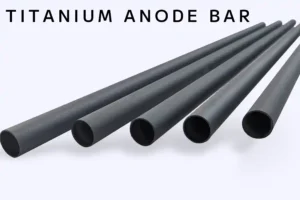
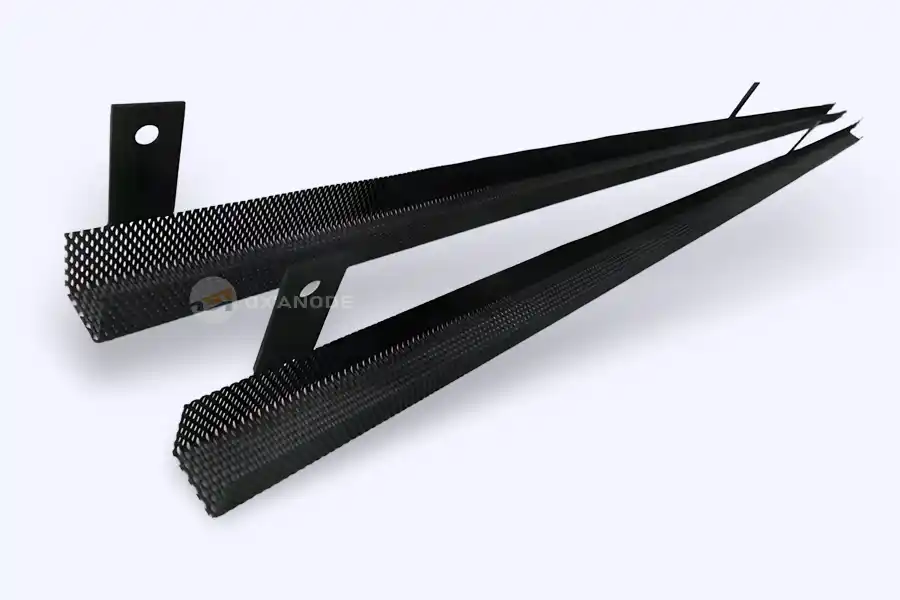
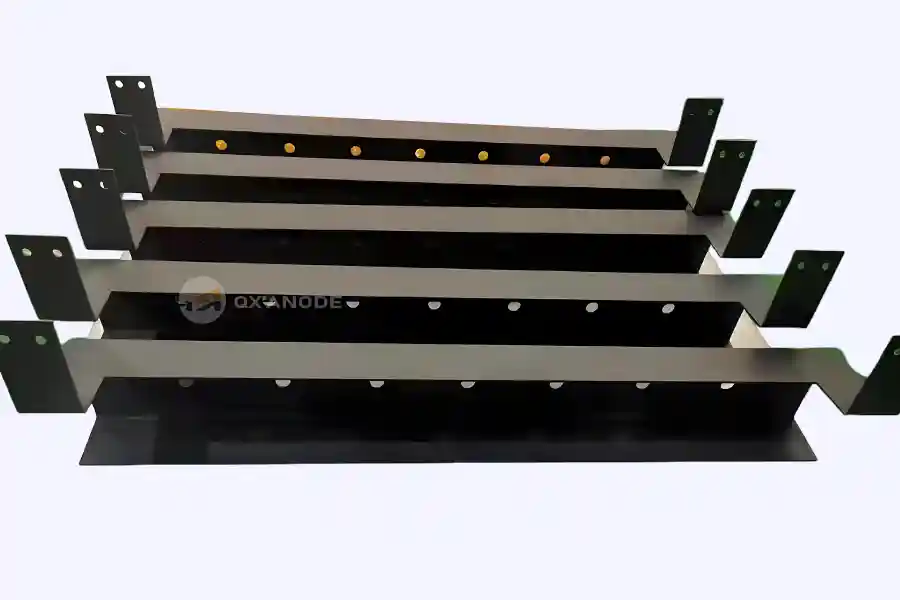
| Forms | Plate 1.0–3.0 mm; rod Ø6–20 mm; tube Ø25–32 mm; expanded mesh | Plate for wire curtains, tube for single-strand or concentric layouts. |
| Flatness | ≤ 3 mm over the plate length | Holds the anode-to-wire gap constant along the run. |
| Electrical connection | Titanium bus bar, bolted or welded | Copper-to-titanium transitions kept out of the bath. |
| Testing | Thickness map, adhesion, accelerated life, dimensional | Accelerated life run at elevated current density in acid electrolyte. |
| Recoating | Substrate reusable | Strip, re-prepare, re-coat. Same dimensional envelope, lower cost than new. |
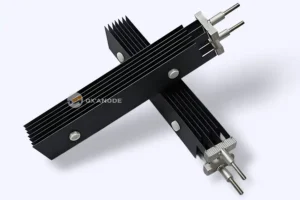
Plate, for wire curtains
The default for multi-strand lines. Two banks facing each other across the wire run, gap set by the tank width. Titanium anode plate
Tube, for single strands
A wire passing through the bore of a coated tube sees the same gap all the way around. Best concentricity, highest anode area per strand. Titanium tube anode
Where the anodes go, and how we size them
A correct anode in the wrong place gives you a coating that is thick on one side of the wire and thin on the other. Geometry is not a detail here.
Typical electrolytic phosphating line. The anode sits at step 6:
Four layout rules we apply
Face both sides. A single plate on one side of a wire run coats the near face and shadows the far one. Two opposing banks, or a tube around each strand, is the fix.
Keep the gap constant. Coating thickness tracks current density, and current density tracks the gap. A plate that bows by 5 mm along a 1.4 m run is a 5 mm variation in the film. That is why we hold flatness to 3 mm.
Stand the anodes up. Oxygen has to leave. Horizontal plates trap gas on the working face, the effective wetted area drops, voltage creeps up and the coating goes streaky. Vertical plates with a clear bubble path cost nothing extra.
Shield the edges. Wire enters and leaves the bath at the tank ends, where current crowds. Insulated shields or a slightly shorter anode bank at the entry and exit keep the first and last few centimetres from over-coating.
What we need to size a set
Send these and we can quote without a call. A hand sketch of the tank with wire positions is enough to start.
line speed and pass configuration
target film thickness
rectifier rating and maximum current
tank dimensions and immersion depth
bath recipe: Zn, PO₄, NO₃, F⁻, Cl⁻
operating temperature and duty cycle
From those we return anode area, plate count and spacing, coating thickness, bus arrangement and a dimensional drawing. If the numbers do not add up (say the rectifier cannot deliver what the wire load needs), we will tell you that before quoting hardware.
What actually shortens anode life here
Coating loss in phosphating service is rarely a mystery. In our experience it comes down to eight things, and most of them happen on the plant side.
Chloride carried in on the wire
Poor rinsing after pickling drags chloride into the phosphating tank. Chloride accelerates oxide loss on an oxygen-evolving anode, quietly. Check the conductivity of your final rinse, not just the tank.
Running the anode dry while hot
Draining the tank with the anode still hot, or letting the top of a plate sit above the bath line, cooks the coating. Keep it submerged, or let it cool before you drain.
Reverse polarity, even briefly
Wiring a plate as cathode strips the oxide in hours. So does a rectifier that fails with a reversed output. Interlock the polarity, and check it after any bus work.
Current crowding at plate edges
Edges run hotter electrically than the face. Without shielding they wear first and set the replacement date for the whole anode. Thieves and edge masks are cheap insurance.
Gas blanketing
A plate mounted horizontally, or too close to a tank wall, holds oxygen against its own face. Voltage climbs, coating quality falls, and the anode looks fine when you pull it.
Fluoride in the additive package
Fluoride attacks titanium through any pinhole in the coating. If your bath contains it, that is a specification input, not a surprise we should discover from a failed part.
Mechanical cleaning
Wire brushing or scraping scale off the working face takes coating with it. Soak in dilute acid, rinse, and put it back. If scale will not lift, call us before you reach for the grinder.
Letting the bath drift
Not an anode failure, but it gets blamed on the anode. Zinc off-spec changes film mass, operators push current up to compensate, and the coating pays for it.
What ships with the anode
A coated anode is only as good as the last inspection step. These are the four checks we run before a phosphating anode leaves the plant.
Coating thickness map. Nine readings per plate face, in micrometres, recorded and shipped with the part. If you want to audit an anode against its certificate, you can repeat those points yourself with an eddy-current gauge.
Adhesion. Bend and tape test on a coupon from the same coating batch. Blistering or lift at this stage means the etch was wrong, and the part does not ship.
Accelerated life. A coupon run at elevated current density in acid electrolyte until the potential climbs. It does not predict your service life in months, but it catches a bad batch before it reaches your tank.
Dimensional and electrical. Flatness, hole pattern, bus bar fit and resistance across the connection. An anode that does not fit the jig is not an anode.
Substrate mill certificates to ASTM B265 come with the shipment. If your QA needs the inspection report in a specific format, say so on the order. We would rather fill in your form than send ours.
Recoating, and when to plan for it
Grade 1 titanium does not wear out in this service. The oxide does. When the cell voltage at fixed current has climbed beyond what you can pay for, or the coating has visibly thinned at the edges, the anode comes out and the substrate goes back through the line.
Recoating keeps the same dimensions, so nothing in the tank changes. It also costs materially less than a new anode. Most plants plan it as a scheduled outage rather than a breakdown, which is the point. You get to pick the week.
Recoating and refurbishment service · Technical data sheets
Questions we get asked before the first order
Short answers, in the order they usually come up. Longer explanations are in the site FAQ and the titanium anode guide.
What is a titanium anode for electrolytic phosphating?
It is the inert, oxygen-evolving electrode in an electrolytic phosphating cell. The steel wire is the cathode and the titanium anode closes the circuit. Current splits water at the wire surface, the local pH rises, and zinc phosphate crystallizes onto the steel. The anode does not dissolve, so no iron enters the bath and no iron phosphate sludge forms.
Why not use stainless steel or a lead anode?
Stainless passivates and then stops conducting; lead dissolves slowly and puts metal into a bath you are trying to keep in balance. A coated titanium anode keeps its dimensions and its electrochemistry for years, and contributes nothing to the bath except oxygen.
Which coating should go in a zinc phosphate bath?
IrO₂–Ta₂O₅. The bath is acidic and the anode evolves oxygen, which is exactly the duty this coating was developed for. Ruthenium-based coatings are built for chlorine evolution and dissolve anodically in this service.
How thick is the coating on the anode?
Standard phosphating anodes are coated to 8–25 µm of IrO₂–Ta₂O₅, measured on each part. The upper part of that range goes to high-current or three-shift duty. We quote thickness in micrometres, not coating weight per square metre.
Does electrolytic phosphating produce sludge?
No iron phosphate sludge, because the wire never dissolves into the bath. Bath solids, drag-out salts and zinc scale still need filtration. What disappears is the sludge volume that conventional immersion lines have to dredge out and dispose of.
What wire sizes does this suit?
In-line electrolytic phosphating is normally specified for 2.5–4.0 mm semi-finished wire feeding in-line dry drawing at 6–8 m/s. Smaller 1.5–2.5 mm wire for water-tank drawing is usually handled by conventional in-line phosphating, and coiled rod by immersion phosphating.
How long does the anode last?
Most anodes we ship into phosphating lines are pulled for recoating in the 24–36 month range on three-shift duty. Life is dominated by current density and bath chemistry, so we quote a charge-based figure for your duty rather than one headline number that will be wrong for half the plants reading it.
Can the substrate be recoated?
Yes. Grade 1 titanium is fully reusable. We strip the spent coating, re-prepare the surface and apply a new oxide layer. It costs less than a new anode and keeps the dimensional envelope of your existing tank unchanged.
Do I still have to control the bath?
More than ever. Current density sets the film thickness, but bath composition sets the film quality. Zinc content is the dominant lever: raise it and film mass rises; raise phosphate or nitrate and it falls. The rectifier cannot compensate for a bath that has drifted.
What do you need to size a set?
Wire count and diameter, line speed, target film thickness, rectifier rating, tank dimensions and immersion depth, bath recipe including zinc, phosphate, nitrate, fluoride and chloride, operating temperature and duty cycle. A sketch of the tank with wire positions is enough to start.
Send the tank drawing
We will send the anode layout.
Quotes come back within 12 hours on weekdays, with anode area, plate count, coating thickness and a dimensional sketch, not a price list. If your bath or rectifier will not support the film you are asking for, that goes in the reply too.