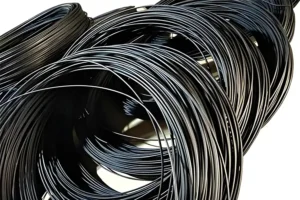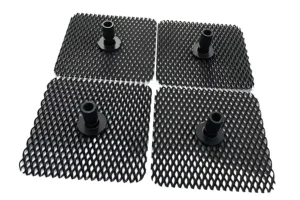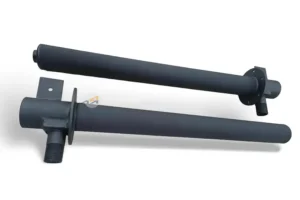




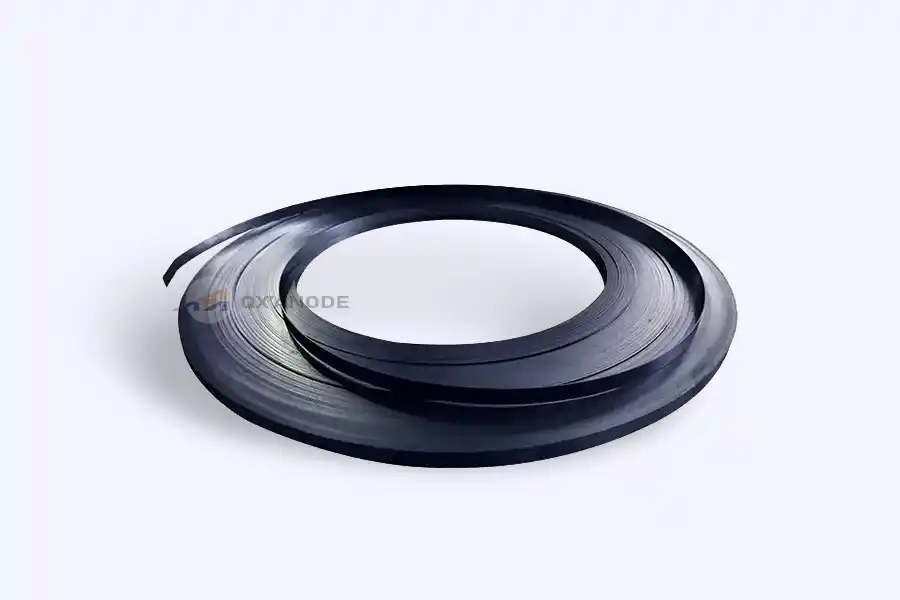
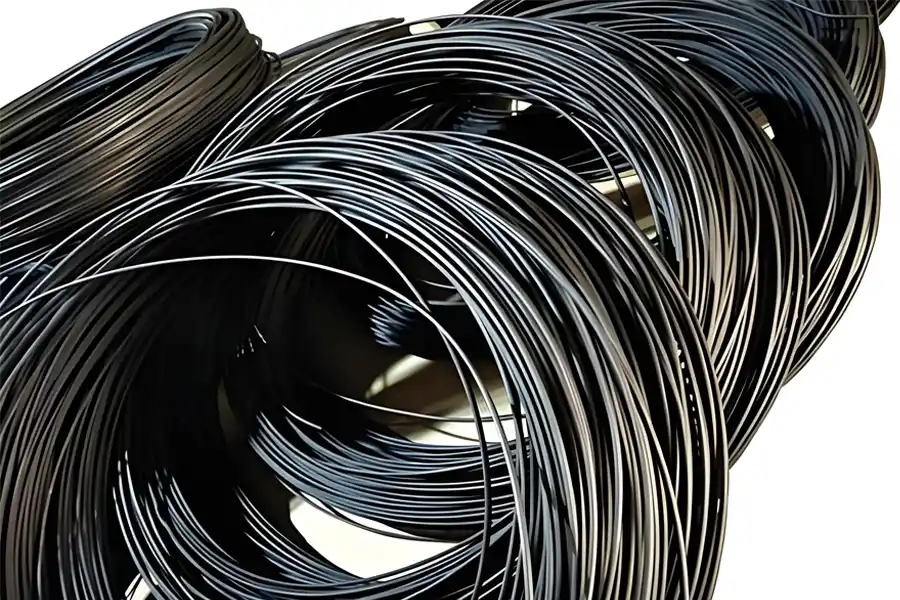
MMO titanium anode ribbon is a dimensionally stable anode made from ASTM B265 Grade 1 titanium strip, 0.635 mm or 0.9 mm thick, coated with a mixed metal oxide catalyst and sintered. Buried in coke breeze or cast into concrete, it releases impressed current along its whole length instead of from a single point. The titanium stays passive and carries the current. The oxide coating does the electrochemical work, and it is the part that eventually wears out.
ASTM B265 Gr 1
IrO₂–Ta₂O₅
76.2 m & 152.4 m coils
A thin titanium strip with a mixed metal oxide coating, run in long lengths as the current source in impressed current cathodic protection. Two standard profiles, 6.35 × 0.635 mm and 12.7 × 0.9 mm, in 250 ft coils. In practice it ends up under tank bottoms, along pipelines, and inside concrete decks.
- Standard profiles
- 6.35 × 0.635 mm
12.7 × 0.9 mm - Coatings
- IrO₂–Ta₂O₅
- Coil lengths
- 76.2 m (250 ft)
152.4 m (500 ft) - Referenced standards
- ASTM B265 · API RP 651
NACE SP0169 · ISO 15589-1
What is actually inside the ribbon
Two materials, one job each. The strip is the conductor and the mechanical carrier. The coating is the electrode. Suppliers who quote only a width and a thickness are leaving out the number that decides how long the anode lasts.
The substrate
The base is a cold-rolled titanium strip, not a wire and not a tube. Grade 1 is the usual choice: it is the most ductile of the unalloyed grades, so it bends around a tank chine or a pipe bend without cracking, and it forms a stable passive film the moment it is exposed to soil moisture or concrete pore water. Grade 2 appears when a project specification calls for it, typically on long pulls where the strip sees more handling.
Thickness matters more than width for handling. A 0.635 mm strip coils tightly and follows a trench; a 0.9 mm strip resists kinking better when a crew is pulling it across a tank pad. Both are stocked.
The coating
Before coating, the strip is degreased, grit-blasted, and pickled. The catalyst goes on in repeated brush-and-fire passes. Each pass is baked at roughly 450–550 °C, which decomposes the metal salts into oxides and leaves a thin, porous, electrochemically active layer. Ten to twenty passes is normal for a cathodic protection coating; heavy loadings take more.
That is why the purchase order should carry a coating weight in g/m². The oxide layer is thin, usually under 15 µm, and the loading is what sets the ampere-hours the anode can deliver before the titanium underneath starts to anodize and the voltage climbs.
| Layer | Material | Typical thickness | Function |
|---|---|---|---|
| Active layer | IrO₂–Ta₂O₅ | < 15 µm | Catalyzes oxygen or chlorine evolution |
| Substrate | Ti Gr 1 (Gr 2 on request) | 0.635 / 0.9 mm | Carries current, stays passive |
| Weld tab | Bare titanium | 30–50 mm | Connection to conductor bar |
Field note
A ribbon anode fails at the connection far more often than in the middle. If a joint is made with a stick welder or left wet, the coating is irrelevant. Specify the weld method before you specify the coating weight.
Standard profiles and what they weigh
Both profiles below are stocked in 76.2 m (250 ft) and 152.4 m (500 ft) coils. Mass and surface are calculated from the nominal section at a titanium density of 4.51 g/cm³, with both faces and both edges counted as active surface.
| Profile, mm | Profile, in | Cross-section | Mass | Anode surface | Standard coil |
|---|---|---|---|---|---|
| 6.35 × 0.635 | 0.250 × 0.025 | 4.03 mm² | 18.2 g/m 0.0122 lb/ft | 0.0140 m²/m 0.046 ft²/ft | 76.2 m / 152.4 m |
| 12.7 × 0.9 | 0.500 × 0.035 | 11.43 mm² | 51.5 g/m 0.0346 lb/ft | 0.0272 m²/m 0.089 ft²/ft | 76.2 m / 152.4 m |
| Custom | on request | 5–25 mm wide 0.5–1.0 mm thick | quoted | quoted | up to 500 m in one length |
Strip tolerances follow ASTM B265. If your welder needs a tighter thickness window, say so on the inquiry; a 10% thickness spread is standard, and it changes how a capacitive discharge welder has to be set.
Why the 6.35 mm profile dominates
Most tank-bottom grids are built from the small profile. It is light enough for two people to carry a 250 ft coil across a pad, it bends by hand, and one meter of it already carries more current than a well-coated tank bottom needs. The larger 12.7 mm profile shows up where the design calls for fewer, longer runs, or where the anode has to survive rougher handling in a rocky trench.
What we need to quote
- Profile and total length. Meters, plus how you want them split into coils.
- Coating and loading. IrO₂–Ta₂O₅, and the g/m² target.
- End detail. Bare tab length, hole or slot, weld prep.
- Documentation. Mill certificate, coating weight record, or a third-party inspection.
How much current one meter carries
Current leaves the ribbon from its whole surface, so amps per meter is a surface calculation, not a cross-section one. This is also where most early-stage estimates go wrong: anode surface current density and structure current density are two different numbers with two different units.
Anode surface current density is amps per square meter of coated titanium, typically tens of amps per square meter. Structure current density is milliamps per square meter of steel being protected, typically single digits to low double digits. A 40 m diameter tank bottom at 10 mA/m² needs roughly 12.6 A in total. Spread that over 2,000 ft of ribbon and each meter carries a small fraction of an amp, even though the anode surface is working hard.
A/m = current density (A/m²) × anode surface (m²/m)
For 6.35 × 0.635 mm ribbon, surface is 0.0140 m²/m. At 20 A/m² that is 0.28 A/m; over a 500 ft run, about 43 A. The same run in 12.7 × 0.9 mm ribbon carries 0.54 A/m, or about 83 A. Whether you need the bigger profile is a question about your rectifier and your soil, not about the anode’s limit.
Watch the units
Datasheets mix A/m², mA/m², A/ft² and mA/ft of ribbon. Convert everything to A/m² of anode surface before you compare two suppliers. A number quoted per foot of ribbon is meaningless without the profile it belongs to.
Current estimator
LIVEIrO₂–Ta₂O₅ or RuO₂–IrO₂
Chloride decides it. The two coatings catalyze different reactions, and the one that matches your electrolyte is the one that lasts. Getting this wrong is expensive in a way that shows up two or three years after commissioning.
| Coating | Dominant reaction | Where it belongs | What to watch |
|---|---|---|---|
| IrO₂–Ta₂O₅ iridium–tantalum | Oxygen evolution | Soil and coke breeze, fresh water, tank-bottom sand pads, concrete | Default for cathodic protection. Lower consumption rate where O₂ is the main product. |
| RuO₂–IrO₂ ruthenium–iridium | Chlorine evolution | Seawater, brackish water, high-chloride brines, some industrial process streams | More active at low overpotential, but consumes faster if pushed hard in oxygen-rich service. |
| Pt on Ti platinized | Depends on duty | Specialty electrochemical work, low-current anodes, electroplating | Not a general-purpose CP coating. See platinum and MMO anodes for electroplating. |
How much coating to order
Coating weight is the lever on service life. At a fixed current density, doubling the g/m² roughly doubles the ampere-hour capacity, which is why designers chasing a 40-year tank-bottom life specify a heavier loading rather than a wider strip.
Ask each supplier for two numbers: coating weight in g/m² and rated capacity in A·h/m². Divide capacity by your design current per meter and you have a life estimate you can defend in a design review. A supplier who cannot give you the second number is selling you a width and a thickness.
A note on seawater
Ribbon is a soil and concrete anode first. In open seawater, tubular and plate anodes usually make more sense because they can be replaced and they handle higher current densities. If your project is a wharf or a sheet-pile wall, tell us the chloride level and we will say whether ribbon is the right shape before you order it.
Mixed electrolytes
Brackish water and some soils sit between the two regimes. In those cases we quote IrO₂–Ta₂O₅ unless the chloride analysis says otherwise, and we say so in writing on the quotation.
Where ribbon earns its place
Four jobs cover most of the ribbon sold into cathodic protection. Each one has its own installation habit and its own standard, and the standard is usually what an inspector asks about first.
API RP 651
Aboveground tank bottoms
A grid of ribbon welded to titanium conductor bar, laid on the sand pad, covered with coke breeze, then sand. The grid is what makes the current distribution even; ribbon alone in parallel runs leaves the center of a large floor underprotected.
Typical grid spacing falls between 1 m and 3 m. The design fixes it, not the supplier.
NACE SP0169 · ISO 15589-1
Buried pipelines
Continuous runs in a coke breeze column alongside the pipe, or looped around a section with failing coating. Ribbon beats a groundbed of discrete anodes when the right-of-way is narrow and the current has to be spread over kilometers rather than concentrated at one point.
Chloride-contaminated concrete
Bridge decks and parking structures
Ribbon goes into saw-cut slots, is backfilled with conductive grout, and is covered by the overlay. Titanium is one of the few anode materials that survives chloride-contaminated concrete for decades. The connection is the weak point, so leave it accessible and seal it properly.
Water and wastewater
Clarifiers, basins, and water tanks
Ribbon grids under a basin floor or around a steel tank shell, run at low current density. The electrolyte is usually fresh water, so IrO₂–Ta₂O₅ is the coating, and the design tends to be limited by the coating’s capacity rather than by the rectifier.
Solid ribbon, mesh ribbon, or wire
Three shapes, three different jobs. The choice is usually made by the installer, not the designer, because it comes down to how the anode behaves while it is being buried.
| Format | What it is | Where it wins | Trade-off |
|---|---|---|---|
| Solid ribbon 6.35 × 0.635 · 12.7 × 0.9 | Continuous coated strip, both faces active | Tank-bottom grids, long pipeline runs, concrete slots | Kinks if handled carelessly; needs a proper backfill |
| Mesh ribbon expanded titanium | Slit and expanded strip with diamond openings, then coated | Sand pads where the backfill has to lock through the anode; concrete overlays | Not a strength upgrade. Harder to coat evenly, and harder to inspect before backfill |
| MMO wire 1.5–3 mm | Round titanium wire with the same family of coatings | Narrow saw-cut slots, small tanks, tight geometry | Much lower current per meter; more fragile in a rocky trench |
Six steps that decide whether the anode survives
Most ribbon failures in service are installation failures. The coating is usually fine. The strip is usually fine. The joint, or the backfill, is not.
-
Uncoil without reverse bending
Keep the coil on a spool or a turntable and pull it straight off. Do not pull a loop over your shoulder and let it kink. A crease in the strip cracks the oxide, and that crack becomes a hot spot the moment current flows.
-
Walk the strip before it goes in
Look for bright metal showing through the coating, and for handling marks on the edges. On a large project, a holiday check on the coated face takes an hour and saves a rework order.
-
Weld only on the bare tab
Use a capacitive discharge stud welder set for titanium. Two or three welds per joint to the conductor bar, made on the uncoated end. Stick welding burns through the coating and leaves a brittle joint.
-
Test every joint, not a sample
A tug test plus a resistance reading across the joint. Record the readings against the joint number. This is the single most useful as-built document you will hand over.
-
Lay it flat on a graded bed
Ribbon goes flat, not on edge. No direct contact with sharp rock or rebar. On a tank pad, the sand layer under the grid should be level before the ribbon comes off the coil.
-
Backfill in lifts, around the full perimeter
Coke breeze has to surround the strip, not just cover it. Dumping a bucket directly onto the ribbon is how strips get crushed. Place the backfill alongside and let it flow under and over.
Before you energize
Record structure-to-electrolyte potentials on all zones, confirm the rectifier polarity, and log the as-built ribbon footage per zone. If a zone reads differently from its neighbors on day one, you have a joint problem, and it is far easier to find now than after the pad is paved.

Send the design, get a drawing back
Ribbon is a made-to-order item, so a useful quotation needs more than a length. These are the details our engineers look for. If you only have some of it, send what you have and we will work from there.
- Profile. Standard 6.35 × 0.635 mm, 12.7 × 0.9 mm, or a custom width.
- Total length and coil split. For example, 3,000 m in twelve 250 ft coils.
- Coating and loading. IrO₂–Ta₂O₅ or RuO₂–IrO₂, and the target g/m².
- Design current density. A/m² of anode surface, if your CP design already fixes it.
- End detail. Bare tab length, hole or slot, weld prep, or a factory-made connection.
- Documentation and inspection. MTC, third-party witness, or a client-specific ITP.
- Destination and date. Port, Incoterm, and when the first coil has to be on site.
We answer technical questions before commercial ones. If the profile you asked for is wrong for your electrolyte, we will say so on the quotation rather than ship it and let you find out.
The conventional 12.7 × 0.9 mm titanium ribbon is widely adopted as a conductive strip for cathodic protection.
Questions that come up on every inquiry
Short answers, with the number you need to check them against.
What is MMO titanium anode ribbon used for?
It is the current source in impressed current cathodic protection. The ribbon is laid in long runs, often welded into a grid with titanium conductor bar, to spread current across a large bare-steel surface: an aboveground storage tank bottom, a pipeline right-of-way, or a chloride-contaminated concrete deck.
What sizes does it come in?
Two profiles cover most projects: 6.35 × 0.635 mm (0.250 in × 0.025 in) and 12.7 × 0.9 mm (0.500 in × 0.035 in). Both ship in 76.2 m (250 ft) and 152.4 m (500 ft) coils. Widths from 5 mm to 25 mm and thicknesses from 0.5 mm to 1.0 mm are made to order, with single lengths up to 500 m.
Which coating should I specify?
Chloride decides it. In soil, coke breeze, fresh water, and concrete, the anodic reaction is oxygen evolution, and IrO₂–Ta₂O₅ has the lower consumption rate. In seawater and high-chloride brines, chlorine evolution dominates and RuO₂–IrO₂ is the more active coating. If you are between the two, send the chloride analysis and we will tell you which one we would quote and why.
How many amps can one meter carry?
Amps per meter equals design anode current density in A/m² multiplied by the anode surface per meter. The 6.35 × 0.635 mm profile exposes 0.0140 m² per meter, so at 20 A/m² it carries 0.28 A per meter. The 12.7 × 0.9 mm profile exposes 0.0272 m² per meter and carries 0.54 A per meter at the same density. Use the estimator above to run your own numbers.
How long will it last?
There is no single number, and any supplier who gives you one without asking about current density is guessing. Life is coating capacity divided by the current actually drawn. Ask for the coating weight in g/m² and the capacity in A·h/m², then divide by your design current per meter. At a fixed current density, doubling the coating weight roughly doubles the capacity.
Ribbon is not always the right shape
If your electrolyte is a plating bath, a brine cell, or a copper foil line, a flat strip is the wrong geometry. Those jobs need plate, mesh, tubular, or platinized anodes, and we make all of them.