Titanium Anode for Electrolytic Copper Foil Production
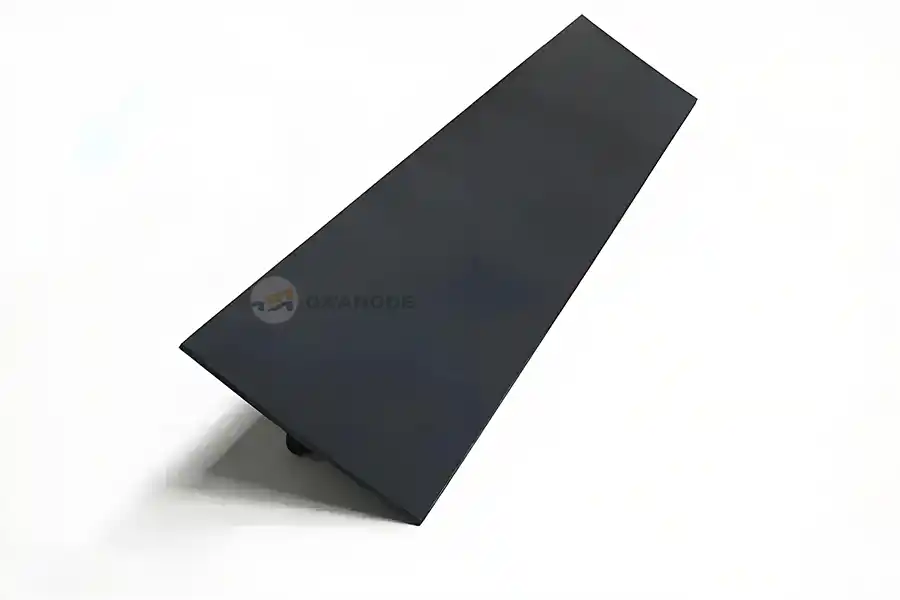
Titanium Anode for Electrolytic Copper Foil (also known as MMO titanium anode or DSA anode) is the core electrochemical component in the continuous electrodeposition production of electrolytic copper foil. Manufactured from high-purity Grade 1 titanium substrate with precision-applied iridium-tantalum mixed oxide (IrO₂/Ta₂O₅) coating, this dimensionally stable anode delivers uniform current distribution, exceptional corrosion resistance, and stable oxygen evolution performance in acidic copper sulfate electrolytes.
Our titanium anodes are engineered for both lithium-ion battery copper foil (4.5μm–12μm ultra-thin foil) and PCB/electrolytic copper foil (12μm–105μm standard foil) production lines, supporting both inlay-type (plum blossom hole) and back-tensioned (FIP — Fixed Integrated Plate) mounting structures compatible with major foil-making equipment. With optimized coating formulation and strict production controls, our anodes achieve 8–12 months of continuous service life, reduce energy consumption by over 10% compared to traditional lead anodes, and directly improve copper foil thickness uniformity, surface finish, and production yield.
How the Anode Works in Copper Foil Electroforming
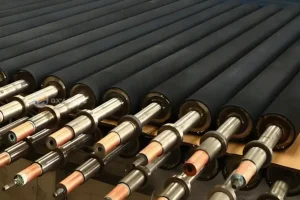
Copper foil is formed on a partially immersed, rotating titanium drum (cathode). As the drum turns through the electrolyte, DC current drives copper deposition onto its surface; the foil is continuously peeled off at thicknesses from 105 μm standard PCB foil down to 4.5 μm battery collector foil.
Cathode (drum): Cu²⁺ + 2e⁻ → Cu (foil deposition)
Anode (our product): 2H₂O → O₂ + 4H⁺ + 4e⁻ (oxygen evolution)
Because the anode does not dissolve, copper concentration in the electrolyte is maintained by continuously feeding copper oxide (CuO) — giving operators independent control over current density, drum speed, and therefore foil thickness and structure. The anode bank — typically curved plates conforming to the drum radius at a fixed 8–15 mm gap — determines how uniformly current reaches every point on the drum surface. Any geometric or electrochemical non-uniformity in the anode translates directly into thickness variation and surface defects in the foil.
Why IrO₂-Ta₂O₅ on Titanium?
The copper foil electrolyte is aggressively acidic — typically 80–150 g/L sulfuric acid, rising above 180 g/L in some HVLP processes — and the anode operates as an oxygen-evolving electrode at high current density. This environment rules out most coating chemistries:
Ruthenium-Iridium MMO (excellent for chlorine evolution in chlor-alkali) dissolves anodically in sulfuric acid and fails rapidly here. Platinum works but is cost-prohibitive at foil-plant scale. Iridium-tantalum oxide is the proven choice: IrO₂ catalyzes oxygen evolution with a low, stable overpotential, while Ta₂O₅ forms a corrosion-resistant matrix that locks the active iridium in place and protects the titanium substrate from passivation.
The result is an anode that holds its dimensions and electrochemical performance for years — where a legacy lead-alloy anode would swell, warp, shed lead sludge into the electrolyte, and demand frequent gap re-adjustment.
The coating process and the quality tests behind that consistency are described under how MMO anodes are manufactured and tested in our titanium anode guide.
Key Features & Benefits
1. Premium Coating Technology
- Iridium-Tantalum (IrO₂/Ta₂O₅) mixed oxide coating — industry-standard formulation for oxygen evolution in acidic sulfate electrolytes
- Coating thickness: 10–25 μm with uniformity deviation ≤ 8% across the entire plate surface
- Low oxygen evolution overpotential (< 1.0 V at 4000 A/m²), significantly reducing cell voltage and power consumption
- Excellent adhesion strength, no peeling or blistering under long-term high-current operation
2. High-Purity Titanium Substrate
- Grade 1 pure titanium (ASTM B265) substrate with ≥ 99.6% titanium content
- Precision surface pretreatment: sandblasting + acid etching to create micro-rough surface for superior coating bonding
- Excellent corrosion resistance in 10–30% H₂SO₄ + CuSO₄ electrolyte environment
- Dimensionally stable structure — no warping, deformation, or sagging under high temperature and high current density
3. Uniform Current Distribution
- Precision flatness control: straightness ≤ 3 mm along the full length
- Optimized hole pattern and plate geometry ensure homogeneous electric field between anode and cathode drum
- Eliminates edge thickness deviation, pinholes, and wavy edge defects in copper foil
- Enables consistent production of ultra-thin 4.5μm–6μm lithium battery copper foil
4. Extended Service Life & Recoatability
- 8–12 months continuous operation under standard working conditions (5000–10000 A/m², 50–70°C)
- Service life rating: ≥ 40,000 kA·h/m²
- Titanium substrate is fully reusable — recoating service available, reducing total ownership cost by over 30%
- No dissolution into electrolyte, maintaining bath purity and eliminating lead contamination
5. Energy & Cost Efficiency
- Over 10% energy savings compared to conventional lead anodes
- Reduced maintenance frequency and production downtime
- No heavy metal pollution, compliant with environmental regulations
- Stable electrochemical performance minimizes additive decomposition and extends electrolyte service life
Technical Specifications
| Substrate Material | Grade 1 / Grade 2 Pure Titanium (ASTM B265) |
| Coating System | IrO₂-Ta₂O₅ (standard) |
| Coating Thickness | 10 – 25 μm (Ir-Ta oxide) |
| Plate Thickness | 1.0 mm / 6.0 mm (customizable) |
| Standard Sizes | 1.0×319×1380 mm, 1.0×313×1370 mm, 6.0×221×1380 mmCustom dimensions accepted |
| Structure Type | Inlay type (cloverleaf hole pattern) / Back-tensioned (FIP) type |
| Flatness Tolerance | ≤ 3 mm along length direction |
| Recommended Current Density | 5000 – 10000 A/m² |
| Operating Temperature | 50 – 70 °C |
| Electrolyte Compatibility | H₂SO₄ + CuSO₄ acidic copper plating solution |
| Typical Service Life | 8 – 12 months (continuous operation) |
| Life Rating | ≥ 40,000 kA·h/m² |
| Surface Treatment | Sandblasting + acid etching + noble metal oxide coating |
| Oxygen Evolution Potential | ≤ 1.2 V (vs. SCE, at 4000 A/m² in 15% H₂SO₄) |
Working Principle & Application Scenarios
How It Works
Our Ir-Ta coated titanium anode acts as an insoluble dimensionally stable anode, maintaining its shape and electrochemical properties over thousands of operating hours. Unlike lead anodes that gradually dissolve and contaminate the electrolyte, the titanium anode remains inert, ensuring consistent foil quality and bath purity throughout the production cycle.
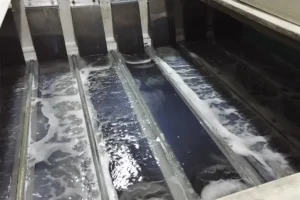
In the electrolytic copper foil production process, copper sulfate electrolyte is circulated between the rotating titanium cathode drum and stationary titanium anode plates. When direct current is applied, copper ions (Cu²⁺) in the solution migrate to the cathode drum and are reduced to metallic copper, forming a continuous ultra-thin copper foil layer. At the anode surface, the oxygen evolution reaction occurs.
Primary Applications
- Lithium-ion battery copper foil — 4.5μm, 6μm, 8μm, 10μm, 12μm ultra-thin foil for EV battery current collectors
- Printed Circuit Board (PCB) copper foil — 12μm to 105μm standard and high-temperature elongation foil
- High-frequency high-speed PCB copper foil — ultra-low profile foil for 5G communication substrates
- Electrolytic copper foil for flexible circuits and advanced electronic packaging materials
- Retrofit and replacement for existing copper foil production lines using lead or graphite anodes
Structure Options
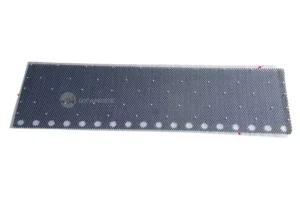
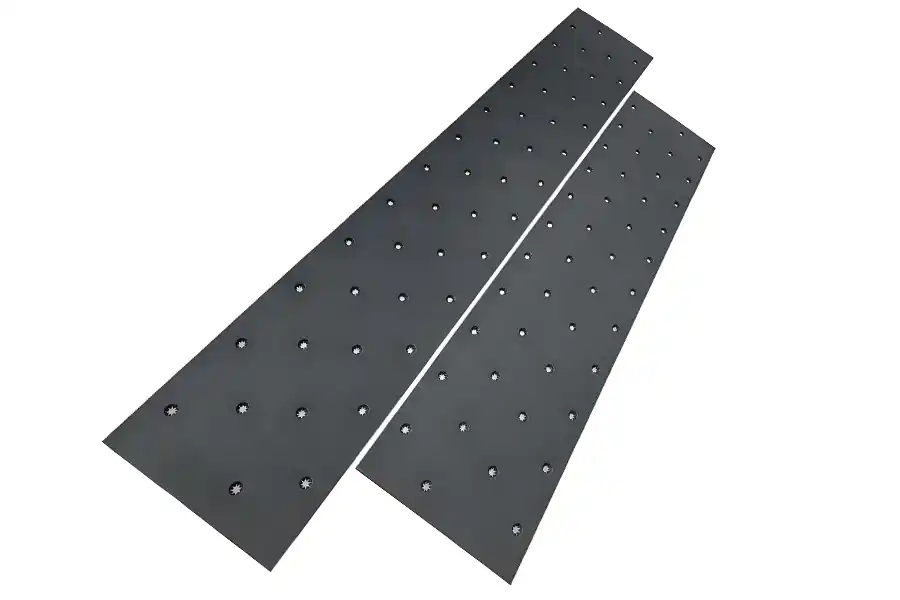
1. Inlay Type (Plum Blossom Hole Pattern)
- Embedded structure with 1mm plum blossom-shaped recessed holes
- Coating applied inside recesses for enhanced electrocatalytic performance
- Extremely constant inter-electrode distance with excellent edge shielding
- Ideal for high-precision ultra-thin lithium battery copper foil production
- Minimizes edge current concentration, preventing thicker edges and burr defects
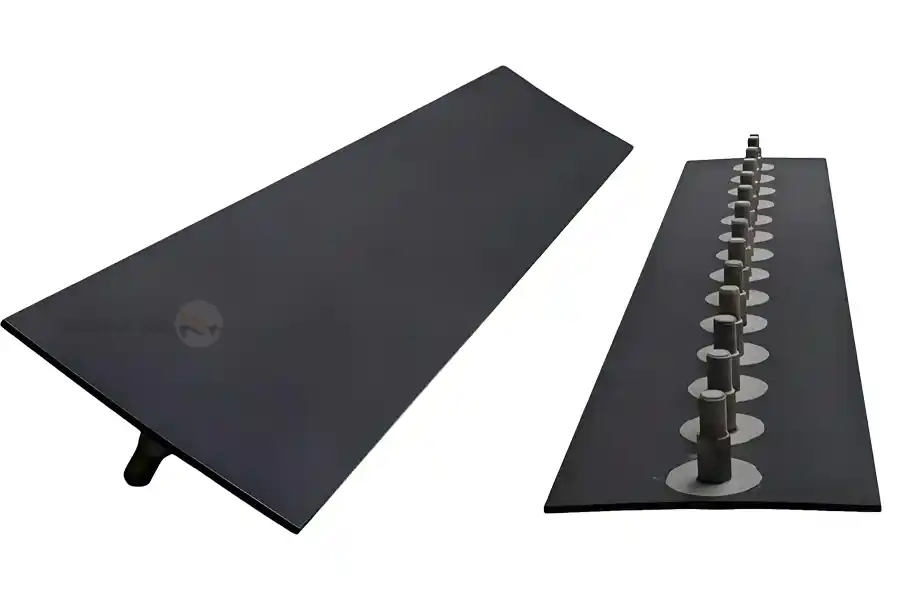
2. Back-Tensioned (FIP) Type
- 6mm FIP structure with anode plates tensioned from the back via titanium tie rods
- Uniform stress distribution across the entire plate for superior flatness
- Open design enables smooth electrolyte circulation and rapid oxygen release
- Reduces gas accumulation and scaling on anode surface
- Easy disassembly and maintenance, suitable for high-capacity continuous production lines
Quality Assurance & Customization
Quality Control
- Full compliance with YS/T industry standard for titanium-based iridium oxide coated anodes
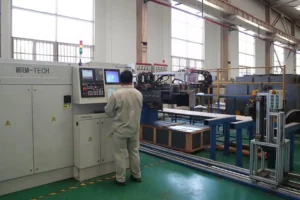
- 100% dimensional inspection and coating thickness testing before delivery
- Electrochemical performance verification via accelerated life testing
- Detailed quality inspection report provided with each shipment
Customization Services
- Custom plate dimensions and thicknesses to match your foil machine specifications
- Tailored coating formulations for specific electrolyte conditions and life requirements
- Complete anode assembly design including conductive bars and mounting hardware
- On-site installation guidance and technical support available
- Anode recoating and refurbishment service for used titanium substrates
Packaging, Shipping & Service
- Packaging: Anti-corrosion film wrapping + wooden crate with shock-absorbing padding
- Lead Time: 10–15 working days for standard sizes; 15–20 working days for custom orders
- Shipping: Worldwide export via sea freight, air freight, or express courier
- MOQ: 1 set (multiple plates per set, depending on machine specification)
- Warranty: Quality guarantee against manufacturing defects; coating life performance warranty under specified operating conditions
FAQ
What is a titanium anode for electrolytic copper foil?
A titanium anode for electrolytic copper foil is a dimensionally stable, insoluble anode (DSA) used in the electrodeposition process that produces copper foil. It is typically made from Grade 1 pure titanium substrate coated with an iridium-tantalum mixed oxide (IrO₂-Ta₂O₅) layer. During electrolysis, the anode facilitates the oxygen evolution reaction while the copper foil deposits onto the rotating cathode drum. Unlike soluble lead anodes, the titanium anode does not dissolve into the electrolyte, ensuring consistent foil quality and bath purity.
Why use iridium-tantalum (IrO₂-Ta₂O₅) coating instead of other coatings?
The copper foil electrolyte is highly acidic (80–150 g/L H₂SO₄) and the anode operates at high current density as an oxygen-evolving electrode. Ruthenium-based coatings, while excellent for chlorine evolution in chlor-alkali, dissolve anodically in sulfuric acid and fail quickly. Platinum coatings work but are prohibitively expensive at production scale. Iridium-tantalum oxide is the industry-proven choice: IrO₂ provides low, stable oxygen evolution overpotential, while Ta₂O₅ forms a corrosion-resistant matrix that locks the active iridium in place and protects the titanium substrate from passivation.
What is the difference between inlay type and FIP type anode structures?
The inlay type (cloverleaf hole pattern) features 1 mm recessed holes embedded into the anode plate, with coating applied inside the recesses. It provides extremely constant inter-electrode distance and excellent edge shielding, making it ideal for ultra-thin lithium battery copper foil production. The FIP (back-tensioned) type uses 6 mm plates tensioned from the back via titanium tie rods, offering superior flatness, open electrolyte circulation, and easy maintenance — suited for high-capacity continuous production lines.
How long does the titanium anode last in copper foil production?
Under standard operating conditions (current density of 5,000–10,000 A/m², temperature of 50–70°C), our iridium-tantalum coated titanium anodes typically achieve 8–12 months of continuous service life, with a life rating of ≥ 40,000 kA·h/m². Actual service life depends on operating parameters, electrolyte composition, and current density. We provide coating life performance warranty under specified operating conditions.
Can the titanium substrate be recoated and reused?
Yes. The Grade 1 titanium substrate is fully reusable. After the original coating reaches end of life, we offer recoating and refurbishment services that restore the anode to full performance. This reduces total cost of ownership by over 30% compared to purchasing new anodes each cycle, and eliminates substrate waste.
What is the lead time and minimum order quantity?
Lead time is 10–15 working days for standard sizes and 15–20 working days for custom orders. The minimum order quantity is 1 set (which may include multiple plates depending on your machine specification). We ship worldwide via sea freight, air freight, or express courier.
Need a custom anode for your process?
Send us your drawing or specs — we’ll quote within 12 hours.