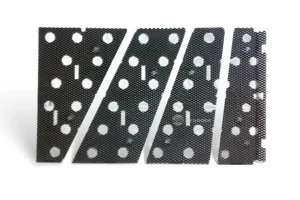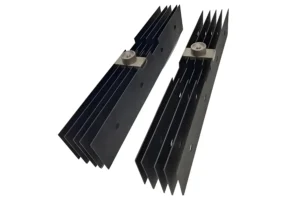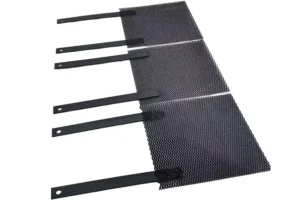
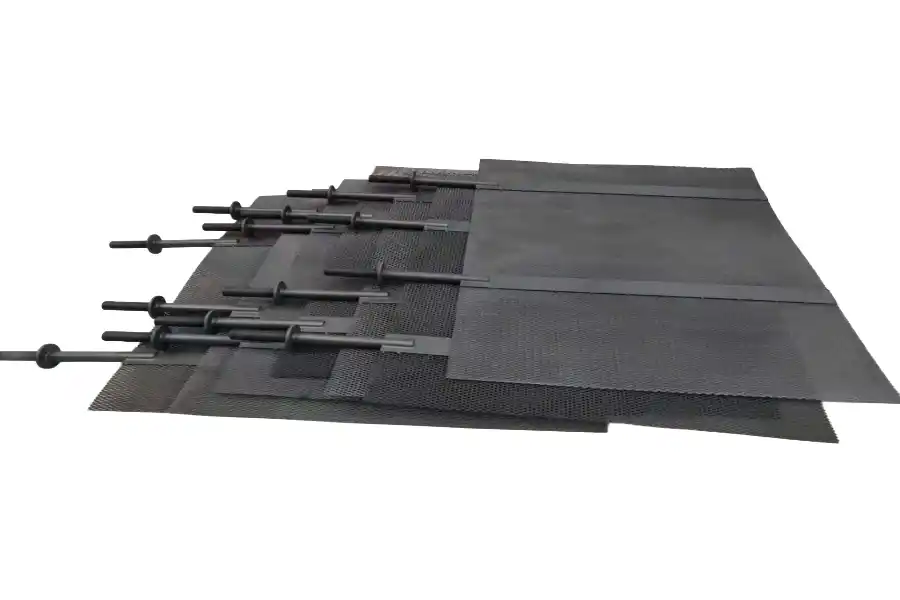
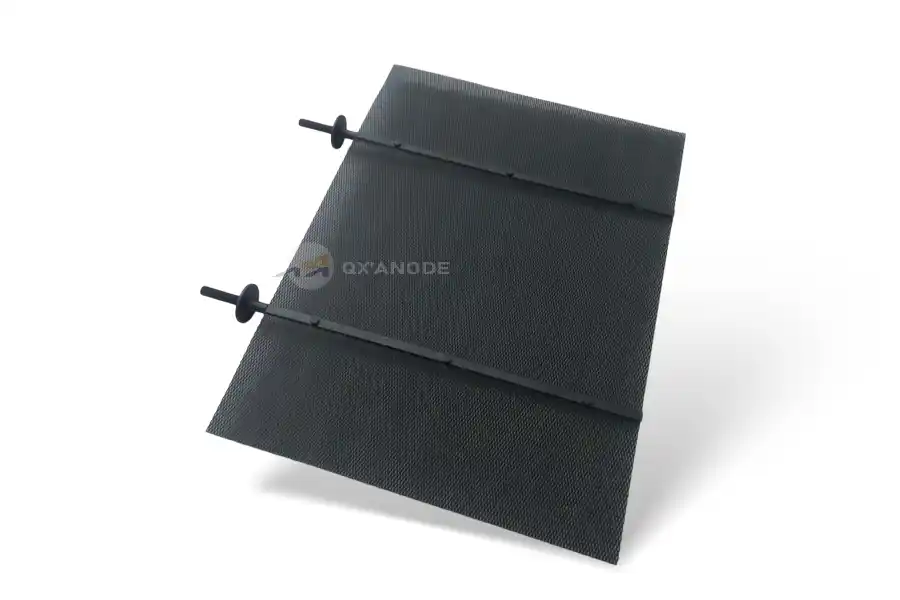
Qixin builds custom MMO coated titanium anodes for electrochemical scale removal units that treat circulating cooling water. Scale forms on our cathode partner plates, not on your heat exchangers, and the chlorine generated at the anode surface keeps biofilm and Legionella in check during the same pass. Every anode is built to your drawing, with Ru-Ir or Ir-Ta coating matched to your water analysis, and every quote request gets an answer within 12 hours.
Related reading: the Titanium Anode Guide covers coating chemistry and service life fundamentals in depth.
How Electrochemical Descaling Works, and Where the Anode Fits
A circulating water descaling unit is a reactor installed on a cooling tower sidestream or directly in the recirculation loop. Inside it, DC current drives two complementary reactions:
- At the cathode: water is reduced, local pH rises, and the hardness that would otherwise plate out on pipe walls and condenser tubes precipitates as a soft calcium carbonate layer on a removable cathode plate. Operators scrape it off on a maintenance schedule. Nothing enters the water, nothing chemical is added.
- At the titanium anode: chloride in the water is oxidized to active chlorine species (hypochlorous acid and hypochlorite) that suppress bacteria, algae, and biofilm, the glue that makes scale stick. In low chloride water, the anode instead evolves oxygen and oxidizes organic matter directly. Hydrogen bubbles rising from the cathode also float fine suspended solids toward the surface for removal.
The anode is the component doing the chemical work, so its coating chemistry decides whether the unit actually performs. A mismatched coating dissolves, the chlorine output collapses, and the plant goes back to hauling acid. That is why we ask for your water analysis before we recommend anything.
Coating Selection: Ru-Ir vs Ir-Ta
| Condition | Recommended Coating | Why |
|---|---|---|
| Chloride above roughly 100 mg/L (most recirculating cooling systems on municipal or brackish make-up) | Ru-Ir mixed metal oxide | Efficient chlorine evolution reaction (CER); keeps a residual disinfectant in the loop |
| Low chloride or soft make-up water | Ir-Ta mixed metal oxide | Stable oxygen evolution reaction (OER); direct electro-oxidation of organics |
| Water chemistry swings between the two regimes | Tuned hybrid loading | We adjust the Ru:Ir ratio and total loading to survive both duties |
For a deeper comparison of the two coating families, see the Ru-Ir titanium anode and Ir-Ta titanium anode product pages.
Specifications
| Parameter | Typical Value | Notes |
|---|---|---|
| Substrate | Grade 1 titanium, ASTM B265 | Expanded mesh, plate, tube, or rod per drawing |
| Coating | Ru-Ir or Ir-Ta mixed metal oxide | Selected from your water analysis |
| Coating loading | 8 to 15 g/m² | Higher loading for longer design life |
| Typical current density | 10 to 50 mA/cm² | Matched to reactor design and water conductivity |
| Operating temperature | Up to 60 °C continuous | Suits condenser and cooling tower loops |
| Cell voltage behavior | Dimensionally stable (DSA) | Electrode gap stays constant; no substrate growth or passivation drift |
| Design life | Commonly engineered for 3 to 5 years | Confirmed per quote based on water analysis and duty cycle |
| Delivery | Custom sizes, welded assemblies, cabling | Drawing and quote turnaround within 12 hours |
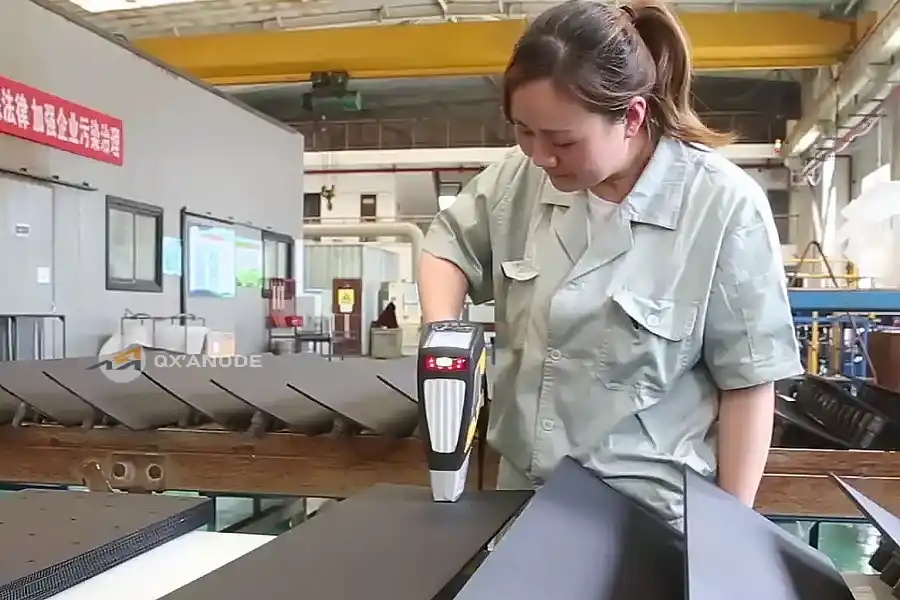
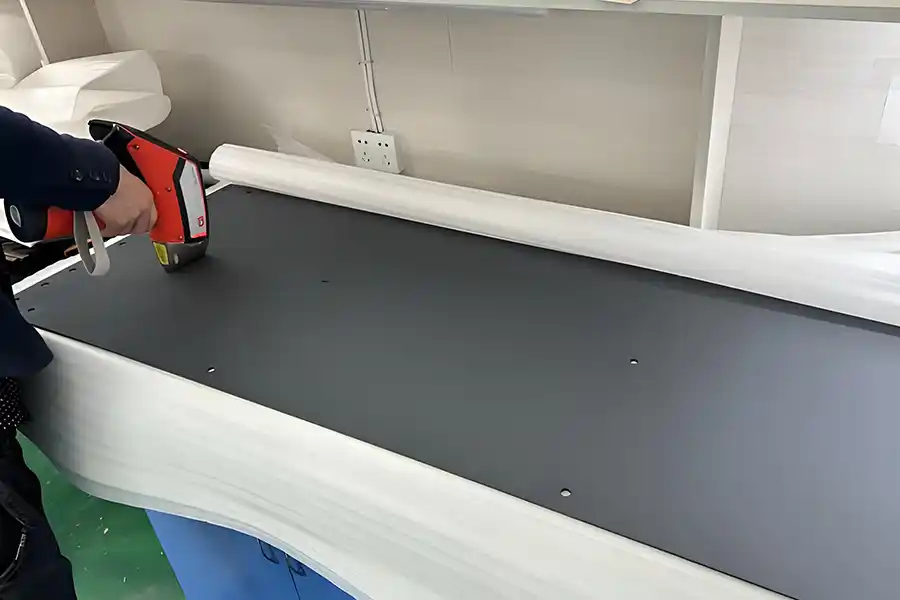
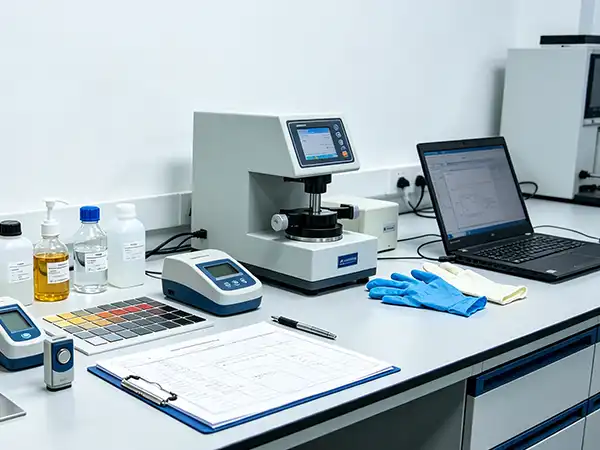
Quality backing: our R&D lab runs coating batch testing on every production lot, and the factory operates under ISO 9001 with more than 10 granted patents.
Built for Real Plant Conditions
Spec sheets rarely mention what actually kills an anode in cooling water service. Here is what we engineer around:
- Polarity reversal protection. Some self-cleaning reactor designs periodically swap electrode polarity to shed the cathode scale layer automatically. Our coatings are formulated to tolerate controlled reversal without coating loss. Tell us your control scheme and we will match the formulation.
- Biofilm under-deposit corrosion. Stagnant zones behind gaskets and bolts attack cheap coatings first. Mesh geometry gives flowing water access to the full surface, which is why our MMO titanium mesh anodes are the usual choice for sidestream reactors.
- Chloride excursions. Cooling towers concentrate everything in the make-up water. A coating sized for day-one chemistry can be undersized after a summer of high cycles of concentration. We size loading for your worst case, not your average.
- Current distribution. A plate anode facing a distant cathode wastes edge current and wears unevenly. We design the current distributor and bus bar layout with the reactor, not just the electrode.
Where This Fits with Our Other Water Treatment Anodes
- Titanium anodes for wastewater treatment: electro-oxidation of organic pollutants and disinfection, a heavier duty cousin of this application.
- Titanium anodes for salt chlorine generators: the same Ru-Ir chemistry applied at higher chlorine output for pools and process water.
- MGPS anodes for marine electrochlorination: anti-fouling for seawater circuits on vessels, where the fouling problem is the same and the chloride is far higher.
- Sintered titanium filter elements: pair with your descaling sidestream to capture the floated suspended solids and precipitated hardness downstream.
Working with Qixin
- Send us your water analysis (hardness, chloride, conductivity, pH) and the reactor drawing or a sketch of your target geometry.
- We reply within 12 hours with a coating recommendation, loading, life estimate, and quote.
- Production runs under ISO 9001 batch control, with coating test records shipped with the anodes.
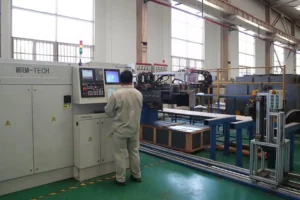
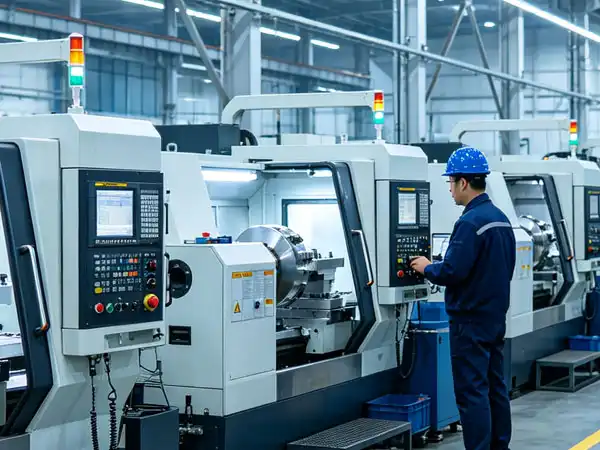
As the manufacturer behind our full titanium anode range, we control substrate preparation, coating formulation, and sintering in-house, which is how we hold batch-to-batch consistency across orders of one prototype to thousands of production anodes.
Frequently Asked Questions
How does a titanium anode remove scale from circulating water?
In an electrochemical descaling unit, scale forms on the cathode, not the anode. The cathode raises the local pH, so calcium and magnesium carbonates precipitate onto a removable cathode plate instead of pipework and heat exchangers. The titanium anode completes the circuit, drives the reaction, and generates chlorine or oxygen species at its surface that suppress biofilm and Legionella in the same pass.
Which coating should I choose, Ru-Ir or Ir-Ta?
Choose Ru-Ir mixed metal oxide when the circulating water carries meaningful chloride, typically above roughly 100 mg/L, because it evolves chlorine efficiently and controls biofouling. Choose Ir-Ta when chloride is low and oxygen evolution dominates. We match the coating to your water analysis before quoting.
How long does the anode last in cooling water duty?
Design life depends on water chemistry, current density, and coating loading. At typical cooling water current densities of 10 to 50 mA/cm², anodes with 8 to 15 g/m² loading are commonly engineered for 3 to 5 years of service. We issue a life estimate with each quotation based on your water analysis and duty cycle.
Does electrochemical descaling replace chemical treatment completely?
In most plants it cuts scale inhibitors and biocide dosing sharply and removes the need for acid handling, but complete replacement depends on cycles of concentration, make-up water quality, and system metallurgy. Many operators run the electrolysis unit as the primary treatment and keep a minimal chemical backup for excursions.
Can you build anodes to our reactor drawing?
Yes. We manufacture plate, mesh, tube, and rod anodes to customer drawings, including welded assemblies, current distributors, and cabling. Send your drawing and water analysis and we reply with a coating recommendation and quote within 12 hours.
Need a custom anode for your process?
Send us your drawing or specs — we’ll quote within 12 hours.