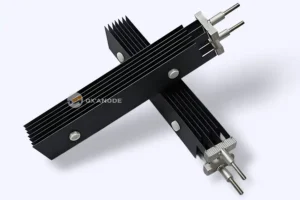
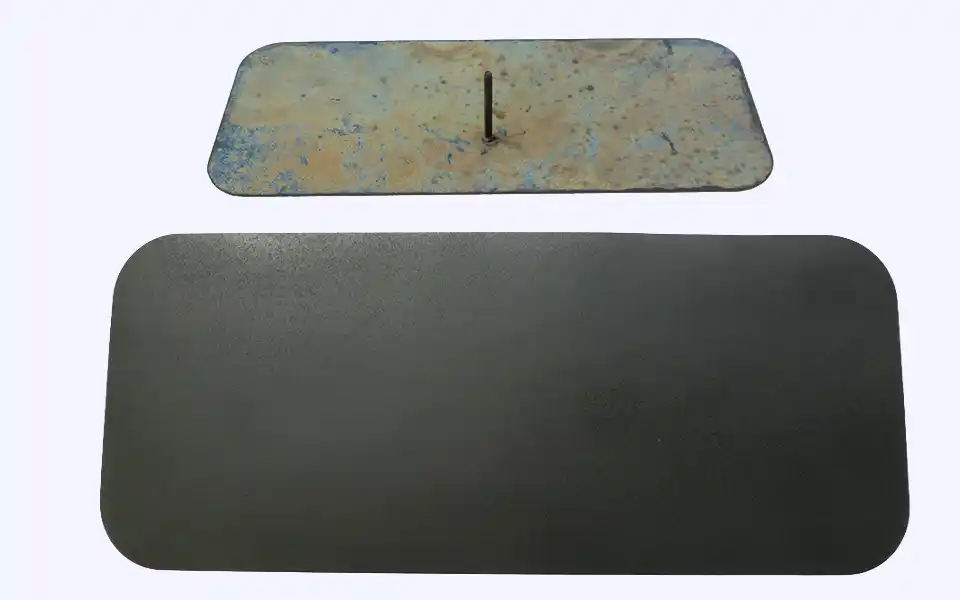
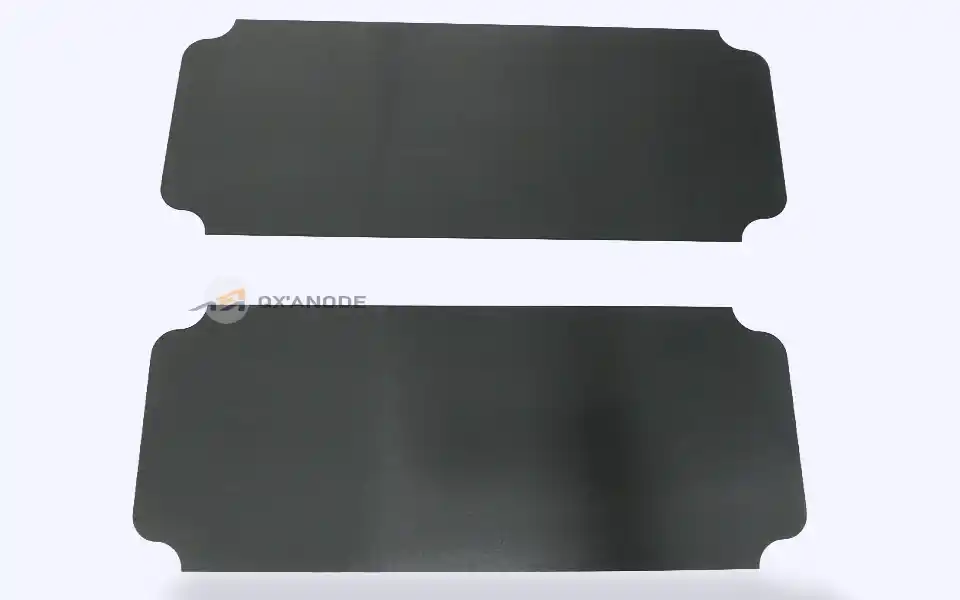
ED · EDR · EDI Stack Electrodes · DSA / MMO
Mixed metal oxide coated titanium anodes and paired cathode assemblies built for electrodialysis, reversal, and electrodeionization stacks. Stable cell voltage, corrosion resistance in brine and acid-alkaline rinse, and fabrication to your stack drawing. We match the coating to your rinse chemistry: ruthenium-iridium for chloride-rich streams, iridium-tantalum where oxygen evolution dominates.
ED, EDR, and EDI: What Sets Them Apart
All three are electric-field membrane processes, but they solve different problems and put different demands on the end electrodes. If you are specifying replacement electrodes, the first question is which process your stack actually runs.
| Process | Full name | Core purpose | Stack setup | Typical feed & output |
|---|---|---|---|---|
| ED | Electrodialysis | Desalinate or concentrate by driving ions through alternating ion-exchange membranes under DC voltage | Cation and anion membranes alternate between two end electrodes; continuous operation, fixed polarity | Brackish or saline feed → demineralized water or concentrated brine |
| EDR | Electrodialysis reversal | ED with timed polarity swap that exchanges diluate and concentrate, lifting scale and fouling off membrane surfaces | Same membrane arrangement as ED, plus a reversal controller and valve switching; polarity flips every 15–30 minutes or hourly | Hard, high-silica, or scaling-prone water → stable operation with less chemical cleaning |
| EDI | Electrodeionization | Continuously regenerate mixed-bed resin inside the compartments with water splitting, producing high-purity water without acid or base regeneration | Membrane compartments filled with ion-exchange resin; electrodes at the ends carry a smaller current than a desalination stack | RO permeate feed → ultrapure water, typically 15–18 MΩ·cm resistivity |
Where ED is used
Brackish and seawater desalination, brine concentration and salt recovery, acid and alkali recovery, food and dairy demineralization, process wastewater reuse, and lithium extraction from salt-lake brines. A coated anode with a bare or coated titanium cathode is the typical arrangement.
Where EDR is used
Industrial water reuse, RO pretreatment, and feeds with high hardness or silica that would scale a standard ED stack. Because polarity reverses on a timer, both end plates spend half their life as the anode and need a reversal-tolerant coating on both sides.
Where EDI is used
Power boiler makeup, electronics ultrapure water, and pharmaceutical polishing trains, usually installed downstream of reverse osmosis. Electrode duty is lighter; coating choice follows the rinse water chemistry and the small continuous current of the EDI module.
Electrode takeaway
ED and EDR both run end electrodes in a rinse loop; the difference is that EDR reversal makes each plate an anode half the time. EDI electrodes see a lower current and a cleaner, low-TOC feed. One anode specification does not cover all three — tell us the process and the reversal cycle when you send the inquiry.
Where the Electrode Sits in the Stack
An electrodialysis stack is a clamp: alternating cation and anion exchange membranes are squeezed between two end plates, product flows through the cell pairs in the middle, and the electrodes sit at the ends, each inside its own rinse compartment separated from the first cell pair by a membrane.
The rinse loop sets the chemistry
The electrode never touches product water. Feed hardness, organics, and pH reach it only indirectly, through a leak or the rinse loop. What it sees continuously is the full stack current — so the rinse composition, not the feed, decides which coating you need.
This is the same DSA construction covered in our Titanium Anode Guide, adapted to the lower current densities and rinse-water chemistry typical of ED, EDR, and EDI equipment.
Check the active area before approving the drawing
With full-face plates that match the membrane area, electrode current density and stack current density are roughly the same number. With strip, rod, or frame-mounted electrodes, the active area is smaller and electrode current density can be several times higher. An electrode sized against stack current density but running at three times that value will shed coating on a schedule nobody planned for.
What Happens at Anode and Cathode
Anode: chlorine or oxygen evolution
- Chlorine evolution (CER) dominates when the rinse carries appreciable chloride: chloride oxidizes to chlorine, which stays in solution as hypochlorous acid or hypochlorite depending on pH.
- Oxygen evolution (OER) dominates in low-chloride, sulfate, or acidic streams: water oxidizes to oxygen and protons.
- The two reactions compete for the same surface, and which wins is set by coating chemistry, not by the rectifier.
Cathode: hydrogen, scale, and hydrogen pickup
At the cathode, water reduces to hydrogen and hydroxide. The local pH rise is why cathodes scale: calcium and magnesium in the rinse drop out as carbonate and hydroxide where current density is highest, usually at the inlet edge and around the stud.
Titanium also absorbs hydrogen. Cool, moderate current, and clean rinse keep the hydride layer to a thin surface film. Hot operation, high current density, or fluoride in the rinse thickens that layer until it cracks — a mechanical failure with an electrochemical cause.
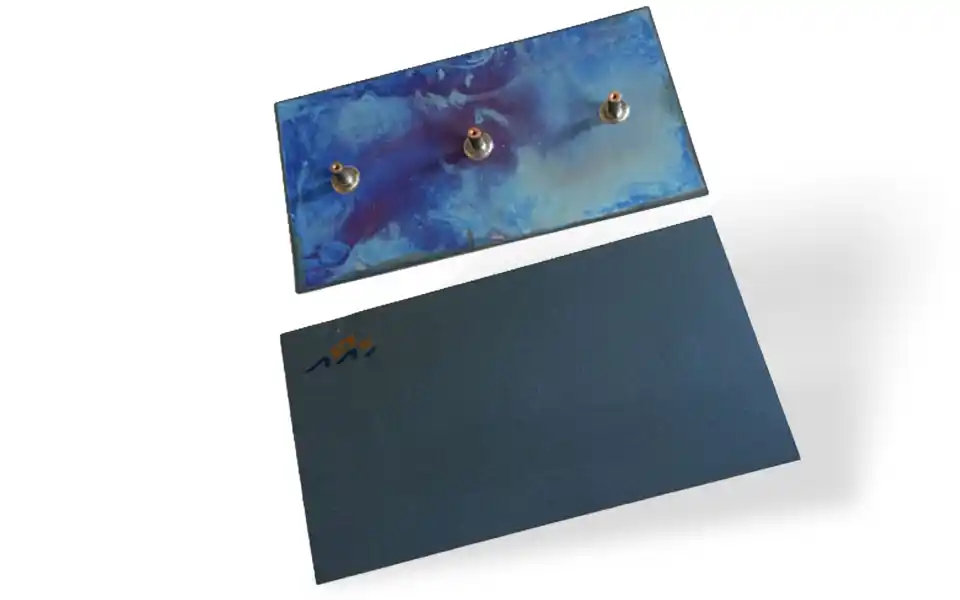
Coating Systems for ED, EDR, and EDI Service
The choice follows rinse chemistry first, current density second, and price per square meter third. Coating thickness is specified in microns per side and checked on arrival, so it becomes a warranty term rather than a marketing figure.
| Coating | Rinse it suits | Strength | Where it goes wrong | Oxide thickness |
|---|---|---|---|---|
| Ir–Ta oxide IrO₂–Ta₂O₅, OER | Sulfate rinse, low chloride, acidic streams | Stable under oxygen evolution; the Ta₂O₅ fraction slows the passivation that eventually ends every IrO₂ coating | Sluggish chlorine evolution, so it loses ground quickly if chloride creeps into the rinse | 5–12 µm |
| Ru–Ir oxide RuO₂–IrO₂–TiO₂, CER | Chloride-bearing rinse, hypochlorite service, seawater-level chloride | Low chlorine overpotential, high activity at moderate current | Ruthenium dissolves under oxygen evolution and high anodic potential; a poor match for a sulfate rinse with frequent reversal | 8–12 µm |
| Reversal-tolerant bifunctional EDR duty | Polarity-reversal stacks, both compartments | Tolerates the potential step, gas switch, and pH swing each reversal produces on either plate | Not a generic coating; must be qualified for the reversal interval and rinse chemistry | 8–15 µm |
| Platinum-plated titanium Pt/Ti | Clean, low-current, small stacks and high-purity duties | Predictable, works as anode or cathode, no oxide growth to manage | Dissolves at high anodic potential; not a reversal coating where chloride and frequent reversal coincide | 1–3 µm |
Specify thickness, not just loading
Put the coating thickness in microns on the drawing, per side, and name the measurement method. A loading figure in g/m² is not comparable between suppliers, because the same mass of IrO₂ and of a mixed IrO₂–Ta₂O₅ film produce different thicknesses and densities. Thickness is also the number you can verify later with an eddy-current gauge or a polished cross-section.
Substrate grade matters too. Grade 1 and Grade 2 titanium differ in iron and oxygen content, and both differ from recycled sheet that shows up in low-cost electrodes. Impurities at grain boundaries are where the passivation film starts; once a TiO₂ layer closes over a pore, that patch of coating is electrically dead regardless of how much precious metal sits above it. See the full MMO anode line, the platinum-plated titanium anode,
How Polarity Reversal Changes the EDR Specification
In an EDR plant the polarity flips on a timer, often every 15 to 30 minutes, sometimes hourly. The reversal is not for the electrode: it swaps diluate and concentrate, lifts scale off the cathode, and pushes foulant away from the membrane surface. Membrane life and cleaning frequency are what the operator is buying. The electrode pays for it.
What each flip does to the plate
After every reversal, the plate that was the cathode becomes the anode. Its potential jumps by several volts, the gas switches from hydrogen to oxygen, and the local pH swings from alkaline to acidic. The coating now runs oxygen evolution on a surface that was a hydrogen electrode minutes earlier.
Three points for the specification
- Both electrodes need an anodic coating. A coated anode paired with a bare titanium cathode is fine for one-way ED and wrong for EDR. Coat both, or fit a bifunctional coating designed for reversal.
- The coating has to tolerate interruption. Each flip is a potential step and a gas-volume change. Coatings qualified on steady-state life tests have not seen the thing that actually kills them here.
- Both rinse compartments need flow in both polarities. The compartment that was the cathode is now the anode and makes oxygen. A vent that only opens one way lets gas accumulate, current crowds into the wet part of the plate, and the dry part cooks.
Reversal frequency deserves the same skepticism. Flipping more often than the scaling rate requires buys nothing and spends coating life, because every cycle is a potential step. Set the interval from the measured scaling rate of your water, not from the commissioning sheet of a similar plant.
Where These Electrodes Are Used
Electrodialysis shows up across water treatment, chemical recovery, and food processing. The electrode specification stays similar across these duties; the coating choice follows the rinse chemistry in each case.
Brackish & seawater desalination
Stacks producing potable or process water from brackish wells and seawater, where the electrode rinse carries seawater-level chloride.
Brine concentration & salt recovery
Concentrating saline streams before evaporation or salt recovery, with chloride-rich rinse and continuous stack operation.
Acid and alkali recovery
Bipolar membrane and recovery loops that reclaim acid and base from process liquors; Ir-Ta coating for the acidic side.
Food & dairy demineralization
Partial demineralization of whey, sugar, and beverage streams where membrane compatibility and low metal shedding matter.
Wastewater reuse & scaling feeds
Removing dissolved salts from process effluent where hardness or silica would foul a standard ED stack. Related: our wastewater treatment anodes.
Ultrapure water & brine extraction
RO polishing for boiler and electronics water, plus pretreatment loops for lithium and salt-lake brine processing.
Typical Specifications
Values below reflect standard industrial practice for ED, EDR, and EDI service. Final dimensions, coating thickness, and current rating come from the stack drawing and the electrolyte the electrode will run in.
| Substrate | Grade 1 or Grade 2 commercially pure titanium (ASTM B265 / F67), with mill certificate on request |
|---|---|
| Coating systems | RuO₂–IrO₂–TiO₂ (CER); IrO₂–Ta₂O₅ (OER); reversal-tolerant bifunctional (EDR); platinum-plated option |
| Oxide thickness | 2–8 µm standard ED service; 8–15 µm heavy-duty or reversal duty; 1–3 µm platinum |
| Available forms | Plate, expanded mesh, rod, tube, wire, ribbon — cut to drawing |
| Current density | 100–1,000 A/m² continuous, on the electrode’s own active area; depending on coating, rinse flow, and cooling |
| pH range | Approximately 0–12, coating dependent; extreme ends reviewed case by case |
| Temperature | Up to about 60 °C in standard designs; higher temperatures evaluated with the duty sheet |
| Electrical connection | Welded titanium tab or threaded stud; copper-cored tab for high-current feed |
| Service life | 2–5 years at rated conditions; influenced by current density, chloride, pH, temperature, and reversal frequency |
Electrode Geometry Options
ED and EDR stacks use flat plate or mesh electrodes most often, but rod, tube, and wire forms show up in modular cells, rinse loops, and retrofitted hardware. Follow a geometry below for the dedicated product page.
Titanium Anode Plate
Flat rigid electrodes for standard stack frames, drilled to match the current distribution of the cell.
MMO Titanium Mesh Anode
Expanded mesh for higher active surface area and open flow, common in water treatment cells.
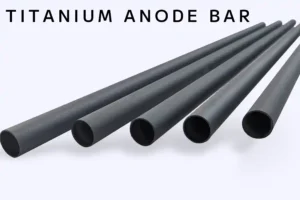
Titanium Anode Rod
Solid or copper-cored rods for modular cells, rinse loops, and threaded terminal assemblies.
Titanium Tube Anode
Cylindrical electrodes for flowing electrolyte and enclosed rinse compartments.
Coated Titanium Anode Wire
Bendable wire for woven electrodes, flexible loops, and confined cell spaces.
MMO Anode Ribbon
Narrow strip form for retrofit frames and cells where a full plate will not fit.
Failure Modes, and What to Check First
Electrode problems in ED rarely announce themselves. They show up as a slow voltage drift that gets blamed on membranes for six months. Work through this diagnostic order before replacing electrodes.
| What you see | What it usually is | Check first |
|---|---|---|
| Cell voltage drifts up 0.1–0.3 V over months, current steady | Passivation film spreading through coating pores | Coating thickness and substrate grade; probe voltage at the plate, not just across the stack |
| Voltage jumps right after a reversal, then settles higher | Gas pocket in the compartment that just became the anode | Vent orientation, check valves, minimum flow per compartment |
| Pitting at cut edges, holes, and bends | Thin or missing coating where the sheet was sheared | Edge coverage on the drawing, deburr and radius spec |
| White or brown deposit on the cathode face | Hardness in the rinse, low velocity, high local pH | Rinse water analysis, flow rate, temperature |
| Cracks, flaking, grey-black film on the cathode | Hydride embrittlement | Temperature, current density, fluoride, whether the cathode is coated at all |
| Coating gone in a band near the inlet | Gas blanketing and erosion at the inlet geometry | Gap to membrane, inlet distributor, flow distribution |
| Fast wear with no visible pattern | Chloride or fluoride contamination in the rinse | Ion analysis of the rinse loop, not the electrode |
Gas blanketing and rinse contamination account for most returns we see. Both are system problems that present as electrode problems, and neither is fixed by buying a thicker coating.
What to Put in the RFQ
| Parameter | What to state | Why it matters |
|---|---|---|
| Substrate | Grade 1 or Grade 2 titanium, with mill certificate | Impurity level sets where passivation starts |
| Form | Plate, expanded mesh, or perforated sheet, with thickness | Mesh buys area but traps gas if the flow is wrong |
| Current density | A/m² at maximum stack current, on the electrode’s own area | Drives coating thickness and expected life |
| Coating | System and thickness in µm per side, plus measurement method | Makes the coating inspectable and warrantable |
| Rinse chemistry | Salt concentration, chloride and fluoride limits, pH, temperature | Decides IrO₂ versus RuO₂, and rules out half the failures |
| Reversal cycle | Minutes per cycle, and whether both electrodes are coated | A reversal stack needs a different electrode, not a bigger one |
| Gap | Distance to the adjacent membrane, with tolerance | Too tight risks puncture at reversal, too wide wastes volts |
| Connection | Stud or tab size, material, torque in N·m | Contact resistance at the joint looks like coating failure |
| Life basis | Hours at a stated current density and temperature, and what voids it | Without the conditions, a life figure means nothing |
Installation Details That Decide Life
None of these points is exotic. All of them get skipped when the crew is under schedule pressure, and all of them show up two years later as an electrode that “failed early.”
- Torque in two passes, then measure. Record busbar-to-electrode resistance at installation. A loose joint shows up as heat at the stud, not as a voltage reading, and by the time you find it the plate is discolored and the coating under the stud is gone.
- Hold the gap. Shim it, then check it after the stack is torqued. Membranes move when the stack compresses, and a gap that measured 4 mm cold is not 4 mm hot.
- Vent the high point of both rinse compartments. Hydrogen leaves the cathode side; oxygen leaves the anode side. In a reversal stack both compartments do both jobs, so both need a vent that works in either direction.
- Commission with a current sweep. Log cell voltage at three currents and keep the sheet. A single point at design current tells you nothing later; three points let you separate an electrode problem from a membrane problem.
- Photograph both electrode faces. At install, and at every membrane cleaning. Six months in, that photo is the only baseline you will have.
Why Specify Qixin ED Anode
Built around your duty sheet
We do not ship a generic coated plate. The substrate preparation, coating chemistry, oxide thickness, and terminal are set from your rinse composition, pH, temperature, stack current, reversal cycle, and mechanical drawing. If you are replacing electrodes in an installed stack, a sample or original dimensions are usually enough to start.
Stable voltage, less membrane trouble
A DSA holds a lower and steadier overpotential than graphite or lead electrodes, which keeps cell voltage and power draw down over the run. It also avoids shedding corrosion products that can foul ion-exchange membranes and shorten membrane life.
In-house coating and fabrication
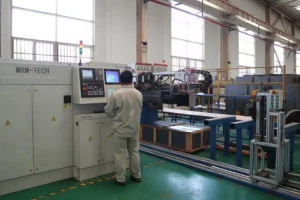
Based in Baoji — China’s titanium valley — we machine the titanium substrate, apply the precious metal oxide coating by thermal decomposition, and inspect coating weight, thickness, and electrochemical performance before dispatch. Since 2006 we have supplied more than 300 clients across 25+ countries. Read more on the about page.
Compatible paired hardware
Alongside the anode, we supply matching titanium cathode assemblies and related water-treatment electrodes for the same cell. See our wastewater treatment anode line or talk to engineering through the contact page for a paired assembly.

Frequently Asked Questions
Common questions from ED, EDR, and EDI equipment builders and plant engineers specifying replacement or new-stack electrodes.
Which coating should I choose for an ED, EDR, or EDI electrode?
Match the coating to the electrode rinse chemistry. A ruthenium-iridium oxide (Ru-Ir) coating is selected for chloride-rich streams where chlorine evolution dominates. An iridium-tantalum oxide (Ir-Ta) coating is used for low-chloride, acidic, or sulfate-rich streams where oxygen evolution dominates. EDR stacks, where polarity reverses on a timer, need a reversal-tolerant bifunctional coating on both electrodes. Send the rinse composition, pH, current density, and reversal cycle and we will recommend the system.
What is the difference between ED, EDR, and EDI?
ED (electrodialysis) uses an electric field to push ions through alternating ion-exchange membranes for desalination and concentration. EDR (electrodialysis reversal) is an ED variant that swaps electrode polarity on a timer to lift scale and fouling off membranes. EDI (electrodeionization) fills the membrane compartments with mixed-bed resin that is continuously regenerated by water splitting, producing ultrapure water, usually after reverse osmosis.
How long do MMO titanium electrodes last in electrodialysis service?
Typical service life runs 2 to 5 years at rated duty. Actual life depends on operating current density, chloride concentration, pH, temperature, rinse flow, and reversal frequency. Coating thickness is set for the expected duty rather than a single fixed figure.
Can one plate serve as both anode and cathode in a reversal stack?
Only if it is coated for it. In an EDR stack each plate spends half its life as the anode, so a coated anode paired with a bare titanium cathode fails on the cathode side first. Coat both plates with a reversal-tolerant coating, or specify a bifunctional coating rated for the reversal cycle.
How thick should the oxide coating be?
Two to eight microns of total oxide is the common band for ED service. Heavy-duty builds for high current density or aggressive rinse chemistry run 10 to 15 microns. Specify the thickness per side in microns and require a cross-section or eddy-current measurement on arrival.
Why does cell voltage rise over time?
Three candidates, in order of likelihood: a passivation film growing through coating pores, scale deposited on the cathode, and contact resistance at the busbar joint. Probing voltage at the plate itself separates the electrode contribution from the membrane stack before either is replaced.
Can electrodes be fabricated to our existing stack drawing?
Yes. We build plate, expanded mesh, rod, tube, wire, and ribbon electrodes to customer drawings, with welded titanium tabs or studs and copper-cored tabs for high-current feeds. Dimensions, hole patterns, edge treatment, and terminal position follow the stack hardware.
What information do you need to quote an ED, EDR, or EDI electrode?
Provide the rinse or electrolyte composition (chloride, sulfate, fluoride), pH, temperature, stack current or current density on the electrode’s own area, reversal cycle if applicable, electrode spacing, and a drawing or sample of the existing part. Without these, a quote is a guess rather than an engineering answer.