Titanium Wire and Titanium Alloy Wire to ASTM B863
Cold-drawn titanium wire from 0.5 mm to 6.0 mm in Grade 1, 2, 3, 4, 5, 7, 9 and 12 — annealed, pickled or bright, on spools, coils or straight lengths. Every coil is traceable to its vacuum-arc-remelted heat.
ASTM B863 AWS A5.16 ASTM F67 / F136 GB/T 3623 ISO 9001:2015
In short: Titanium wire is cold-drawn wire made from commercially pure titanium or a titanium alloy and supplied to ASTM B863. Buyers use it in four roles: welding wire, feedstock for machined or formed parts, spring and fastener stock, and the substrate for MMO-coated wire anodes. Qixin draws 0.5–6.0 mm wire in Baoji, China, and ships it annealed or in a specified cold-worked temper.
What titanium wire is, and how it is made
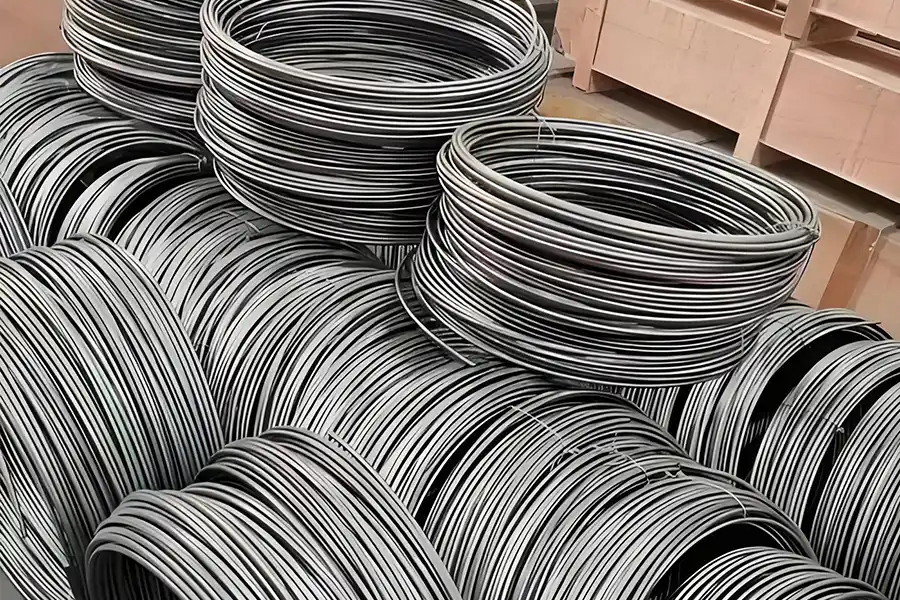
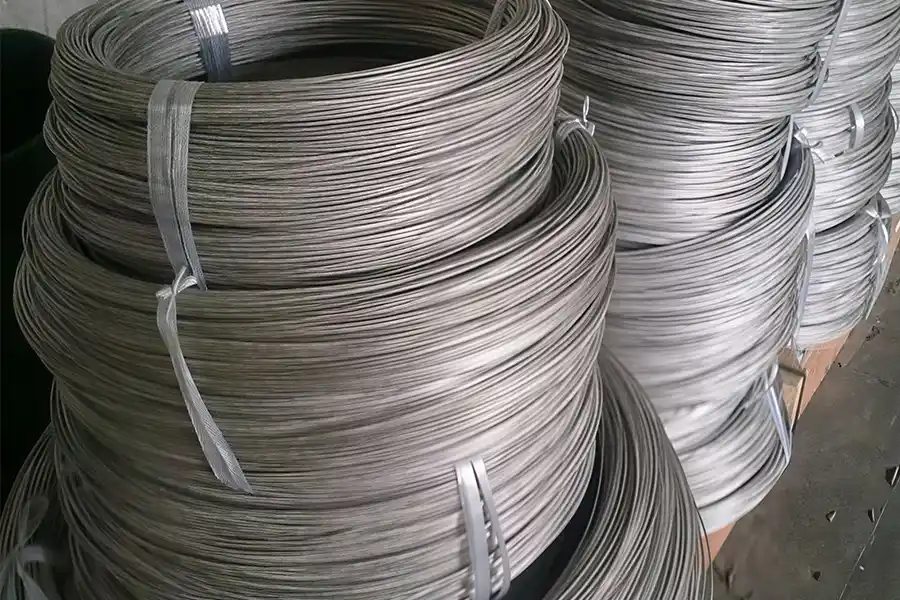
Titanium wire is produced by cold drawing. A hot-rolled wire rod is descaled, pointed and pulled through a series of carbide dies that step the diameter down; the wire is annealed between passes to restore ductility, then finished to the required surface and temper. Where titanium rod and bar is straightened and cut in larger sections, wire is delivered coiled — the form that lets it feed a TIG torch, a spring coiler, a medical wire former or a mesh loom without a secondary straightening step.
The grade you specify changes three things: tensile strength, corrosion behaviour, and how much cold reduction the wire will accept before it has to be re-annealed.
In the unalloyed grades, strength is set almost entirely by oxygen. Oxygen sits in interstitial solution and blocks dislocation movement, so the four commercially pure grades are the same metal at four oxygen levels: Grade 1 at 0.18 % maximum gives 240 MPa minimum tensile strength, Grade 2 at 0.25 % gives 345 MPa, and Grade 4 at 0.40 % reaches 550 MPa. Grade 2 accounts for most of the wire we ship, because it keeps the corrosion resistance and weldability of the pure grades at a strength that holds up in real hardware.
The alloy grades trade formability for strength. Grade 5 (Ti-6Al-4V) reaches 895 MPa annealed and is the choice where the wire is a load path — fasteners, springs, surgical instruments. Grade 9 (Ti-3Al-2.5V) sits at 620 MPa and still cold-forms well, which Grade 5 does not. Grade 7 adds 0.12–0.25 % palladium to a Grade 2 chemistry and resists reducing acids and crevice attack below pH 3; Grade 12 gets most of the same resistance from 0.3 % molybdenum and 0.8 % nickel at a fraction of the cost.
Temper matters as much as grade. Annealed wire is soft and ductile — the default for welding, coiling and heading. Cold-drawn wire carries the strength of the reduction it has seen, with lower elongation: that is the condition specified for springs, straight-length spokes and wire that must hold a set. State the temper, not just the grade, or you will receive the mill’s default anneal.
Grades, mechanical properties and chemistry
Minimum mechanical values are taken from ASTM B863 for wire in the annealed condition. Cold-drawn temper raises tensile strength and lowers elongation; specify it separately if the part depends on it.
| Grade | UNS | Tensile min | Yield min (0.2 %) | Elongation min | Typical wire use |
|---|---|---|---|---|---|
| Grade 1 | R50250 | 240 MPa | 170 MPa | 24 % | Mesh, woven screens, deep-formed parts, filtration |
| Grade 2 | R50400 | 345 MPa | 275 MPa | 20 % | Welding wire, anode substrate, general fabrication |
| Grade 3 | R50550 | 450 MPa | 380 MPa | 18 % | Intermediate strength, pressure hardware |
| Grade 4 | R50700 | 550 MPa | 483 MPa | 15 % | Springs, fasteners, high-strength CP parts |
| Grade 5 | R56400 | 895 MPa | 828 MPa | 10 % | Fasteners, surgical instruments, aerospace hardware |
| Grade 7 | R52400 | 345 MPa | 275 MPa | 20 % | Reducing-acid and chloride service |
| Grade 9 | R56320 | 620 MPa | 483 MPa | 15 % | Cold-formed tube, springs, bicycle and aerospace lines |
| Grade 12 | R53400 | 483 MPa | 400 MPa | 18 % | Heat-exchanger and chemical plant hardware |
Chemical composition, weight percent, maximum unless shown as a range:
| Grade | O | Fe | C | N | H | Alloying elements |
|---|---|---|---|---|---|---|
| Grade 1 | 0.18 | 0.20 | 0.08 | 0.03 | 0.015 | — |
| Grade 2 | 0.25 | 0.30 | 0.08 | 0.03 | 0.015 | — |
| Grade 3 | 0.35 | 0.30 | 0.08 | 0.05 | 0.015 | — |
| Grade 4 | 0.40 | 0.50 | 0.08 | 0.05 | 0.015 | — |
| Grade 5 | 0.20 | 0.40 | 0.08 | 0.05 | 0.015 | Al 5.50–6.75, V 3.50–4.50 |
| Grade 7 | 0.25 | 0.30 | 0.08 | 0.03 | 0.015 | Pd 0.12–0.25 |
| Grade 9 | 0.15 | 0.25 | 0.08 | 0.03 | 0.015 | Al 2.50–3.50, V 2.00–3.00 |
| Grade 12 | 0.25 | 0.30 | 0.08 | 0.03 | 0.015 | Mo 0.20–0.40, Ni 0.60–0.90 |
Titanium is the balance in every grade. Certificates report actual heat chemistry, not just compliance with the limits.
Which grade to choose
- Welding titanium to titanium, or cladding: Grade 1 or 2 wire, matched to the base metal — ERTi-1 for Grade 1 plate, ERTi-2 for Grade 2. A filler stronger than the base metal adds nothing and costs more.
- Wire that becomes an electrode: Grade 2. It draws cleanly, takes the etch before coating, and is the substrate used on our MMO coated titanium wire anode.
- Springs, fasteners, spokes, instrument parts: Grade 4 for pure titanium, Grade 5 where the load is high, Grade 9 where the part is cold formed after drawing.
- Chemical service in reducing acid, or crevices below pH 3: Grade 7. If cost rules it out, Grade 12 covers most chloride and mildly reducing duties.
- Anything that must be bent, headed or woven after delivery: stay annealed. Buying cold-drawn temper and then forming it is the most common cause of cracking we see in wire enquiries.
Diameters, tolerances and surface finish
| Diameter | Process route | Standard tolerance | Surface | Supply form |
|---|---|---|---|---|
| 0.5–1.0 mm | Cold drawn, annealed, bright | ±0.02 mm | Bright, pickled | Spool |
| 1.0–3.0 mm | Cold drawn, annealed | ±0.03 mm | Pickled, bright | Spool or coil |
| 3.0–6.0 mm | Cold drawn from rolled rod, annealed | ±0.05 mm | Pickled, black | Coil or straight |
| 6.0–8.0 mm | Drawn or rolled, annealed | To drawing | Pickled | Straight |
Tighter tolerances, ground finishes and intermediate diameters are quoted on enquiry. Tolerances shown are our standard offering; the governing class on an order is the one written on the drawing or in the ASTM B863 callout.
Surface condition decides how the wire behaves in the next process.
- Black — annealed with the oxide layer left on. Lowest cost, acceptable where the wire is pickled or welded after a mechanical clean, or where it is anodised and the oxide is stripped anyway.
- Pickled / acid washed — oxide removed per ASTM B600 descaling practice, leaving a matte silver surface. The normal choice for welding wire, for wire that will be coated, and for any part where surface contamination would show up in a bend test.
- Bright — vacuum or bright annealed, no oxide and no pickle residue. Specified for medical wire, eyewear, decorative and food-contact applications.
Supply forms and packaging
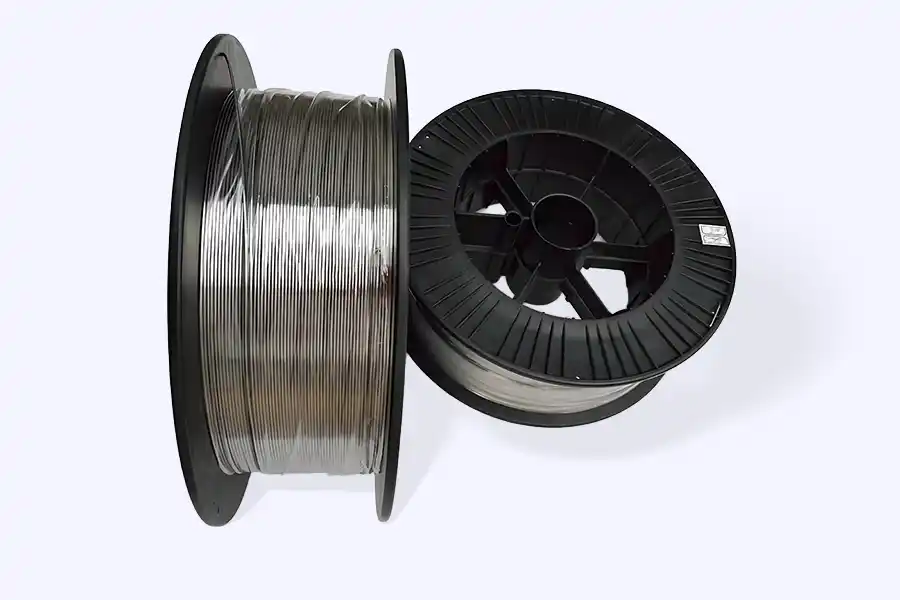
- Spools, 1–10 kg, for automatic welding, spring coilers and wire formers.
- Coils, up to 100 kg, for drawing, mesh weaving and coating lines.
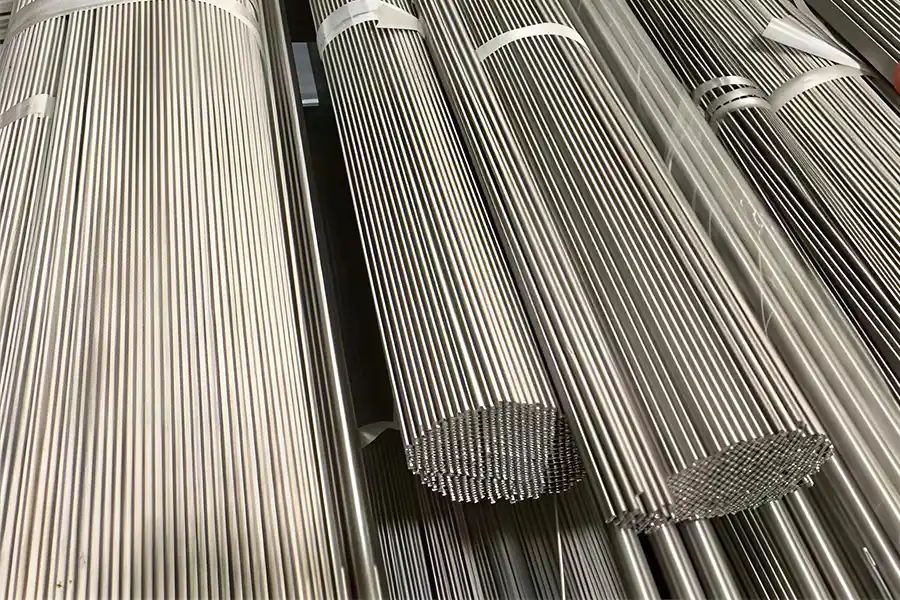
- Straight lengths, cut to 1,000 mm or to your drawing, bundled at 5 kg, straight to 1 mm per metre.
Each spool and bundle carries grade, heat number, diameter, temper, net weight and surface condition. Coils are wrapped in VCI paper, foam-padded on the flange and crated for export.

How to specify titanium wire on an enquiry
| Field | Example |
|---|---|
| Standard | ASTM B863 |
| Grade | Grade 2 (UNS R50400) |
| Diameter and tolerance | Ø 1.6 mm, ±0.03 mm |
| Temper | Annealed |
| Surface | Pickled |
| Form and weight | 5 kg spools, 20 kg total |
| End use | TIG filler for Grade 2 vessels |
| Testing | Chemistry + tensile per heat |
Eight fields, one line each, and we can quote without a second round of questions. If you only have a drawing, send that.
Grade cross-reference
| ASTM B863 | UNS | China GB | ISO 5832 | EN | Common name |
|---|---|---|---|---|---|
| Grade 1 | R50250 | TA1 | 5832-2 | 3.7025 | CP titanium |
| Grade 2 | R50400 | TA2 | 5832-2 | 3.7035 | CP titanium |
| Grade 3 | R50550 | TA3 | 5832-2 | 3.7055 | CP titanium |
| Grade 4 | R50700 | TA4 | 5832-2 | 3.7065 | CP titanium |
| Grade 5 | R56400 | TC4 | 5832-3 | 3.7165 | Ti-6Al-4V |
| Grade 7 | R52400 | TA9 | — | 3.7235 | Ti-0.2Pd |
| Grade 9 | R56320 | TA18 | — | 3.7195 | Ti-3Al-2.5V |
| Grade 12 | R53400 | TA10 | — | 3.7105 | Ti-0.3Mo-0.8Ni |
Equivalents are not interchangeable. GB TA2 and ASTM Grade 2 overlap closely, but their impurity limits are not identical, and ISO 5832-2 differs again on oxygen. If the drawing names one standard, we certify against that standard rather than substituting an equivalent.
Which standard to cite on the purchase order
| End use | Cite on the PO |
|---|---|
| General industrial wire | ASTM B863 + grade + diameter + temper |
| Welding filler | AWS A5.16 / A5.16M, ERTi-1 to ERTi-12 as applicable |
| Medical implant wire | ASTM F67 (CP) or ASTM F136 (Ti-6Al-4V ELI) |
| Surgical instruments | ASTM F899 |
| China domestic orders | GB/T 3623, chemistry to GB/T 3620.1 |
| European pressure work | certificate with the applicable PED route |
Physical constants
| Property | CP titanium (Grade 2) | Ti-6Al-4V (Grade 5) |
|---|---|---|
| Density | 4.51 g/cm³ | 4.43 g/cm³ |
| Melting point | 1668 °C | 1604–1660 °C |
| Elastic modulus | 105 GPa | 114 GPa |
| Thermal conductivity | 15.2 W/m·K | 7.2 W/m·K |
| Thermal expansion | 8.6 µm/m·K | 8.6 µm/m·K |
| Electrical resistivity | 0.55 µΩ·m | 1.75 µΩ·m |
| Magnetic permeability | Non-magnetic | Non-magnetic |
| Beta transus | ≈ 915 °C | ≈ 995 °C |
Applications
Welding and fabrication. ERTi-1 to ERTi-5 filler for titanium vessels, pipe, heat exchangers and cladding. Wire is supplied pickled, in 1 kg spools for TIG or 5–10 kg spools for orbital and automated heads.
Anode substrate. Grade 2 wire is drawn, etched and coated to become the electrode on our MMO coated titanium wire anode — used in deep-well cathodic protection, woven mesh anodes and auxiliary anodes in plating. Wire geometry is chosen where the anode has to bend, weave or fit a confined cell; the coating, not the wire, sets the current density.
Medical and dental. Grade 1, 2, 4 and 23 wire for bone screws, K-wires, archwires, staples and instrument components, to ASTM F67 and F136.
Springs, fasteners and formed parts. Grade 4 and Grade 5 wire for springs, clips, fasteners and spokes; Grade 9 where the part is cold headed or bent after drawing.
Aerospace and defence. Wire for lockwire, rivets, hydraulic line supports and instrument hardware, with heat-level traceability and mechanical testing on the certificate.
Additive manufacturing and coating feedstock. Cut titanium wire is used as feedstock in wire-based deposition processes, where diameter consistency matters more than surface brightness.
How every heat is verified before it ships
Wire is only as traceable as the melt behind it. Every coil we ship carries a heat number that follows it from the VAR ingot through drawing, annealing, finishing and packing.
- Melt route — double or triple vacuum arc remelt from certified sponge; chemistry sampled at head, middle and tail of the ingot.
- Drawing — multi-pass cold reduction with intermediate anneal; die wear logged per lot so diameter drift is caught before it reaches final size.
- Annealing — vacuum or atmosphere anneal to the specified temper, with hardness checked on the first and last coil of each run.
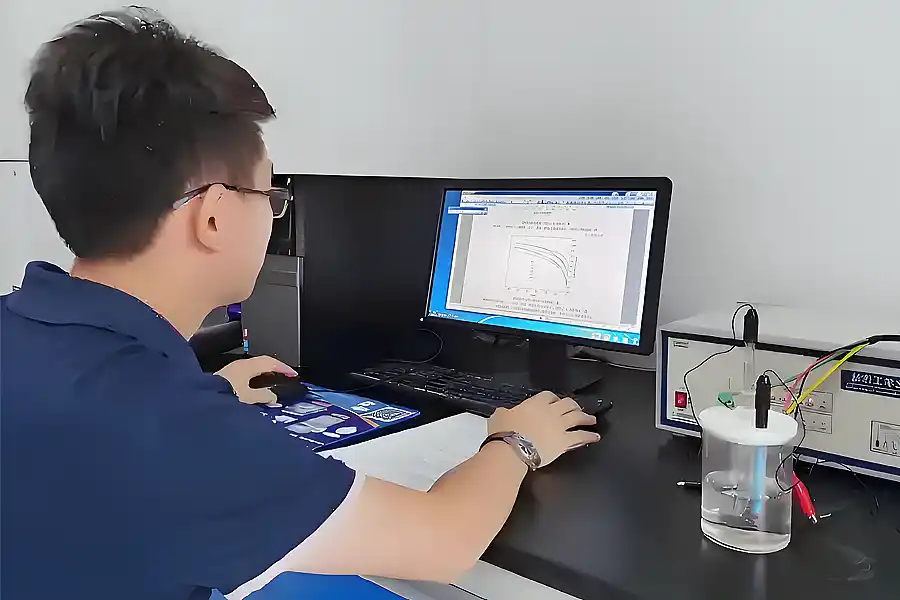
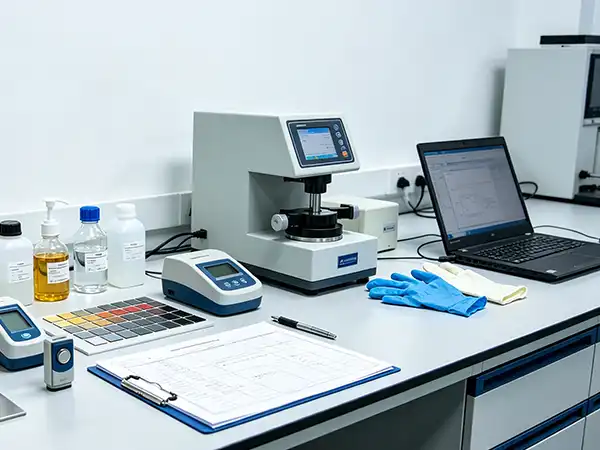
- Testing — chemistry by XRF or ICP, tensile and elongation per heat, hardness, dimensional and surface inspection on 100 % of spools. Our R&D and testing laboratory runs the same checks on incoming rod and on finished wire.
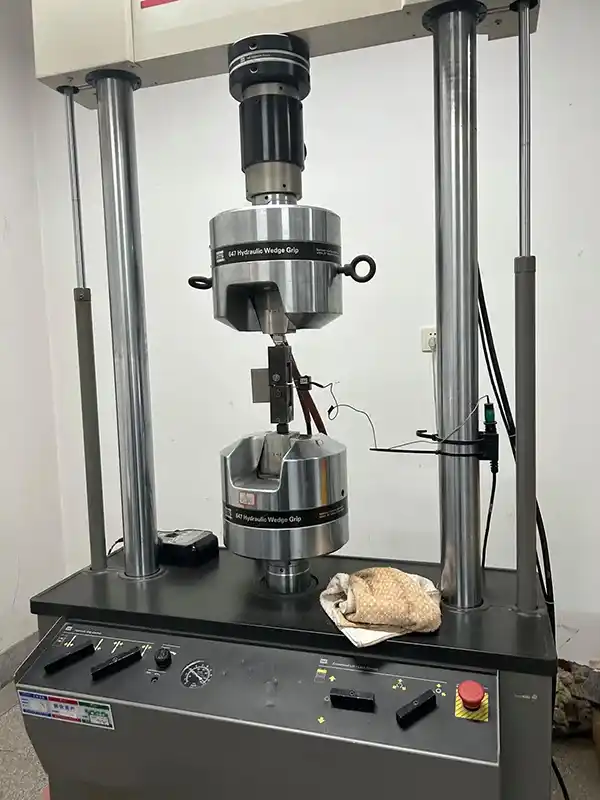
Titanium wire as an anode substrate
Most of the wire that leaves this plant in Grade 2 becomes an electrode rather than a fastener. The wire is degreased, etched, coated with RuO₂-IrO₂ or IrO₂-Ta₂O₅ by thermal decomposition and sintered — the process described on the coated titanium wire anode page, alongside the titanium anode rod and plate formats.
If your application is an electrode rather than a structural wire, start from the anode pages: coating selection follows the reaction (chlorine or oxygen evolution), and that decision sets the wire diameter, the loading and the service life. If you need the material only, this page is the right starting point — the titanium anodes section covers the finished electrode formats.
Frequently asked questions about titanium wire
What is titanium wire used for?
Titanium wire is used as welding filler for titanium vessels and pipe, as feedstock for medical and aerospace components, as spring and fastener stock, and as the substrate for MMO-coated wire anodes. The grade and temper are chosen against the duty, not the diameter.
What is the difference between Grade 1 and Grade 2 titanium wire?
The difference is oxygen content: 0.18 % maximum in Grade 1 versus 0.25 % in Grade 2. That lifts minimum tensile strength from 240 MPa to 345 MPa and lowers elongation from 24 % to 20 %. Grade 1 is chosen for maximum formability and weldability; Grade 2 for general fabrication where a little more strength is useful.
Which titanium wire grade is best for welding?
Match the filler to the base metal: ERTi-1 for Grade 1, ERTi-2 for Grade 2, ERTi-5 for Ti-6Al-4V. A stronger filler does not strengthen a titanium weld — it only changes the chemistry of the fusion zone. Specify AWS A5.16 on the order and state the base metal grade.
d the risk of surface defects, and the upper limit by coil handling rather than by the mill.
What is the difference between black, pickled and bright wire?
Black wire retains the oxide left by annealing. Pickled wire has that oxide removed by acid, giving a matte silver finish suitable for welding and coating. Bright wire is vacuum or bright annealed with no oxide and no pickle residue, and is specified for medical, decorative and food-contact parts.
What temper should I order for wire that will be formed?
Annealed. Cold-drawn temper is stronger but has little elongation left, and forming it after delivery is the most common cause of splitting in wire we are asked to investigate. If the finished part needs strength, form it annealed and specify the strength after forming, or buy the temper that matches the final operation.
What is the minimum order quantity and lead time?
Standard grades and diameters ship from 5 kg, with trial spools available for prototyping. Standard lead time is 10–15 business days; made-to-order grades and non-standard diameters run 20–30 days because they need a dedicated drawing and annealing sequence.
Do you provide material test certificates?
Yes. Every shipment carries an EN 10204 3.1 mill certificate with heat number, chemistry, tensile strength, yield strength, elongation and the standard certified against. Third-party inspection and additional testing can be arranged on request.
Can titanium wire be used as an anode?
Yes, and it usually is not used bare. Grade 2 wire is etched and coated with a mixed metal oxide layer to become a dimensionally stable anode for cathodic protection, electrochlorination and plating. Bare wire in an electrolyte would corrode; the coating is what makes it an electrode.
Send grade, diameter, temper, surface, form and quantity — or a drawing — and we will confirm price and lead time within 12 hours. Custom diameters, cut lengths and welded spool ends are quoted on the same route.