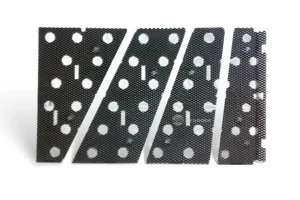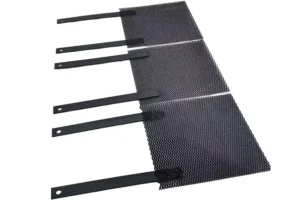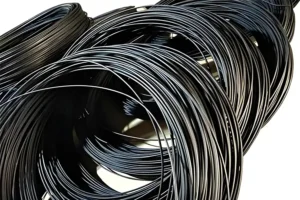
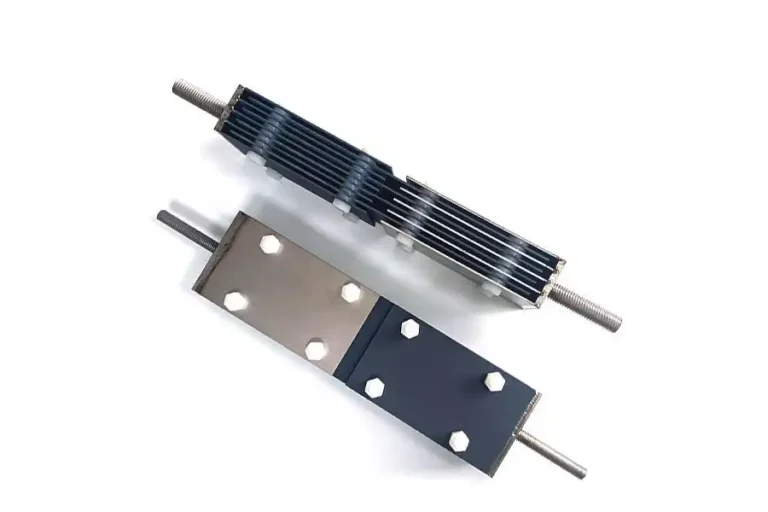
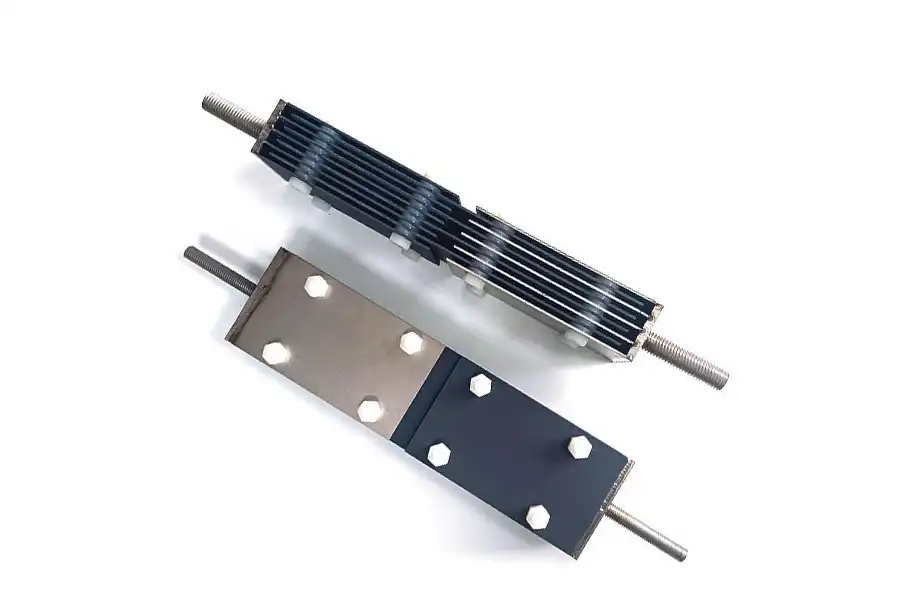
A titanium anode for ballast water treatment is a titanium electrode coated with a mixed metal oxide (MMO) catalytic layer. Installed as the positive electrode in an electrolysis cell, it oxidizes chloride ions from seawater to produce active chlorine (hypochlorous acid and hypochlorite), which disinfects ballast water before discharge. Since September 2024, all internationally trading ships have had to meet the IMO D-2 discharge standard, which is why electrolytic systems, and the anodes inside them, are now a routine procurement item for ship owners, shipyards, and BWMS integrators. The sections below cover how the anode works, how to specify it, and how to plan replacements, followed by the standard specification of Qixin RuO₂-IrO₂ coated anodes for seawater electrolysis.
Table of Contents
Key specs at a glance
- Coating: RuO₂-IrO₂ mixed metal oxide, chlorine evolution type
- Substrate: ASTM B265 Grade 1 or Grade 2 titanium
- Operating current density: up to 2,000 A/m² in seawater service
- Dosing range: typically 1 to 10 ppm as Cl₂ (total residual oxidant)
- Geometries: plate, expanded mesh, tube, and custom machined shapes
- Manufactured in Baoji, China, with SEM/EDX inspection before dispatch
Why Ballast Water Treatment Became a Hard Requirement
Ships take on ballast water to stay stable in light condition and discharge it at the next port. What travels with that water is the problem: plankton, larvae, and microbes that may have no natural predators in their new environment. When they establish, they outcompete native species and disrupt local ecosystems and economies. This is the problem the Ballast Water Management Convention was built to solve. Adopted by the IMO in 2004, it entered into force on 8 September 2017.
The convention works through two standards. D-1 requires open-ocean ballast water exchange. D-2 sets the discharge performance limits, and it is the standard that matters for treatment equipment. Under D-2, discharged ballast water must contain:
- Organisms ≥ 50 µm: fewer than 10 viable organisms per cubic meter
- Organisms 10 to 50 µm: fewer than 10 viable organisms per milliliter
- Indicator microbes: Vibrio cholerae under 1 cfu per 100 mL; Escherichia coli under 250 cfu per 100 mL; intestinal enterococci under 100 cfu per 100 mL
D-2 was phased in over several years; by 8 September 2024, all internationally trading ships had to comply. Treatment systems installed on board must be type-approved under the BWMS Code, and ships trading to U.S. waters must use systems approved by the U.S. Coast Guard. Compliance is verified by sampling and testing the treated water, so a system that cannot hold its dose becomes the shipowner’s problem at every port state inspection. This is the context that matters when buying anodes: the anode is the working component that keeps an electrolytic system compliant.
What a Titanium Anode for Ballast Water Treatment Is
Strip one down and you have two things: a titanium substrate and a catalytic coating.
Titanium substrate
Commercially pure titanium, Grade 1 or Grade 2 per ASTM B265, gives the electrode mechanical strength, low weight, and, above all, resistance to chloride attack. Seawater is one of the most corrosive environments a metal can sit in, and titanium survives there because of a thin, self-healing oxide film that forms naturally on its surface.
MMO catalytic coating
The mixed metal oxide layer is the working surface of the electrode. For chlorine evolution in seawater, the standard coating is a ruthenium iridium mixed oxide (RuO₂-IrO₂) formulation. Iridium tantalum oxide (IrO₂-Ta₂O₅) coatings are oxygen evolution types and are not interchangeable with chlorine service coatings. The oxides are applied to a prepared surface (degreased, blasted, etched), then thermally treated to form a crystalline conductive layer, usually only a few microns thick. It is this layer that carries the electrochemical reaction. Bare titanium, left uncoated, would passivate under anodic current and stop passing current almost immediately.
Because the coating keeps the electrode dimensionally stable through its working life, these parts are often called dimensionally stable anodes, or DSA, a term that comes from the chlor-alkali industry, where the same coating technology has run for decades.
How an Electrolytic BWMS Uses the Anode
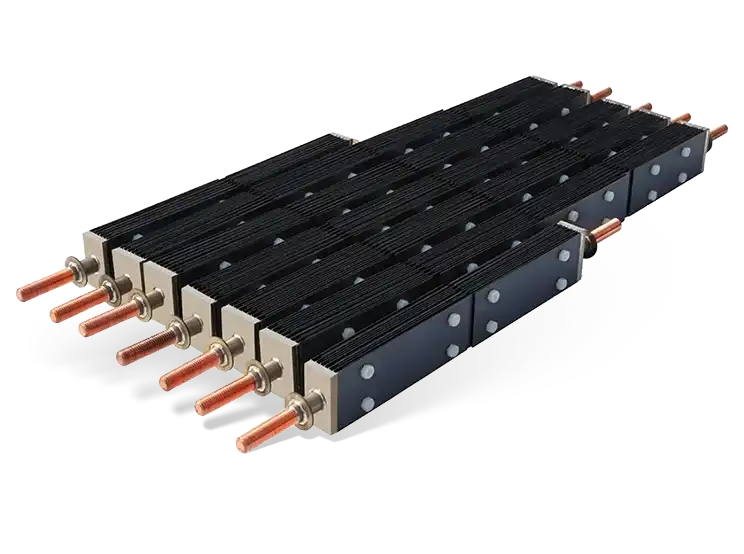
Electrolytic systems make their own oxidant on board, and they do it in one of two ways. Flow-through cells treat the ballast water itself, or a portion of it, as it passes the electrodes. Side-stream electrochlorination takes a small slipstream of seawater, electrolyzes it into a concentrated sodium hypochlorite solution, and injects that solution into the main ballast line, where it dilutes to the target dose. Systems may treat on uptake, on discharge, or both; the anode duty follows the system design. On low-salinity routes, a brine dosing step ahead of the cell keeps the electrolyte conductive, and the anode chemistry stays the same.
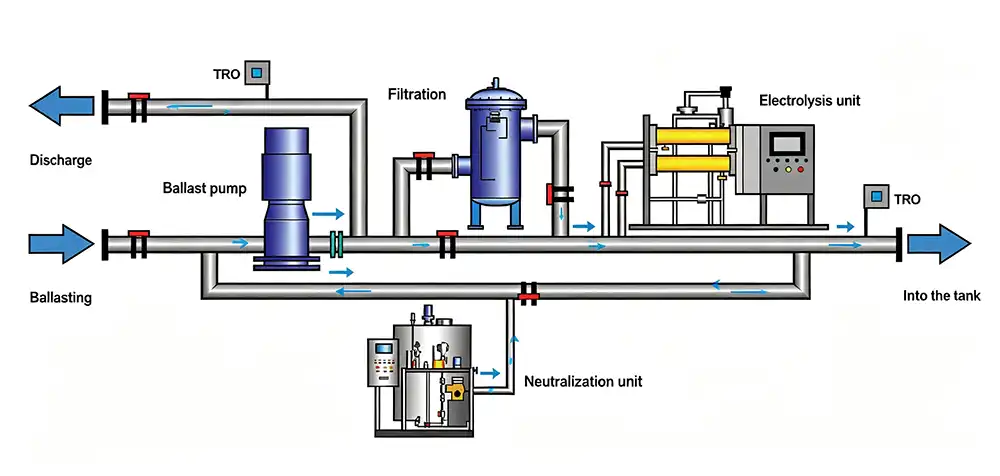
In both designs the anode chemistry is the same. Chloride ions give up electrons at the anode surface:
2Cl⁻ → Cl₂ + 2e⁻
The chlorine dissolves and hydrolyzes immediately:
Cl₂ + H₂O → HOCl + H⁺ + Cl⁻
HOCl ⇌ H⁺ + OCl⁻
The hypochlorous acid and hypochlorite, measured together as total residual oxidant (TRO), oxidize the cell structures of organisms in the water. Dosing is typically controlled at 1 to 10 ppm as Cl₂, sufficient to inactivate aquatic organisms and meet the D-2 discharge standard. The cathode side evolves hydrogen, which the system must vent or degas safely. Before discharge, most systems neutralize the residual oxidant with a reducing agent such as sodium thiosulfate, so the treated water does not leave the ship carrying a harmful oxidant load.
One clarification: not every BWMS on the market is electrolytic. UV, ozone, filtration, and deoxygenation systems exist and are widely approved. The titanium anode is the core working part only in electrolytic and electrochlorination-based systems, which happen to be a very large share of the installed fleet.
WHow MMO-Coated Titanium Compares with the Alternatives
The electrode material sets the efficiency, stability, and maintenance profile of the whole cell. These are the practical options in seawater service:
| Electrode material | Chlorine evolution | Seawater durability | Main drawback |
|---|---|---|---|
| MMO-coated titanium | Strong | Excellent | Coating is a consumable; higher first cost |
| Graphite | Moderate | Poor | Erodes in service, sheds carbon, higher overpotential |
| Lead dioxide | Good | Moderate | Lead content is a concern in marine discharge |
| Platinized titanium | Moderate | Excellent | High cost per square meter of active area |
| Sacrificial anode (zinc/aluminum) | None | N/A | Corrodes by design; makes no oxidant |
MMO-coated titanium matches what a seawater cell needs: a coating formulated for chlorine evolution, so current goes into making oxidant rather than oxygen; a substrate that survives chloride environments; and a stable geometry that keeps voltage and dose predictable over years of operation. It is also tunable: the ruthenium to iridium ratio and the coating loading can be adjusted to the duty. That flexibility matters when you are matching an anode to an existing cell rather than designing from scratch.
Technical Specifications
The table below is the standard specification for Qixin MMO titanium anodes in ballast water electrolysis service. Values marked project specific are confirmed against your cell design and duty cycle before quotation.
| Item | Specification |
|---|---|
| Coating system | RuO₂-IrO₂ mixed metal oxide (MMO), chlorine evolution type |
| Substrate material | ASTM B265 Gr1 or Gr2 titanium (plate, mesh, tube) |
| Available geometries | Plate, expanded mesh, tube, custom machined shapes per drawing |
| Operating current density | Up to 2,000 A/m² in seawater electrolysis service (project specific) |
| Electrolyte | Natural seawater, brackish water, diluted brine |
| Active chlorine output | Sized per required treatment capacity and TRO target, typically 1 to 10 ppm as Cl₂ |
| Coating service life | Verified by accelerated life testing; project specific value quoted against your duty cycle |
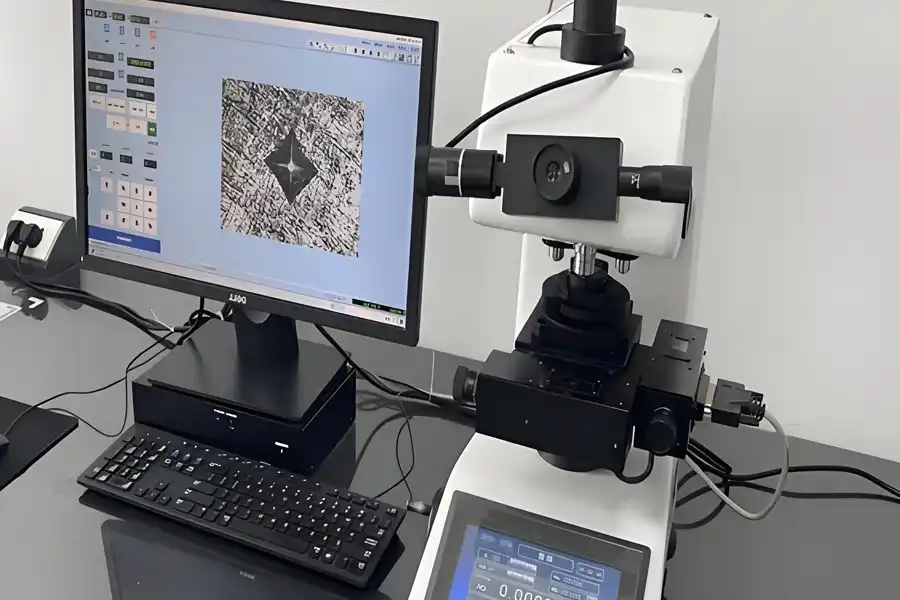
| Quality inspection | Coating adhesion, thickness and composition checked by SEM/EDX before dispatch |
Accelerated life test reports and SEM/EDX inspection records are available with each shipment on request.d SEM/EDX inspection records are available with each shipment on request.
What Decides How Long an Anode Lasts
Anyone who quotes a flat “ten-year service life” without asking about your operating conditions is guessing. Anode life is a design outcome, and the inputs are these:
- Current density. The single biggest factor. Coating is consumed as a function of the charge passed, and running a cell hard at high current density shortens coating life sharply. A cell designed for continuous high-current duty needs more coating reserve than an intermittently run unit.
- Coating loading. The amount of noble metal oxide per square meter of active area is the anode’s fuel tank. More loading costs more; the right loading is matched to current density and duty cycle.
- Hours of operation. A vessel that ballasts constantly accumulates charge far faster than one on a quiet trade route.
- Water chemistry. Salinity sets the chloride concentration; temperature changes reaction kinetics; suspended solids and biofouling can abrade or block the active surface. Hard water can deposit calcium and magnesium scale that masks part of the electrode and pushes local current density up, which is why several marine systems reverse polarity periodically to shed scale.
- Cell design. Electrode gap, flow distribution, and how evenly the current spreads across the anode determine where the coating wears first.
Under sensible design conditions, MMO titanium anodes in seawater service commonly run for years before the coating needs attention, but that figure only means something when tied to your current density, salinity, and operating hours. This is why a responsible supplier asks for operating parameters before quoting a life figure, and why replacement stock should be planned from the system’s duty, not from a brochure.
Signs That an Anode Is Reaching the End of Its Life
Coating does not fail overnight, and the symptoms are readable from the system’s own numbers:
On inspection: bare titanium showing through, blistering, or pitting on the electrode surface.
Cell voltage creeps up at the same current setting: the coating is losing activity, or the surface is passivating.
TRO output drifts down and the dosing struggles to hold its target.
Power per cubic meter treated rises; the cell works harder for the same result.
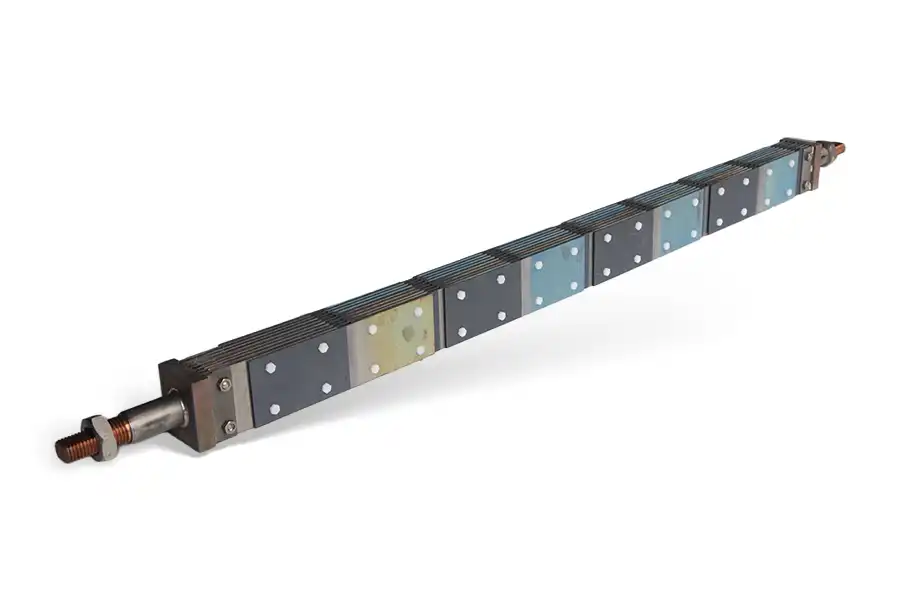
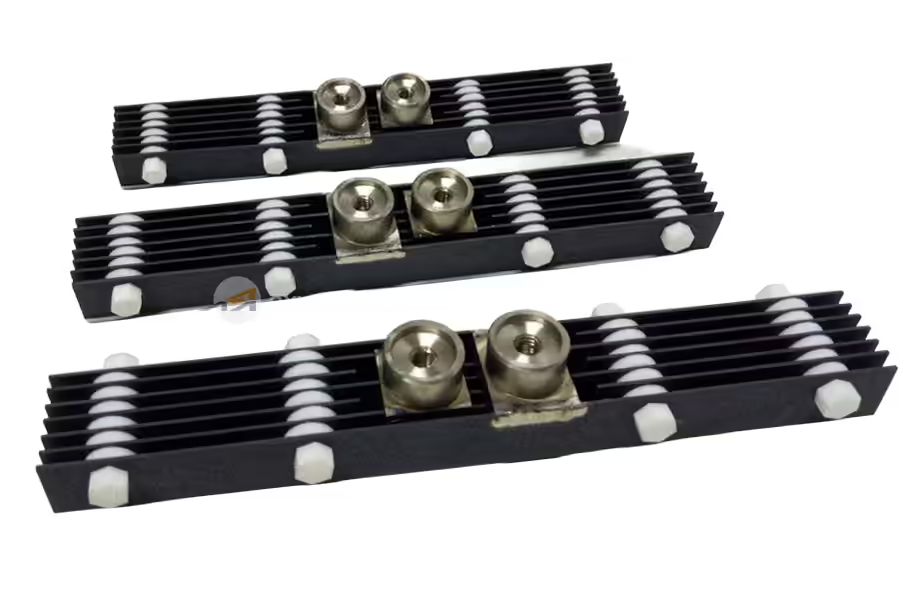
Track cell voltage and TRO against a commissioning baseline. When the trend turns clearly upward, order replacement electrodes before the system fails mid-voyage; a port state sampling failure costs far more than a spare anode. For the wear mechanisms behind these symptoms, see our article on titanium anode coating failure and maintenance. In our workshop, the most common request we see is a customer who inherited a BWMS and cannot get electrodes from the original equipment maker anymore. From a drawing, a sample, or the cell’s electrical specification, a manufacturer can reproduce the substrate geometry, active area, and coating system the cell was designed for. Early-generation systems are worth checking this way: some have electrodes that are no longer stocked parts.
Manufacturing and Quality Control
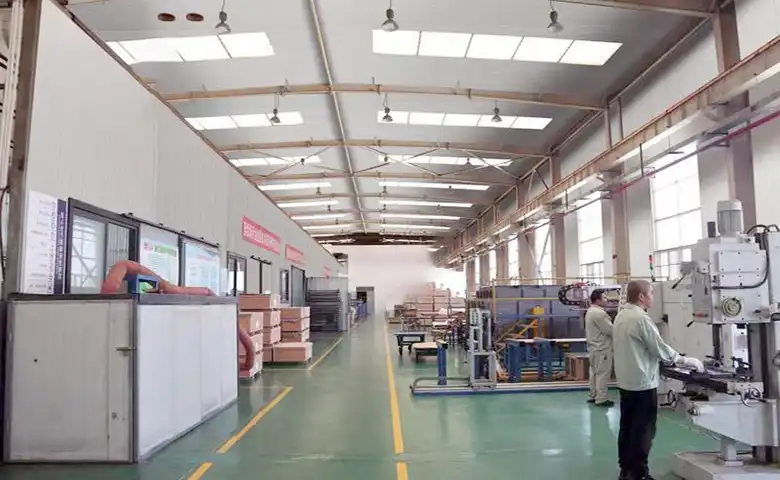
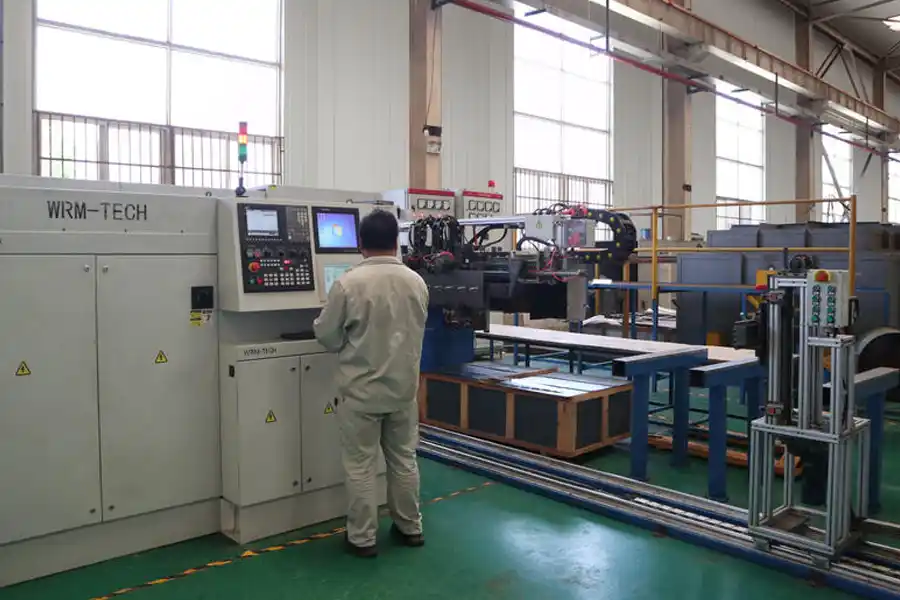
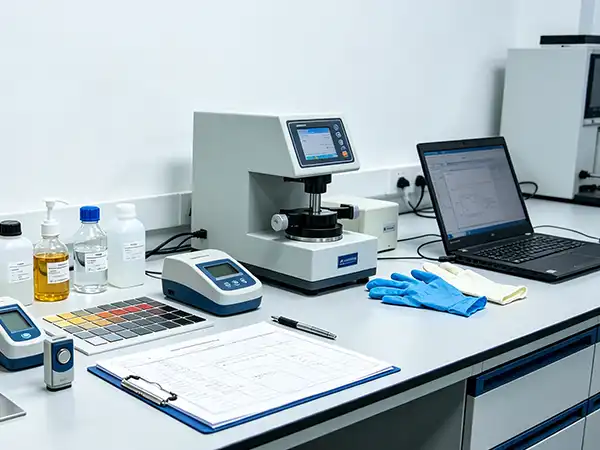
Each anode starts from certified Gr1 or Gr2 titanium, followed by acid etching for surface activation, multi-pass thermal decomposition coating, and controlled sintering. Coating uniformity is checked batch by batch, and accelerated life testing is run on witness samples from each coating lot. Coating adhesion, thickness, and composition are verified by SEM/EDX before dispatch, and test reports are available with your shipment on request. Manufacturing is based in Baoji, Shaanxi, the center of China’s titanium industry, which keeps raw material supply and machining capacity close to the coating line.
Buying or Replacing: What to Send the Supplier
An anode chosen by dimensions alone usually ends up oversized, undersized, or short lived. A complete enquiry includes:
- drawing or sample of the existing electrode;
- substrate material and grade;
- overall dimensions and the active coated area;
- number of electrodes per cell;
- operating current and voltage;
- electrolyte type (seawater or brine) and salinity;
- water temperature range;
- duty cycle (hours per day, days per year);
- quantity, and whether this is an OEM build or a replacement run.
For a new BWMS under development, the same information frames the anode design. Cell current and flow determine the active area; salinity and temperature refine the coating selection; the duty cycle decides coating loading. Getting these numbers right at the design stage costs nothing and prevents an electrode that is either oversized (expensive) or undersized (short lived). For a broader selection framework, see our guide on how to choose coated titanium electrodes.
Frequently Asked Questions
What is a titanium anode for ballast water treatment?
A titanium electrode coated with a mixed metal oxide catalytic layer, used as the positive electrode in an electrolytic ballast water treatment cell. It produces active chlorine from seawater chloride ions, which disinfects the ballast water.
How does an electrolytic ballast water treatment system work?
Seawater, or a slipstream of it, passes through an electrolysis cell. The anode oxidizes chloride to chlorine, which hydrolyzes to hypochlorous acid and hypochlorite; these oxidants kill or inactivate organisms. Residual oxidant is neutralized before discharge.
What does MMO mean on a titanium anode?
Mixed metal oxide. It is the catalytic coating applied to the titanium substrate. For chlorine evolution from seawater, the standard formulation is ruthenium iridium oxide (RuO₂-IrO₂). Titanium provides corrosion resistance and structure; the MMO layer carries the electrochemical reaction.
Which coating is used for seawater electrolysis in BWMS?
RuO₂-IrO₂ mixed metal oxide coatings are the standard choice for chlorine evolution from seawater. IrO₂-Ta₂O₅ coatings are oxygen evolution types and are not interchangeable with chlorine service coatings.
How long does an MMO titanium anode last in a ballast water system?
It depends on current density, coating loading, operating hours, salinity, temperature, and water quality. Under design conditions, years of service are common, but no honest manufacturer quotes a universal life figure without knowing the operating parameters. We verify life by accelerated life testing under defined current density and electrolyte conditions, and quote against your actual duty cycle.
Can replacement anodes be made for an existing BWMS?
Yes. Send us the original drawing or a sample anode, and we will match the dimensions, coating type and connection geometry for direct replacement, including electrodes for cells whose original maker no longer supplies parts.
What information is needed for an anode quotation?
Cell drawing or anode dimensions, substrate grade, active coated area, operating current and voltage, electrolyte salinity and temperature, target chlorine output, duty cycle and annual operating hours.
Is an MMO titanium anode the same as a sacrificial anode?
No. Sacrificial anodes (zinc, aluminum) corrode deliberately to protect steel hulls and structures. An MMO titanium anode is a dimensionally stable electrode that generates oxidants for water treatment; it does not corrode by design.
The Bottom Line
Electrolytic ballast water treatment is a mature, widely installed technology, and its performance on every ballasting operation comes down to the electrodes. A correctly specified MMO titanium anode, matched to the cell’s current density, the water chemistry, and the duty cycle, keeps the system compliant and predictable for years. If you are developing a new BWMS or replacing electrodes in an existing one, send the drawing or the operating parameters, and let the anode be sized to the job rather than to a brochure.
Request a technical quote or send your electrode drawing to our engineering team.
References
- International Maritime Organization: International Convention for the Control and Management of Ships’ Ballast Water and Sediments (BWM)
- IMO: FAQ: Implementing the Ballast Water Management Convention (PDF)
- Frontiers in Marine Science (2024): “Biological testing of ships’ ballast water indicates challenges for the implementation of the Ballast Water Management Convention”
- SGS: Commissioning Testing of Ballast Water Management Systems: A White Paper