Table of Contents
What Is a Titanium Flange?
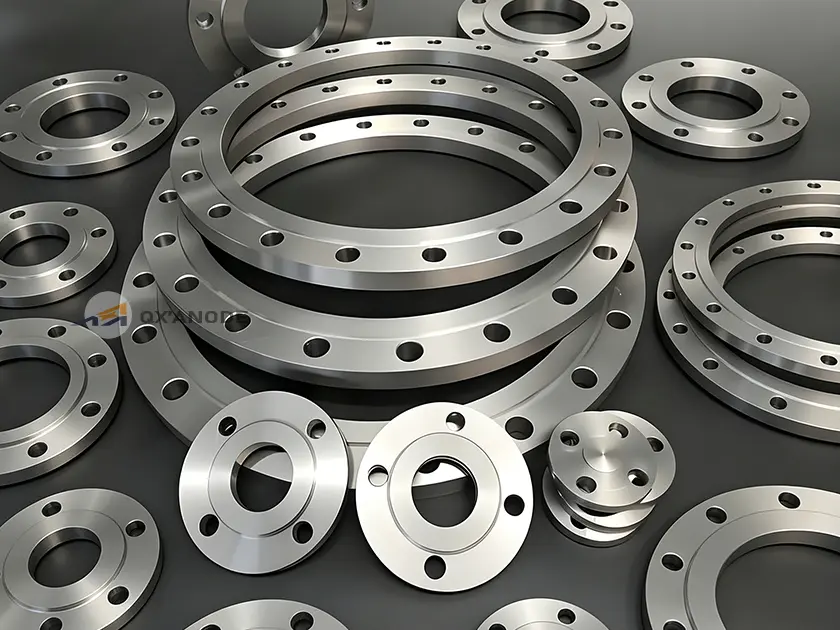
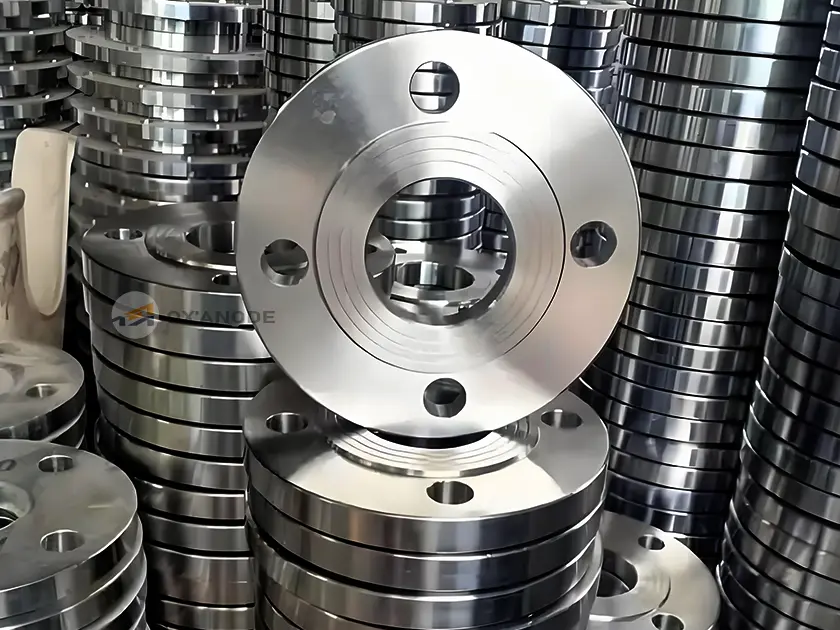
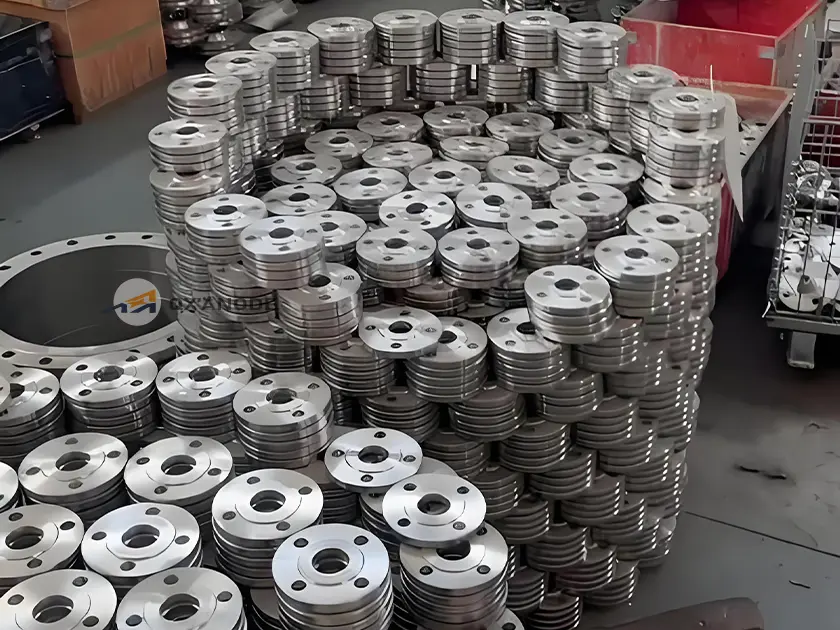
A titanium flange is a forged or machined ring fitting that joins pipes, valves, pumps, and pressure vessels with a bolted, demountable connection. It is built from titanium or titanium alloy instead of steel, so the joint survives seawater, brine, hypochlorite, and wet chlorine service that destroys conventional materials. This guide covers materials to ASTM B381, forging and heat treatment, testing and quality control, and installation, and it ends with a selection checklist.
Key specs at a glance
- Dimensional standards: ASME B16.5 (1/2″ to 24″), ASME B16.47 Series A/B (26″ to 48″), MSS SP-44, API 6A
- Material standard: ASTM B381 forgings, Grades 1, 2, 3, 4, 5, 7, 12
- Pressure ratings: Class 150 to 2500 (ASME B16.5); 2,000 to 20,000 psi (API 6A)
- Testing: EN 10204 3.1/3.2 certificates, PMI, UT, PT, hydrostatic test at 1.5 times design pressure
- Manufactured in Baoji, China, with third party inspection (SGS, BV, TÜV, DNV) on request
What Is a Titanium Flange?
A titanium flange performs the same mechanical job as a steel or stainless steel flange: it provides a bolted joint that can be assembled and disassembled for maintenance. The difference is the material. Titanium forms a self-healing TiO₂ passive film in oxidizing environments, so it resists chloride corrosion at roughly half the density of steel.
Titanium flanges are manufactured to dimensional standards such as ASME B16.5 (1/2″ to 24″), ASME B16.47 Series A/B (26″ to 48″), MSS SP-44, and API 6A. The material itself is certified to ASTM B381 (titanium and titanium alloy forgings), with the plate and bar specifications ASTM B265 and B348 used for non-forged or hybrid constructions.
In chloride-rich service such as seawater, brine, hypochlorite, and wet chlorine, a Grade 2 titanium flange routinely outlasts 316L stainless steel in the same duty. That is why titanium is the default flange material for desalination, chlor-alkali, and offshore systems.
1. Raw Material: Titanium Grades and Specifications
1.1 Commercially Pure (CP) Grades
CP titanium contains no intentional alloying elements; strength is controlled by interstitial levels of oxygen, iron, and nitrogen.
| Grade | UNS No. | Typical UTS | Density | Primary Use |
|---|---|---|---|---|
| Grade 1 | R50250 | 240 MPa min | 4.51 g/cm³ | Deep-drawn, highly formed parts |
| Grade 2 | R50400 | 345 MPa min | 4.51 g/cm³ | Standard chemical and marine piping |
| Grade 3 | R50550 | 450 MPa min | 4.51 g/cm³ | Higher-strength CP applications |
| Grade 4 | R50700 | 550 MPa min | 4.51 g/cm³ | Highest-strength CP, aerospace |
Grade 2 is the standard choice. It balances formability, weldability, and corrosion resistance, and it is the default specification for titanium flanges in chemical plants, desalination trains, and offshore systems.
1.2 Alloyed Grades
| Grade | UNS No. | Composition | UTS | Use Case |
|---|---|---|---|---|
| Grade 5 | R56400 | Ti-6Al-4V | 895 MPa min | High-pressure, high-strength joints |
| Grade 7 | R52400 | Ti-0.15Pd | 345 MPa min | Reducing-acid service (crevice corrosion) |
| Grade 12 | R53400 | Ti-0.3Mo-0.8Ni | 483 MPa min | Higher-temperature reducing media |
Grade 5 (Ti-6Al-4V) is the strongest common flange material. Its alpha plus beta microstructure delivers nearly three times the strength of Grade 2, but it is harder to machine and less forgiving under welding. Specify Grade 5 when pressure class or weight savings demand it, not as a default.
Grade 7 adds 0.15% palladium, which extends corrosion resistance into mildly reducing acids and closes the crevice corrosion gap that CP titanium can suffer in hot, stagnant chloride solutions.
1.3 Material Certification
Every heat of titanium forging stock must arrive with a Mill Test Certificate (MTC) to EN 10204 3.1 or 3.2, showing chemical composition and mechanical properties. Reputable manufacturers also run Positive Material Identification (PMI) by XRF on incoming billets before any forging begins, a low-cost step that prevents an entire batch from being made from the wrong grade.
2. Manufacturing Process
A titanium flange for pressure-boundary service must be forged, not cut from plate and drilled. Forging aligns the grain flow with the flange geometry and closes internal porosity inherited from the ingot.
2.1 Billet Preparation and Heating
The verified billet is cut to weight, accounting for forging scale and machining allowance.
Heating is done in electric or gas furnaces with a controlled atmosphere to limit oxygen pickup. For CP titanium, the typical forging temperature is 900 to 1,050 °C. For Grade 5, forging is held in the alpha plus beta field, typically 900 to 970 °C, to avoid excessive beta grain growth.
Overheating above the beta transus (about 900 °C for Grade 2, about 995 °C for Grade 5) produces a coarse, brittle microstructure that cannot be repaired. Furnace pyrometers must be calibrated and logged.
2.2 Forging
Open-die forging is used for large or one-off flanges; closed-die forging for high-volume, repeatable dimensions.
The billet is upset, then pierced or ring-rolled to form the flange blank. Ring rolling produces a ring with no weld seam and circumferential grain flow, the preferred route for weld-neck and large-diameter flanges.
Reduction ratio is typically 3:1 or greater to support full recrystallization and a refined, uniform grain size.
2.3 Heat Treatment
Heat treatment is grade-specific and must follow a documented cycle with recorded time at temperature.
| Treatment | Temperature | Purpose | Typical Grades |
|---|---|---|---|
| Stress relief | 540 to 650 °C, 1 to 4 h, air cool | Remove machining and welding residual stress | All |
| Annealing | 700 to 850 °C, 0.5 to 2 h, air or furnace cool | Restore ductility, stabilize dimensions | CP Grades, Gr 7, Gr 12 |
| Solution treatment | 900 to 970 °C, water quench | Produce metastable beta for aging | Grade 5 |
| Aging | 480 to 595 °C, 4 to 8 h, air cool | Precipitate alpha for peak strength | Grade 5 |
For a standard Grade 2 flange, the normal route is stress relief or full annealing after forging, followed by machining. Grade 5 flanges for high-pressure service typically receive solution treatment and aging (STA) to reach the 895 MPa minimum UTS.
2.4 Alpha-Case Removal
Hot forging creates a thin, oxygen-enriched surface layer called alpha case. It is hard, brittle, and acts as a crack initiation site. It must be removed by machining, grinding, or acid pickling (HF/HNO₃ mixture) before final machining. A flange shipped with visible alpha case has not been properly processed.
2.5 CNC Machining
Final machining produces the hub, bore, bolt circle, bolt holes, and sealing face. Key controlled dimensions:
- Sealing-face flatness: 0.05 mm or better for RF faces; 0.01 mm or better for RTJ grooves in critical service.
- Bolt-hole position tolerance: ±0.8 mm (ASME B16.5), verified by CMM or template.
- Surface finish (Ra): 1.6 to 3.2 µm on the gasket contact face; smoother finishes are required for RTJ metal-to-metal seals.
- Chamfers and radii per drawing to avoid stress concentrations at the hub-to-disc transition.
Drilling uses sharp cobalt or carbide tooling at reduced feed rates. Titanium has low thermal conductivity (about 21 W/m·K for Grade 2), so heat concentrates at the cutting edge and the surface work-hardens if tools dull.


3. Flange Types, Facings, and Pressure Ratings
3.1 Common Types
- Weld Neck (WN): the strongest, most fatigue-resistant type; the tapered hub transfers stress away from the weld. Preferred for critical, cyclic, or high-pressure service.
- Slip-On (SO): slides over the pipe and is fillet-welded inside and outside. Lower cost and easier alignment, but not recommended for cyclic or high-fatigue duty.
- Blind (BL): a solid disk used to close a line end or vessel nozzle. It must withstand full pressure with no bore reinforcement.
- Socket Weld (SW): the pipe inserts into a socket; used for small-bore (4″ and under) high-pressure lines.
- Threaded (THD): NPT or BSPT thread with no welding; used where welding is impractical or prohibited.
- Lap Joint (LJ): used with a titanium stub end; the backing flange can be a lower-cost material if galvanic isolation is maintained.
3.2 Facings
- Raised Face (RF): the most common facing. ASME B16.5 specifies a 1.6 mm raised face for Class 150 and 300, and 6.4 mm for Class 400 and above, with a serrated (phonographic) finish to grip the gasket.
- Flat Face (FF): full-face contact; used with brittle mating flanges (cast iron) or where full-face gaskets are required.
- Ring Type Joint (RTJ): a metal-to-metal seal using an oval or octagonal ring (typically soft iron or 316L) in a precision-machined groove. Used for Class 600 and above.
- Male and Female (M&F) / Tongue and Groove (T&G): self-aligning, gasket-retaining faces for high-integrity service.
3.3 Pressure and Size Range
- Pressure classes: Class 150, 300, 600, 900, 1500, 2500 (ASME B16.5); API 6A ratings of 2,000 to 20,000 psi for wellhead service.
- Sizes: 1/2″ to 24″ per B16.5; 26″ to 48″ per B16.47.
- Note on pressure-temperature ratings: titanium is not listed in the ASME B16.5 pressure-temperature tables. Ratings are derived from the allowable stress in ASME BPVC Section II, Part D, and must be confirmed by the manufacturer or a licensed engineer for each service condition.
4. Testing and Quality Control
A titanium flange is only as reliable as its test record. The following inspections are standard for pressure-boundary flanges; critical-service orders should add third-party witness.
4.1 Chemical and Mechanical Testing
- Spectrometric analysis (OES or XRF) on every heat to verify composition against ASTM B381.
- Tensile test (UTS, yield, elongation) per ASTM E8 from a test coupon forged with the same reduction and heat-treated with the batch.
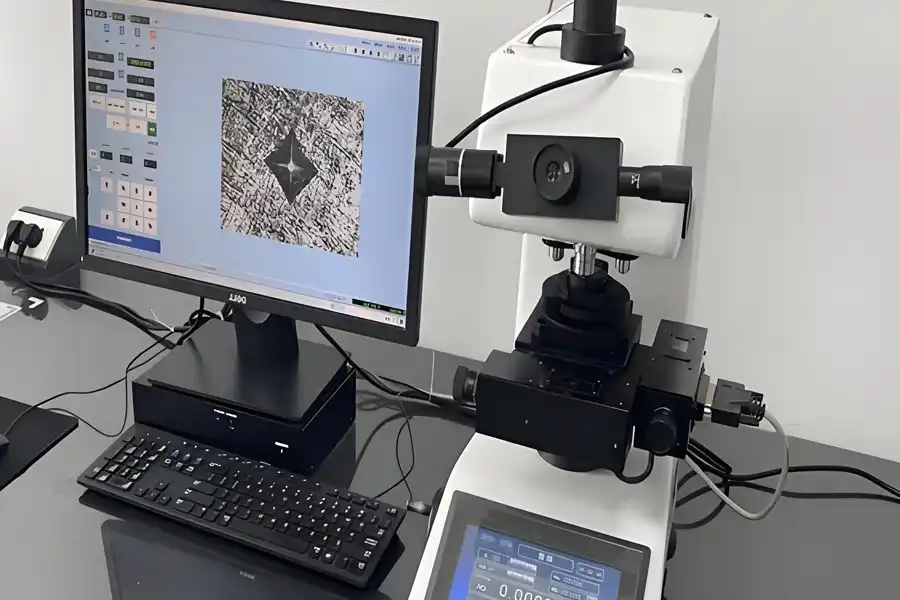
- Hardness test (HB or HRC) across the flange body to confirm heat-treatment uniformity.
- Impact test (Charpy V-notch) when specified for low-temperature service.
4.2 Non-Destructive Testing (NDT)
- Ultrasonic Testing (UT): 100% volumetric inspection per ASTM A388 / ASTM B594 to detect internal laminations, voids, and forging bursts.
- Liquid Penetrant Testing (PT): 100% surface inspection on machined faces, bores, and weld preparations to catch cracks and laps.
- Radiographic Testing (RT): applied to weld-neck-to-pipe welds after installation, or to cast and hybrid constructions.
- Eddy Current Testing (ET): used for surface and near-surface defect screening on high-volume production.
4.3 Dimensional and Pressure Verification
- CMM or template inspection of OD, bolt circle, bolt-hole diameter and count, hub length, bore, and face flatness.
- Hydrostatic testing at 1.5 times design pressure for blind flanges and assembled joints, with a minimum 10-minute hold and zero visible leakage or permanent deformation.
- Pneumatic testing is an alternative where water is prohibited, but it carries higher stored-energy risk and requires stricter safeguards.
4.4 Documentation
- EN 10204 3.1 certificate (manufacturer’s independent inspector) or 3.2 (customer or third-party witness).
- Material traceability report linking each flange to its heat number and forging lot.
- NDT reports with technician certification (ASNT Level II minimum) and procedure references.
- Third-party inspection by SGS, BV, TÜV, or DNV available on request.
5. Where Titanium Flanges Are Used
Titanium is selected when the medium or environment makes stainless steel uneconomical or unsafe:
- Chemical processing: chlor-alkali cells, hydrochloric acid recovery, organic acid reactors, bromine production.
- Seawater and desalination: reverse-osmosis high-pressure piping, heat-exchanger water boxes, offshore firewater and cooling systems.
- Oil and gas: high-chloride produced water, sour service (when H₂S partial pressure stays within titanium’s safe envelope), subsea manifolds.
- Pulp and paper: bleach plant piping (chlorine dioxide, hypochlorite), digester liquor lines.
- Aerospace and defense: engine test stands, hydraulic ground-support systems, weight-critical structures.
- Medical and pharmaceutical: pure-steam and WFI (Water for Injection) systems where leachable metal ions must be minimized.
- Power generation: flue-gas desulfurization (FGD) scrubbers, condenser water boxes in coastal plants.
6. Installation and Usage Precautions
A correctly manufactured titanium flange can still fail in service if it is installed without regard for titanium’s specific behavior. The following precautions come from field practice.
6.1 Galvanic Corrosion: the Most Common Failure Mode
Titanium is noble in the galvanic series. When it is bolted directly to carbon steel, stainless steel, or copper alloy in the presence of an electrolyte (seawater, condensate, even humid air), the other metal becomes the anode and corrodes, often rapidly. The titanium flange itself will look pristine while the steel flange, bolts, or gasket erodes away.
Mitigation:
- Use insulating gasket kits (PTFE or phenolic facing, insulating sleeves on bolts, insulating washers) whenever titanium joins a dissimilar metal.
- If insulation is impractical, use all-titanium bolting (Grade 5 or Grade 2) and accept that the mating steel flange will need a protective coating or cathodic protection.
- Keep the joint dry and drained; trapped electrolyte between faces accelerates the cell.
- Do not use graphite-based gaskets in direct contact with titanium in oxidizing chloride service. Graphite can form a galvanic couple and, in rare cases, contribute to crevice attack.
6.2 Gasket Selection
- PTFE (modified or expanded): the best general-purpose choice for chemical service; chemically inert, with low creep under proper torque.
- Spiral-wound gasket with titanium inner ring and 316L/Inconel outer ring: for high-temperature, high-pressure RF flanges. The inner ring prevents gasket blowout and protects the flange bore.
- Flexible graphite with tanged metal reinforcement: acceptable for steam and high-temperature service, but verify compatibility with the process medium.
- RTJ metal ring: for Class 600 and above RTJ flanges; the ring material is typically soft iron, 316L, or Inconel, never titanium, because titanium-on-titanium RTJ surfaces can gall under bolt load.
6.3 Bolt Torque and Tightening Sequence
Titanium has a modulus of elasticity of about 110 GPa, roughly half that of steel (210 GPa). Titanium flanges and bolts therefore deflect more under the same bolt load, and over-torquing can permanently yield the flange hub or strip bolt threads.
- Use a calibrated torque wrench (accuracy ±3 to 5% for critical service).
- Tighten in a star (criss-cross) pattern in at least three passes: 30%, 70%, then 100% of target torque. A final pass in circular order confirms even load.
- Calculate target torque from the bolt material’s proof load, not from a steel flange table. For Grade 5 titanium bolts, typical preload is 60 to 70% of proof load.
- Re-torque after 24 hours on PTFE-gasketed joints, because PTFE creeps under initial load.
- Do not use impact wrenches for final torque on titanium flanges.
6.4 Alignment and Surface Protection
- Flange parallelism: 0.2 mm or better per 100 mm of flange diameter before tightening. Misalignment causes uneven gasket compression and bolt bending.
- Do not lever flanges into alignment with a pry bar. Titanium is notch-sensitive, and a scored hub can become a fatigue crack origin.
- Keep iron contamination off titanium surfaces. Use dedicated stainless steel or titanium tools, wire brushes, and grinding discs. Carbon steel particles embedded in a titanium surface will rust and can initiate pitting or crevice corrosion.
- If iron contamination is suspected, run a ferroxyl test (potassium ferricyanide and nitric acid) and re-pickle the affected area with HF/HNO₃ solution.
6.5 Temperature and Environment Limits
- Continuous service above about 315 °C in air causes progressive oxidation and oxygen diffusion (alpha-case formation). For long-term high-temperature service, consider Grade 12 or a high-temperature titanium alloy.
- Reducing acids (hydrochloric, sulfuric at low pH, hydrofluoric) attack titanium. Grade 7 or Grade 12 extends the safe envelope, but HF acid is incompatible with all titanium grades.
- Dry chlorine or dry bromine can cause ignition or severe attack. Titanium needs a minimum moisture content (typically above 150 ppm H₂O for chlorine) to maintain its passive film.
- Crevice corrosion in hot (above 70 °C), stagnant, high-chloride solutions can affect CP titanium. Use Grade 7 or Grade 12, or design to eliminate crevices.
6.6 Storage and Handling
- Store flanges indoors, dry, and separated from carbon steel inventory.
- Do not stack titanium flanges directly on steel pallets or shelves without a barrier (wood, plastic, or cardboard).
- Keep sealing faces protected with plastic or plywood covers until installation.
- Avoid contact with chlorides (road salt, de-icing fluids, swimming-pool environments) during storage and transport.
6.7 Welding Notes
- Titanium is welded by GTAW (TIG) with 100% argon or helium shielding on both the front and back of the weld. Air contamination above about 50 ppm produces brittle, oxygen-enriched weld metal.
- CP titanium (Grade 2) is typically welded autogenously (no filler); Grade 5 requires matching ERTi-5 filler and post-weld stress relief.
- Keep interpass temperature below about 200 °C for Grade 5 to avoid beta-phase coarsening.
- Weld color is a quick quality indicator: silver or straw is acceptable; blue, purple, or gray means contaminated and must be removed and re-welded.
7. How to Choose the Right Titanium Flange
Use this decision sequence when specifying:
- What is the process medium and temperature? Chloride, seawater, hypochlorite, or oxidizing acid service justifies titanium. For reducing acid or HF, consider Grade 7 or 12, or a different alloy.
- What pressure class and pipe size? Select ASME B16.5 (24″ and under) or B16.47 (above 24″), then the class (150 to 2500) from the design pressure and temperature.
- Grade 2 or Grade 5? Default to Grade 2. Move to Grade 5 only when weight, space, or pressure class requires the extra strength, and accept higher machining and welding cost.
- Which flange type? Critical, cyclic, or high-pressure service calls for WN. General utility calls for SO. Line closure calls for BL. Small-bore high-pressure lines call for SW.
- Which facing? General service uses RF. Class 600 and above uses RTJ. A brittle mating flange uses FF.
- Will it join a dissimilar metal? If yes, specify an insulating gasket kit and confirm the bolting material.
Frequently Asked Questions
What standard are titanium flanges made to?
Titanium flanges follow the dimensional standards ASME B16.5 (1/2″ to 24″), ASME B16.47 (26″ to 48″), MSS SP-44, or API 6A. The material is certified to ASTM B381 for forgings, with ASTM B265 (plate) and B348 (bar) covering related product forms.
What is the difference between Grade 2 and Grade 5 titanium flanges?
Grade 2 is commercially pure titanium with a minimum UTS of 345 MPa. It is easy to form and weld, and it is the standard choice for chemical and marine service. Grade 5 is Ti-6Al-4V with a minimum UTS of 895 MPa, nearly three times stronger but harder to machine and weld. Use Grade 5 only when pressure or weight demands it.
Can a titanium flange be bolted to a steel flange?
Yes, but galvanic corrosion will attack the steel side unless the joint is electrically isolated. Use an insulating gasket kit (PTFE or phenolic facing with insulating bolt sleeves and washers), or specify all-titanium bolting with a coated steel flange. A direct bolted joint without isolation is not safe in wet service.
What is the maximum pressure for a titanium flange?
Pressure rating depends on size, class, grade, and temperature. ASME B16.5 flanges are produced through Class 2500, and API 6A flanges reach 20,000 psi. Because titanium is not in the B16.5 pressure-temperature tables, the actual allowable pressure must be calculated from the allowable stresses in ASME Section II, Part D and confirmed by the manufacturer or a licensed engineer.
How do I prevent titanium flange leaks?
Keep flange parallelism within 0.2 mm per 100 mm of diameter, use the correct gasket for the medium, tighten bolts in a star pattern in three passes with a calibrated torque wrench, and re-torque PTFE-gasketed joints after 24 hours. Inspect the sealing face for scratches and iron contamination before assembly.
What causes titanium flange failure?
Field experience points to five recurring causes. The most common is galvanic corrosion of dissimilar-metal mating parts when insulation is missing. Next are over-torquing that yields the hub or strips bolts, crevice corrosion in hot stagnant chloride service, alpha case or iron contamination left on the surface, and weld contamination from inadequate inert-gas shielding. All five are preventable with the installation practices in Section 6.
Need titanium flanges quoted to your specification?
Send us the process medium, design pressure and temperature, pipe size and class, grade, and quantity. Our engineering team in Baoji will confirm manufacturability and return a quotation within 48 hours.