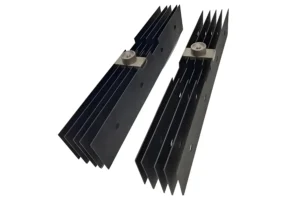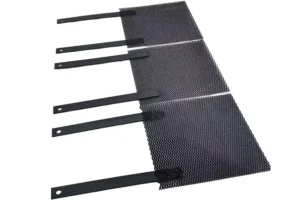
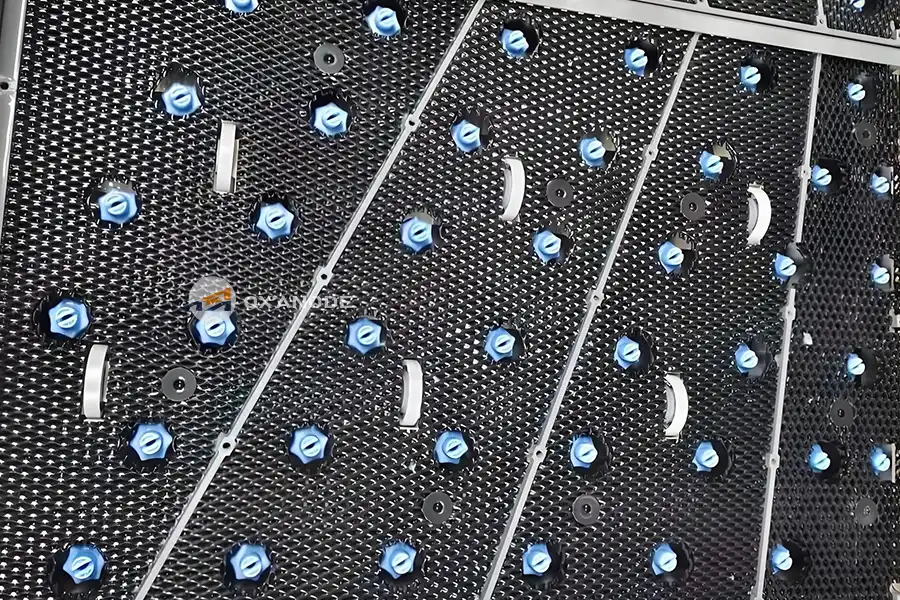
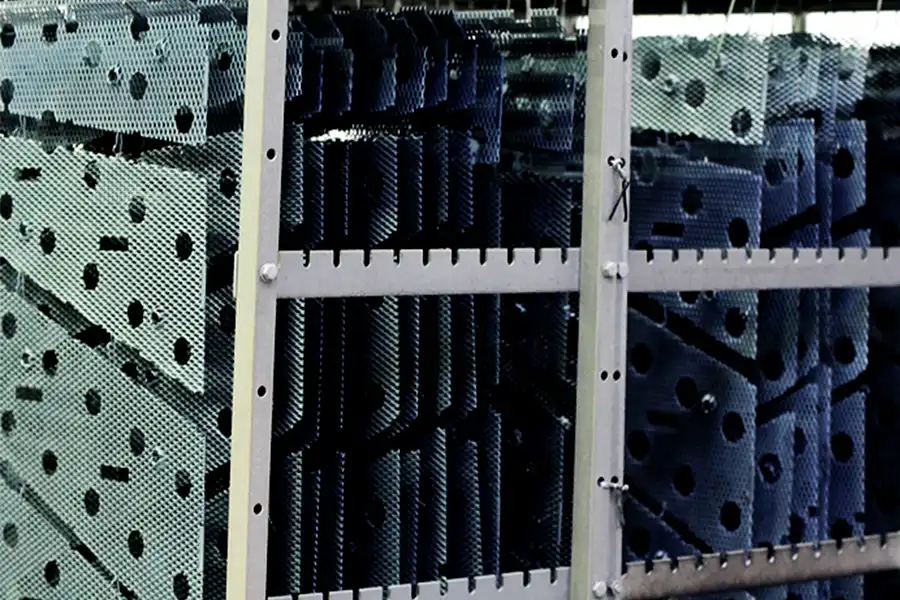
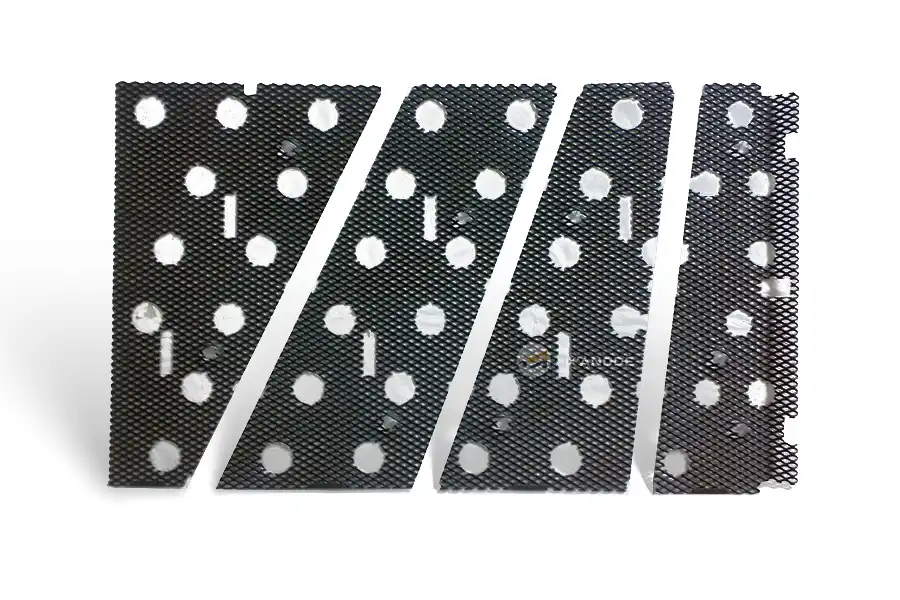
A titanium anode for PCB horizontal copper plating is an insoluble, dimensionally stable electrode: a Grade 1 or Grade 2 titanium substrate carrying an iridium tantalum mixed metal oxide coating (IrO₂-Ta₂O₅), mounted above and below the panel to evolve oxygen while holding a fixed anode-to-cathode gap in acid sulfate copper electrolyte.
A horizontal copper plating line carries the panel flat, face up, on a conveyor. The anode sits above it and below it, a short fixed distance away, and it does not dissolve. That last point is the reason the whole line works the way it does.
Phosphorized copper anodes feed the bath as they corrode. Put them on a horizontal line and they change shape as they wear, drop sludge and nodules onto the panel, and move the anode-to-cathode gap while the run is in progress. So horizontal modules run insoluble anodes instead: a titanium substrate carrying a mixed metal oxide coating, most often IrO₂-Ta₂O₅. The anode keeps the geometry the process engineer set, and all the copper in the deposit comes from the electrolyte.
Key takeaways
- Horizontal lines run insoluble anodes. Soluble phosphorized copper shifts the gap, sheds sludge, and cannot operate under reverse pulse.
- IrO₂-Ta₂O₅ is the coating for acid sulfate copper. Ruthenium-based coatings lose precious metal to volatile RuO₄ under sustained oxygen evolution.
- PCB anodes usually fail sooner than electrowinning anodes at comparable current density. Organic brighteners and levelers attack the coating. The current is not the limiting factor.
- Reverse pulse plating needs a reverse-current-tolerant formulation. Standard coatings lose adhesion under cathodic half-cycles.
- Mesh is the standard form on horizontal modules. Open area, wire diameter, and flatness govern both flow and current distribution.
- Track cell voltage, not calendar time. A sustained 15 to 20% rise over baseline at identical conditions means the coating is spent.
Horizontal plating and VCP: what the anode is actually asked to do
On a vertical continuous plating (VCP) line the panel hangs from a flight bar and passes through the bath upright. The anodes are fixed vertical plates on either side. On a horizontal conveyorized line the panel lies flat and travels through a series of short plating modules, each with anode banks above and below.
The two designs solve different problems, and the anode sits at the center of the difference.
VCP is generally credited with better throwing power on very high aspect-ratio through-holes, and it handles thick, rigid boards well. Its known weakness is the dog-bone effect: copper builds up faster near the panel edge than at the center, because the edge sees a shorter current path to the anode. Plants compensate with auxiliary anodes and current shields.
Horizontal plating puts every panel through the same anode bank in the same orientation, so panel-to-panel consistency is high and edge effects are easier to manage. The trade-off is that the anode-to-cathode gap is short and fixed by the module geometry. There is no room to compensate for a worn anode by moving it. The anode has to hold its shape.
Horizontal lines are the usual choice for thin cores, flexible and rigid-flex constructions, and boards that a vertical flight bar would bend or mark. If your line runs any of those, the anode specification matters more than it does on a conventional VCP line.
Why horizontal lines run insoluble anodes instead of copper
Four reasons, in the order they usually matter to a process engineer.
1. The gap has to stay put. Current distribution across a panel depends on the anode-to-cathode distance. A soluble anode dissolves unevenly, faster at the edges and faster where flow is highest, so the gap changes through the campaign. Throwing power drifts with it. A dimensionally stable anode does not move. What you set at commissioning is what you run in month thirty.
2. No anode sludge. Phosphorized copper anodes leave behind an insoluble film and, over time, nodules and debris. On a vertical line that debris falls to the bottom of the tank. On a horizontal line the panel is directly underneath the upper anode bank, and the gap is small. Debris that detaches lands on wet copper. The result shows up as pitting, roughness, and rejects on boards that plated correctly everywhere else.
3. No anode maintenance cycle. Soluble anodes need bags, periodic replacement, and dummy plating to condition new anodes before they go into production. Insoluble anodes need inspection. On a line running three shifts, that difference is measured in lost production hours.
4. Reverse pulse plating requires it. RPP and pulse-reverse waveforms run a cathodic half-cycle at the anode. A copper anode simply plates during that half-cycle and cannot function. An insoluble anode can, provided the coating is formulated to survive the reversal. More on this below, because it is where most specification errors happen.
The coating that works in acid copper, and the ones that do not
Acid sulfate copper is an oxygen-evolving environment. That single fact decides the coating.
In an acidic sulfate bath the anode reaction is oxygen evolution, and it runs at a high anodic potential. Under those conditions RuO₂ oxidizes further to RuO₄, which is volatile. A ruthenium-based coating in this duty loses precious metal continuously and can fail in a fraction of its expected life. Ru-Ir coatings are the right answer for chloride and brine service (chlorine evolution, hypochlorite generation, chlor-alkali) and the wrong answer for acid copper. Do not let price pull you that way.
IrO₂-Ta₂O₅ is the industry standard for acid sulfate oxygen evolution. The two oxides do different jobs:
- Iridium dioxide catalyzes the oxygen evolution reaction at low overpotential and, critically, stays put. Under high anodic potential IrO₂ does not form a volatile higher oxide, so the coating dissolves slowly rather than evaporating.
- Tantalum pentoxide is largely inert electrocatalytically but forms a dense, acid-resistant framework. It suppresses cracking, slows iridium dissolution, and shields the titanium substrate from anodic passivation.
Published work and industrial practice converge on roughly 70 mol% IrO₂ / 30 mol% Ta₂O₅ as the best balance of activity and service life for acidic oxygen evolution. A 65:35 formulation trades some life for cost. Higher iridium fractions buy life at rising cost, and iridium price moves with the market.
| Coating | Environment it fits | Anode reaction | Why it fails in acid copper |
|---|---|---|---|
| IrO₂-Ta₂O₅ (Ir-Ta) | Strong acid, sulfate systems, sustained OER | Oxygen evolution | Correct choice for this duty |
| RuO₂-IrO₂ (Ru-Ir) | Chloride / brine, chlor-alkali, hypochlorite | Chlorine evolution | RuO₂ oxidizes to volatile RuO₄; rapid precious-metal loss |
| Platinized titanium (Pt/Ti) | Fluoride-free plating, general purpose | Varies | High cost; limited life at high current density |
| PbO₂ / lead alloy | Cost-driven electrowinning | Oxygen evolution | Lead contamination of the deposit; heavy; shorter life |
Ir-Ta versus platinized titanium
Both work in acid copper. The choice is usually economic.
Platinized titanium anodes carry a solid platinum layer and are the historical solution. Several OEM horizontal lines were commissioned with them, and suppliers such as Umicore still market platinum-based insoluble anodes for PCB service. They perform well, and they cost more, both at purchase and at recoat.
MMO anodes use less precious metal for the same duty. Published comparisons put Ir-Ta coatings below Pt/Ti on cost for oxygen-evolving service, with a lower oxygen evolution overpotential, which shows up as lower cell voltage and lower power draw at the rectifier. Where platinized titanium retains an advantage is at the upper end of current density and in certain specialized electrolytes.
If you are replacing Pt/Ti anodes in an existing horizontal module, the mechanical dimensions and connection design usually transfer directly. Send the drawing.
Why PCB anodes wear out faster than electrowinning anodes
This is the part most supplier literature skips.
An Ir-Ta anode in copper electrowinning at a few hundred A/m² routinely runs for years. An anode in PCB acid copper, at a comparable or even lower current density, often does not. The current density is not the difference.
The difference is the additive package. Acid copper for PCB work contains organic brighteners, levelers, and carriers, plus chloride, all maintained within a narrow window. Those organics adsorb on the anode surface and are oxidized there. Peer-reviewed work on IrO₂-Ta₂O₅ durability in copper electroplating systems has shown that organic additives actively accelerate coating degradation: the mechanism is chemical and electrochemical attack on the active layer, not simple wear from charge throughput.
Three practical consequences:
- Do not extrapolate anode life from a different application. A lifetime quoted for electrowinning, cathodic protection, or copper foil is not transferable to PCB acid copper. Ask your supplier what their number is based on.
- Additive control is anode control. A bath running hot on brightener, or one where carrier breakdown products accumulate, will shorten anode life independently of anything the anode does. If anodes are failing early across a line, check bath chemistry before blaming the anode.
- Life is application-specific, and honest suppliers say so. For our Ir-Ta anodes we quote service life against your electrolyte, your current density, and your target, not as a headline number. Any supplier guaranteeing a fixed multi-year life for PCB acid copper without asking about your additive system is quoting marketing, not engineering.
Reverse pulse plating changes the anode specification
If your line runs RPP, pulse-reverse, or any waveform with a cathodic half-cycle at the anode, the coating specification changes.
Reverse and intermittent current reduces coating adhesion. The mechanism is straightforward: during the cathodic half-cycle the local chemistry at the coating interface shifts, and repeated cycling works at the bond between the oxide layer and the titanium substrate. Over time the coating can lift or spall, and once the substrate is exposed, titanium passivates to an insulating TiO₂ film, resistance climbs, and the anode stops carrying current where it stopped conducting.
What to specify:
- Tell the manufacturer the waveform. Not just “pulse plating”, but the reverse current density, the reverse-to-forward charge ratio, and the frequency. These determine the formulation.
- Ask for a reverse-current-tolerant coating. Formulations differ. A standard DC-service coating is not automatically suitable.
- Cover the shutdown case. Plants with unreliable mains power or planned interruptions expose anodes to reverse current during decay. If that describes your line, say so in the inquiry.
Getting this wrong is expensive and slow to diagnose. The anodes look fine. Cell voltage creeps up over months. Uniformity drifts. By the time anyone connects it to the waveform, a full anode bank has been consumed.
How to tell an anode is nearing end of life
Ir-Ta coatings wear out gradually. Iridium dissolves at a slow, finite rate. Once active loading drops below a threshold, cell voltage climbs.
The most reliable indicator is not visual. It is a sustained voltage rise of 15 to 20% over baseline, measured under identical conditions: same current density, same temperature, same bath chemistry, same gap.
Set that up deliberately:
- Record baseline cell voltage per module at commissioning, with the operating conditions logged alongside it.
- Measure at fixed intervals under the same conditions. Trend it. A single reading means little; the slope means everything.
- Watch for uneven behavior across a bank. One anode drifting while its neighbors hold suggests a local problem (poor connection, flow blockage, coating damage), not general wear.
- Inspect for spalling and passivation. Exposed titanium turns from metallic grey to a dull, insulating surface. Where you see it, that section is not plating.
Two other conditions shorten life below specification, and both are avoidable:
- Running above design current density. Pushing a module harder than the anode was rated for accelerates coating wear and raises bath temperature. Both feed each other.
- Fluoride in the electrolyte. Fluoride attacks the titanium substrate underneath the coating. Above trace levels, discuss substrate protection with the manufacturer before ordering. This is uncommon in acid copper but not unheard of where upstream treatments carry over.
Recoating a spent anode
A spent anode can usually be recoated, and it is normally cheaper than buying new. The titanium substrate is stripped, re-etched, and recoated. Whether recoating is worthwhile depends on substrate condition: if the titanium has been passivated or pitted, particularly from fluoride attack or prolonged reverse current, the substrate may not be reusable. Send photographs and the operating history with the recoating inquiry.
Specifications at a glance
| Parameter | Typical value for PCB horizontal copper plating |
|---|---|
| Coating system | IrO₂-Ta₂O₅ mixed metal oxide, about 70:30 molar ratio |
| Substrate | Grade 1 / Grade 2 commercially pure titanium, ASTM B265 |
| Substrate thickness | 1 to 2 mm plate; mesh wire diameter to module design |
| Primary anode reaction | Oxygen evolution in acid sulfate media |
| Coating thickness | 5 to 20 µm, applied in multiple thermal-decomposition cycles |
| Precious metal loading | About 20 g/m², set by duty and target life |
| Cathode current density (acid copper) | Typically 1 to 8 A/dm² (10 to 80 A/m²), DC or pulse; additive-system dependent |
| Bath temperature | 20 to 60 °C continuous (acid copper commonly runs at the lower end) |
| Common forms | Mesh |
| End-of-life criterion | Sustained 15 to 20% cell voltage rise over baseline at identical conditions |
| Service life | Application-dependent; shorter in PCB acid copper than in electrowinning at similar current density, because of additive attack |
These are typical industry ranges, not a universal specification. Acid copper bath composition varies significantly with the additive system in use. Every anode we quote is engineered against your electrolyte chemistry, waveform, current density, and target life. The datasheet issued with your quotation governs.
Nine items to send with your quotation request
Nine items. Send these and we can quote a coating engineered to your duty, typically within two business days. For PCB horizontal plating, items 2 and 7 matter more than usual.
- Electrolyte chemistry: copper sulfate / sulfuric acid concentrations, chloride level, additive system (supplier and type), fluoride if present
- Waveform: DC or pulse; if pulse, forward and reverse current density, frequency, and reverse-to-forward charge ratio
- Current density: design point in A/dm² or A/m², plus any peak or transient loads
- Operating temperature: continuous and maximum bath temperature
- Module geometry: anode-to-cathode gap, module width and length, anode bank arrangement (above / below / both)
- Form and dimensions: drawing or sketch; mesh count and wire diameter, or plate thickness; flatness tolerance
- Target service life: expressed as calendar time or accumulated charge throughput (kAh/m²), and what you are currently getting
- Line make and model: OEM and equipment series, if known; this often determines the connection design
- Quantity and delivery schedule: annual volume, first-delivery date
If you have an existing anode, a photograph and its dimensions are enough to start. We quote from a drawing within 12 hours.
What does a titanium anode for horizontal copper plating cost?
Pricing tracks iridium metal, so it moves with the market. Quotes are per piece or per square meter of coated area, driven by precious metal loading, geometry, form, and quantity. Send your operating conditions for a firm quotation.
Frequently Asked Questions
What is the difference between an MMO anode and a DSA anode?
They are the same thing described from different angles. DSA (dimensionally stable anode) names the behavior: the electrode does not dissolve and holds its geometry. MMO (mixed metal oxide) names the coating. A titanium anode with an IrO₂-Ta₂O₅ coating is both.
Can I use a ruthenium-coated titanium anode in acid copper?
No. Ruthenium-based coatings are built for chlorine evolution. Under the sustained high anodic potential of oxygen evolution in acid sulfate media, RuO₂ oxidizes to volatile RuO₄ and the coating loses precious metal continuously. Ir-Ta is the correct system for acid copper.
Why are my anodes failing earlier than the quoted life?
Check three things in order. First, the waveform: if your line runs reverse pulse and the anodes were supplied for DC service, adhesion failure is the likely cause. Second, bath chemistry: accumulated organic breakdown products accelerate coating degradation. Third, operating current density against the rated value. Calendar life quoted for a different application is not a valid benchmark.
Do horizontal lines always use mesh anodes?
Mesh is the most common form because open area improves electrolyte exchange in a short gap, and it is lighter to handle. But the form follows the module design. Some lines use solid plate, and OEM-specific corrugated profiles exist. Match the original specification rather than substituting.
Are insoluble anodes compatible with all acid copper additive systems?
They are the standard choice for horizontal lines regardless of additive system, and they keep bath composition stable because nothing dissolves into the electrolyte. The additive system does affect anode life, since organics are oxidized at the anode surface, so tell your supplier which system you run. It changes the coating recommendation.
Can I replace platinized titanium anodes with MMO anodes in an existing line?
Usually yes, and it is a common cost-reduction step. The mechanical envelope and connection design generally transfer. Confirm the operating current density and waveform first: platinized titanium retains an advantage at the upper end of current density, so a high-load module needs checking before substitution.
Can a spent anode be recoated?
Usually yes, and it is normally cheaper than buying new. The titanium substrate is stripped, re-etched, and recoated. Whether recoating is worthwhile depends on substrate condition: if the titanium has been passivated or pitted, particularly from fluoride attack or prolonged reverse current, the substrate may not be reusable. Send photographs and the operating history with the recoating inquiry.
Sources and further reading
Technical claims in this article are supported by the following. We cite them so you can check our reasoning rather than take it on trust.
- PCB007 / I-Connect007: The Use of Insoluble Anodes in Acid Copper Plating. Industry technical article on insoluble anode behavior, current distribution, and VCP comparison. https://iconnect007.com/article/119542
- De Nora, Electrode Technologies: Anodes for Horizontal Plating Lines in PCB. OEM electrode manufacturer technical page on horizontal line anode design. https://denora.com/en/electrode-technologies/technologies/anodes-for-horizontal-plating-line
- Uyemura: Platinized Titanium and MMO Anodes in Electroplating Applications. Supplier technical brochure comparing Pt/Ti and MMO coatings, including cost and oxygen evolution overpotential. https://www.uyemura.com/pdfs/Platinized-Titanium-and-MMO-Anodes-in-Electroplating-Applications.pdf
- Li, Y. et al.: Mechanistic insights into the durability of IrO₂-Ta₂O₅ DSA influenced by organic additives in a copper electroplating system. Electrochimica Acta, 2026. Peer-reviewed study on additive-driven coating degradation, the basis for the section on PCB anode life. https://www.sciencedirect.com/science/article/pii/S0013468626001258
- Hu, J.-M. et al.: Electrochemical ageing behavior of Ti-based IrO₂+Ta₂O₅ anodes in H₂SO₄ solution. Acta Physico-Chimica Sinica, 2002. Peer-reviewed study on Ir-Ta failure mechanisms in sulfuric acid. https://www.whxb.pku.edu.cn/CN/10.3866/PKU.WHXB20020104
On this site: Iridium-Tantalum Coated Titanium Anode·The Titanium Anode Guide·Coated Titanium Anodes·Platinum Plated Titanium Anode·Ru-Ir Coated Titanium Anode
Need an anode engineered for your horizontal line?
Send us your electrolyte chemistry, waveform, current density, module geometry, and target service life. We quote from a drawing within 12 hours, and confirm a coating engineered to your duty within two business days.