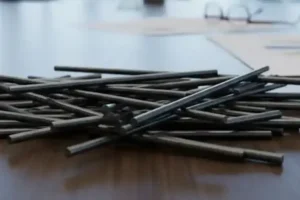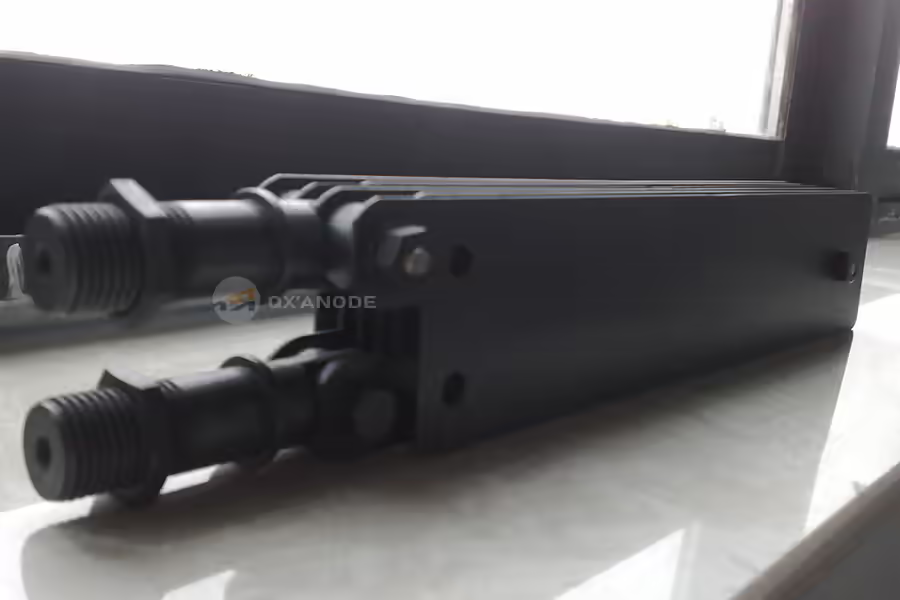
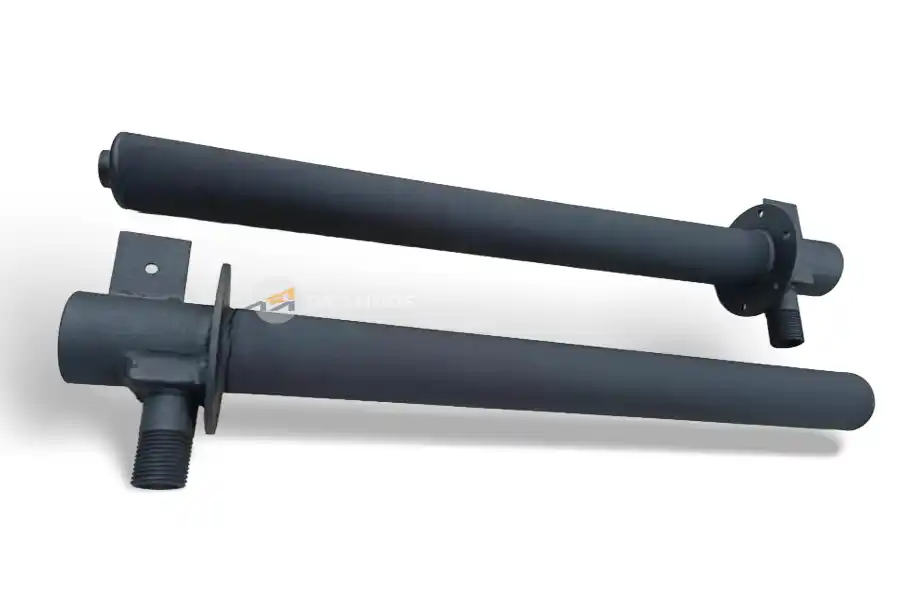
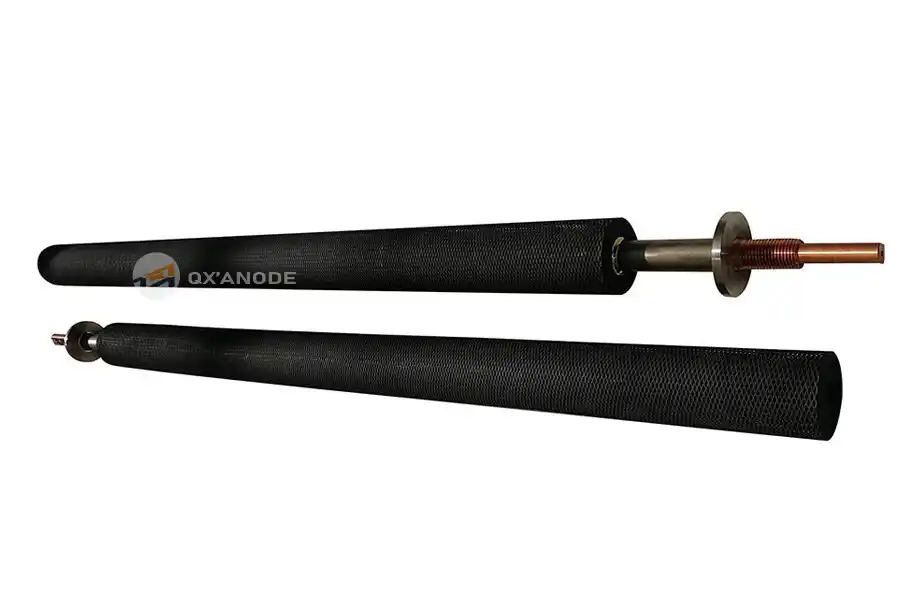
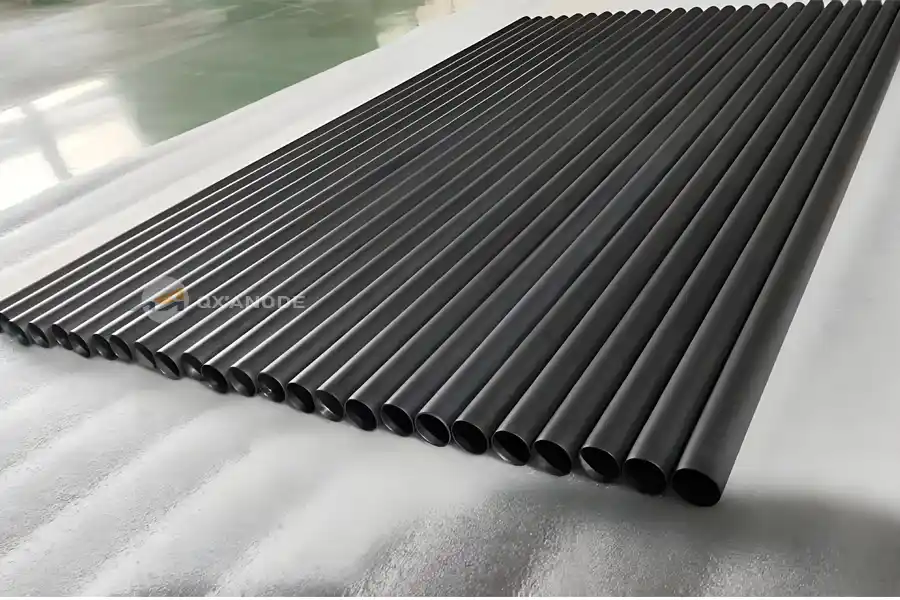
An MMO titanium tube anode is an insoluble electrode made from a Grade 1 or Grade 2 titanium tube (ASTM B338) with a mixed metal oxide (MMO) coating on the outer surface. The coating is iridium tantalum oxide (IrO₂-Ta₂O₅) for oxygen evolution duty and ruthenium iridium oxide (RuO₂-IrO₂) for chlorine evolution duty, applied by thermal decomposition in multiple layers. Tube anodes are specified when the cell or protection system needs a cylindrical geometry with even current distribution, low pressure drop for flowing electrolyte, and easy gas release along the tube wall.
Key specs at a glance
- Substrate: Grade 1 / Grade 2 titanium tube per ASTM B338
- Coating: IrO₂-Ta₂O₅ (oxygen) or RuO₂-IrO₂ (chlorine), 5 to 20 microns
- Continuous current density: 500 to 1,200 A/m² in electrolysis duty; about 100 A/m² in soil or freshwater cathodic protection
- Common diameters: 10 – 108 mm, custom sizes available
- Service life: 2 to 5 years at rated electrolysis conditions; 25+ years in low current cathodic protection
- Connections: threaded, welded, or flanged, to your drawing
What Is an MMO Titanium Tube Anode?
An MMO titanium tube anode is a dimensionally stable anode (DSA) built on a titanium tube. The titanium tube is the structural and conductive base, and a thin mixed metal oxide (MMO) catalytic layer is baked onto its outer surface. “MMO” refers to the coating chemistry: a blend of precious metal oxides such as iridium dioxide (IrO₂), tantalum pentoxide (Ta₂O₅), and ruthenium dioxide (RuO₂).
The coating does the electrochemical work and the titanium stays passive underneath. That is why the anode holds its dimensions over years of operation, unlike sacrificial anodes that are consumed and graphite or cast iron anodes that erode. The tube form adds two practical benefits: electrolyte flows evenly around the tube with a low pressure drop, and gas bubbles generated on the surface rise along the tube wall instead of collecting on a flat face.
Coating Systems and Selection
Coating selection follows one rule: match the coating to the reaction the anode must drive.
- IrO₂-Ta₂O₅ (iridium tantalum oxide), typical molar ratio about 70:30: the standard coating for oxygen evolution in acidic sulfate media. Iridium dioxide catalyzes oxygen evolution with a low overpotential and resists dissolution at high anodic potentials. Tantalum pentoxide stabilizes the coating and slows cracking. Use this coating for copper electrowinning, copper foil formation, acid copper plating, persulfate synthesis, and organic oxidation.
- RuO₂-IrO₂ (ruthenium iridium oxide): the standard coating for chlorine evolution in chloride-rich electrolytes. Use this coating for sodium hypochlorite generation, seawater electrochlorination, swimming pool disinfection, and brine electrolysis. Ruthenium based coatings are not suitable for sustained oxygen evolution in strong acid, where iridium tantalum is the defensible choice.
The coating is applied by thermal decomposition: the tube surface is degreased, sandblasted, and acid etched, then coated and fired in repeated cycles until the target thickness of 5 to 20 microns and precious metal loading of 5 to 50 g/m² are reached. Loading is set against your current density and target service life.
Technical Specifications
| Parameter | Value |
|---|---|
| Product Name | MMO Titanium Tube Anode (Mixed Metal Oxide Coated) |
| Substrate Material | Titanium Grade 1 / Grade 2 tube, ASTM B338 |
| Coating Material | IrO₂-Ta₂O₅ (oxygen evolution) or RuO₂-IrO₂ (chlorine evolution) |
| Coating Thickness | 5 to 20 microns |
| Precious Metal Loading | 5 to 50 g/m², set by current density and target life |
| Continuous Current Density | 500 to 1,200 A/m² (electrolysis); about 100 A/m² in soil/freshwater CP |
| Operating Temperature | Max 60 °C continuous |
| Tube Diameter | 19 / 25 / 32 mm standard, 10 to 108 mm custom |
| Wall Thickness | 1.0 to 4.0 mm |
| Length | 100 to 3,000 mm standard, longer sections on request |
| Connection Method | Threaded / welded / flanged, active and bare sections per drawing |
| Certifications | ISO 9001:2015, CE |
| Lead Time | 10 to 15 business days (standard); 20 to 30 days (custom) |
| Packaging | Export grade wooden crate with foam protection |
| Service Life | 2 to 5 years at rated electrolysis conditions; 25+ years in low current cathodic protection |
Applications
- Impressed current cathodic protection (ICCP): deep well anode strings, buried pipelines, storage tank bottoms, marine structures, and rebar protection in concrete. The tube is threaded into strings or set in coke breeze backfill, running for decades at about 100 A/m² in soil or freshwater and up to 600 A/m² in seawater.
- Electroplating and electrowinning: copper, nickel, zinc, and precious metal deposition where a cylindrical anode improves throwing power in barrel and rack lines. IrO₂-Ta₂O₅ coating keeps the bath free of lead contamination.
- Water treatment and disinfection: electrochlorination of seawater or brine for cooling water treatment and ballast water, with RuO₂-IrO₂ coating generating active chlorine on demand.
- Electrochemical synthesis: persulfate, perchlorate, and other oxidants produced in tubular cells, where the anode doubles as a cell wall element.
How to Specify a Tube Anode
Send us these five items and we will confirm the design within 48 hours:
- Application and environment. Soil, seawater, freshwater, concrete, or an electrolyte bath. This decides the coating system.
- Current density and total current. The per anode current and the current density in A/m² your system is designed for.
- Dimensions. Tube diameter, wall thickness, length, and whether you need bare titanium end sections for connections.
- Connection type. Threaded, welded, or flanged, plus the conductor bar material you plan to use.
- Target service life. We set the precious metal loading against this number, since loading is the main cost driver.
Frequently Asked Questions
What is the difference between Ir-Ta and Ru-Ir coated tube anodes?
The coating is matched to the reaction. IrO₂-Ta₂O₅ is for oxygen evolution in acidic sulfate media, such as electrowinning, copper foil, and acid plating. RuO₂-IrO₂ is for chlorine evolution in chloride-rich electrolytes, such as sodium hypochlorite generation and seawater electrochlorination. A ruthenium based coating degrades quickly under sustained oxygen evolution in strong acid, so the two are not interchangeable.
How long does an MMO titanium tube anode last?
It depends on current density and electrolyte. In electrolysis duty at 500 to 1,200 A/m², expect 2 to 5 years at rated conditions. In cathodic protection at about 100 A/m² in soil or freshwater, the anode typically outlasts the project design life of 10 to 20 years, because coating consumption is measured in milligrams per year. Actual life is set by current density, temperature, electrolyte chemistry, and coating loading.
Can MMO tube anodes be recoated?
Yes. When the coating is depleted, we strip the old oxide layer, sandblast and etch the titanium, and reapply a fresh MMO coating. Recoating costs less than a new anode and is common for cathodic protection strings where the tube itself is still sound.
What current density can an MMO tube anode handle?
For electrolysis duty, continuous operation is typically 500 to 1,200 A/m² depending on the coating and electrolyte. For cathodic protection in soil or freshwater, the design current density is about 100 A/m², and up to about 600 A/m² in seawater. The coating loading and thickness are set to match your rated current density, so send us your number when requesting a quote.