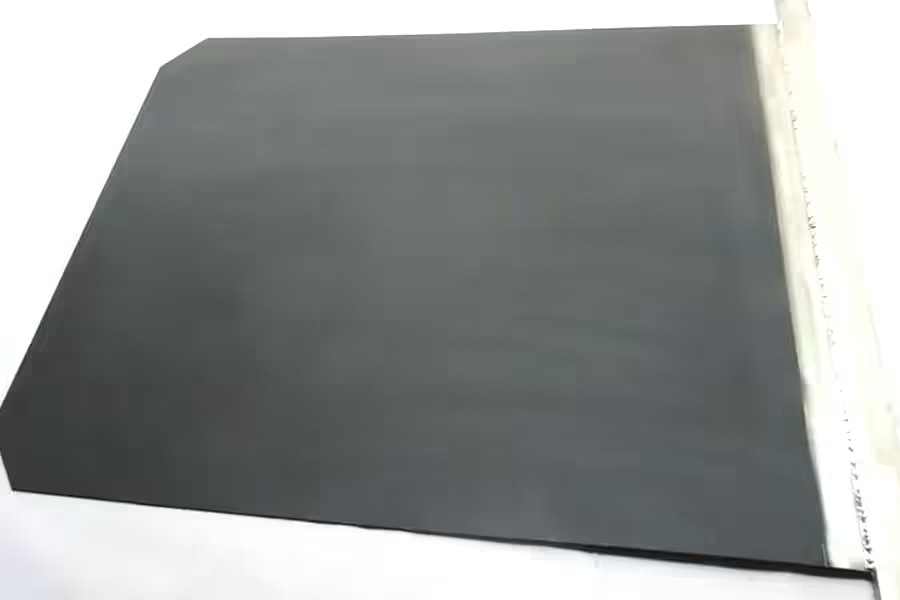
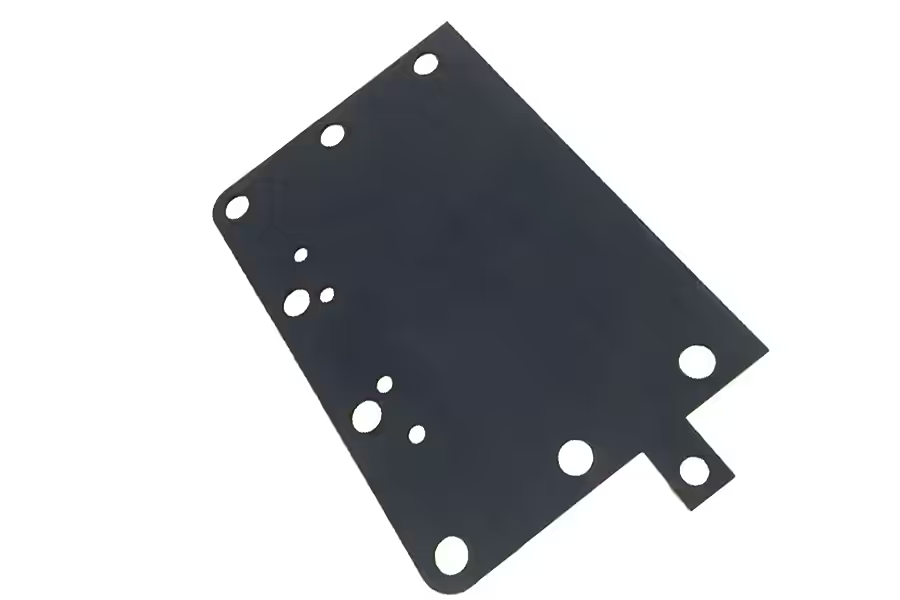
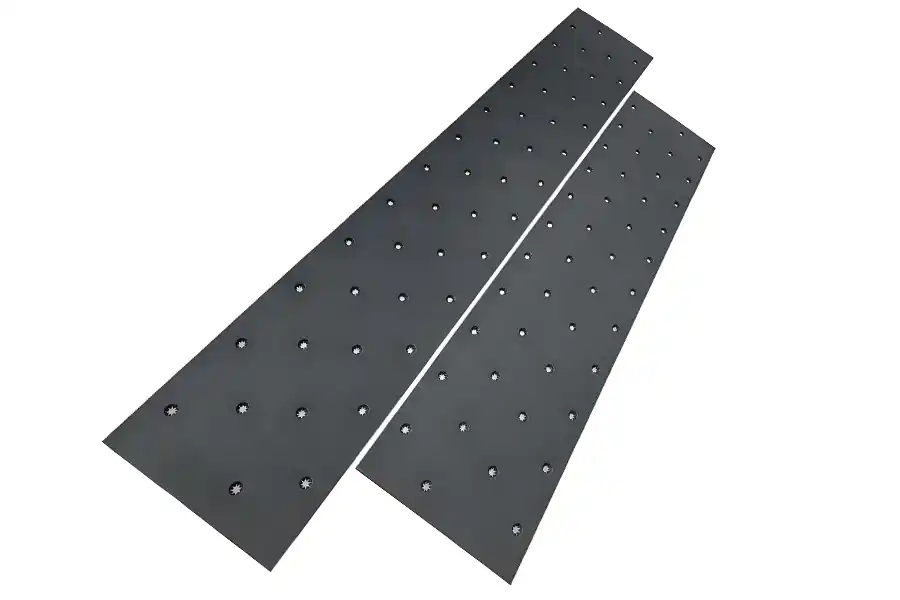
A titanium anode plate is a flat dimensionally stable anode (DSA) cut from Grade 1 or Grade 2 titanium sheet and coated with a thermally decomposed precious metal oxide layer. Plate geometry is the right choice when a cell needs a flat, rigid electrode that carries high current across a controlled gap. Electrolytic copper foil deposition, steel strip electrogalvanizing, and the electro-oxidation of industrial wastewater are the three largest uses. This page covers how plate anodes are made, which of the four coating systems fits which electrolyte, and the specification points that decide service life.
Quick Specifications
| Parameter | Typical range |
|---|---|
| Substrate | Grade 1 or Grade 2 (TA1 / TA2) titanium sheet |
| Sheet thickness | 0.5 to 5 mm |
| Size | Cut to drawing; single plates commonly up to about 1,000 × 2,000 mm |
| Coating systems | Ru-Ir oxide, Ir-Ta oxide, electrodeposited platinum, PbO₂ |
| MMO coating loading | 5 to 15 g/m², set by duty |
| Platinum layer | 0.5 to 5 µm |
| Electrical connection | Welded titanium tab or threaded titanium stud; copper-cored tab for high current |
| Orientation | Vertical or horizontal, anode gap set by cell design |
Values are typical industry practice. Final dimensions, loading, and current rating come from the cell drawing and the electrolyte the anode will run in.
How Titanium Anode Plates Are Made
Cutting and forming
Production starts from mill sheet in the thickness the drawing calls for. The outline is cut by laser, waterjet, or shear, then edges are deburred. Any stiffening bends or flanges are formed before welding, because the coating stage comes last and the finished plate cannot be reworked mechanically.
Welding
Connection tabs, hangers, and stiffeners are joined by argon-shielded TIG welding with titanium filler. Seams that carry current are welded full penetration so joint resistance stays low and heat during operation does not concentrate at a partial weld. On high current plates the tab itself is often a titanium-clad copper strip, since solid titanium conducts roughly one twentieth as well as copper and a solid titanium tab would run hot.
Surface preparation
Coating adhesion is decided here, not in the coating room. The plate is degreased in alkaline solution, sandblasted with quartz or alumina media to roughen and clean the surface, then pickled in a hydrofluoric and nitric acid bath to strip the native oxide and activate the metal. Between stages the plate is rinsed in deionized water and never touched by hand again.
Coating and calcination
The active layer is applied as a solution of precious metal chlorides, typically ruthenium and iridium salts with tantalum or titanium additives, in an alcohol carrier. Each coat is brushed or dipped on, dried, and calcined at 420 to 450 °C, where the salts decompose into a cracked, high surface area oxide. A full loading builds up over 8 to 20 passes, with weight gain tracked per coat. A final anneal stabilizes the layer. Platinum-coated plates skip this route entirely: platinum is electrodeposited directly onto the prepared titanium.
Quality control
Finished plates are checked for total coating loading by weight gain, adhesion by thermal shock and bend testing, surface uniformity by color inspection, and joint resistance at the tab. For critical duty, sample plates run an accelerated life test in the specified electrolyte at elevated current density to confirm the coating formulation before the batch ships.
Coating Options
| Coating | Best suited to | Character |
|---|---|---|
| Ru-Ir oxide | Chloride rich electrolytes: brine, seawater, hydrochloric systems | The standard coating where the anode reaction is chlorine evolution |
| Ir-Ta oxide | Oxygen evolution in acidic sulfate and nitrate baths | Default for copper foil, electrowinning, and wastewater oxidation |
| Platinum on titanium | Moderate current density, high purity baths, potable water contact | Fully precious metal surface, stable voltage, highest unit cost |
| PbO₂ | Oxygen evolution at high potential in aggressive media | Cost effective for hard oxidation duty, but lead bearing, so discharge rules apply |
The selection logic is straightforward. First identify the anode reaction: chlorine evolution calls for Ru-Ir, oxygen evolution for Ir-Ta or PbO₂. Then check the electrolyte for fluoride, which attacks the titanium substrate itself under anodic polarization. In fluoride bearing baths a titanium substrate is the wrong choice regardless of coating, and platinized niobium is the usual substitute. Finally match current density to loading: harder duty justifies heavier loading and shorter recoat intervals.
Where Plate Anodes Are Used
Electrolytic copper foil
Battery grade and standard copper foil is electrodeposited from sulfate baths onto cathode drums. Insoluble Ir-Ta coated titanium anodes keep the anode gap and current distribution stable across the full foil width for the whole campaign, with copper replenished through oxide dissolution rather than anode consumption. That stability is what thin, high tensile foil specifications demand.
Steel strip plating
High speed electrogalvanizing and electrotinning lines run oxygen evolving anodes at current densities far above what lead alloy anodes tolerate long term. Titanium plates with Ir-Ta based coatings hold their geometry, so the anode to strip gap does not drift, and they remove the lead handling and sludge disposal that comes with soluble lead anodes.
Industrial wastewater electro-oxidation
Refractory organics such as dyes, phenols, and landfill leachate organics break down at oxygen evolving anodes. Plate packs give the reactor a large active area in a compact frame, and the same hardware serves cyanide destruction and nitrite oxidation duties.
Brine electrochlorination
Packaged electrochlorination skids that generate sodium hypochlorite on site from brine or seawater often use Ru-Ir coated plate packs where the water flow is managed through a defined channel rather than around a tube bundle.
General electrochemistry
Diaphragm cells, pilot plants, and research rigs use plate anodes because a flat plate is easy to fixture at a precise gap and easy to have recut or recoated when the study changes.
Specifying a Plate Anode
- Thickness and rigidity: a large, thin plate flexes with flow and temperature cycling, and flexing cracks the oxide coating. Spec the thickness for rigidity, not just for corrosion allowance.
- Tab ampacity: size the tab or stud for the full rectifier current, not the average. Ask for copper-cored tabs above a few hundred amperes per connection.
- One side or two: double sided coating doubles the active area but the back face only earns its cost if the cell geometry actually uses it.
- Masked contact zone: the clamped or bolted area should be left bare and protected, otherwise the contact will eat the coating.
- Reverse current: brief polarity reversal, for example from a miswired rectifier or a tripped interlock, damages MMO coatings quickly. If the control system can reverse, say so at ordering.
Frequently Asked Questions
Can a titanium plate anode replace a lead anode?
In oxygen evolving duties in sulfate chemistry, yes, and steel strip plating lines have been converting for exactly that reason. In hard chromium plating from chromic acid, lead alloy anodes still hold the field, because the chemistry relies on the lead dioxide film that forms on the lead surface.
Why is the tab sometimes copper cored?
Titanium is a poor electrical conductor compared with copper. On high current plates, a solid titanium tab long enough to reach the bus would waste voltage and run hot, so a copper core inside a titanium skin carries the current while the skin survives the electrolyte.
What limits single plate size?
Three things in practice: the size of sheet the mill supplies, the dimensions of the coating oven, and handling. Very large anode areas are usually built as several plates on a common frame instead of one oversized sheet.
Related pages
- All titanium anode types, with the coating and geometry options side by side
- Iridium-tantalum coated anodes, the oxygen evolution coating most plate anodes run
- PbO2 titanium anodes for aggressive oxidation duty
- Titanium anode tubes, the usual alternative when the cell uses flowing electrolyte
Frequently Asked Questions
What titanium grade is used for anode plates?
Titanium Grade 1 and Grade 2 (ASTM B265) are the standard substrates. Grade 2 is the default choice for most electrochemical duty because it combines good formability with adequate strength. Grade 1 is specified where deep drawing or tight bending radii are required during fabrication.
Can plates be cut to custom dimensions and shapes?
Yes. Plates are sheared, laser cut, or waterjet cut to drawing, including slots, holes, and irregular outlines. Typical thicknesses run from 1 to 5 mm. Send your drawing and target current density, and the fabrication method will be matched to the tolerance you need.
Which coating should I choose for copper foil production?
Iridium-based coatings, typically iridium-tantalum oxide, are the standard for acid sulfate copper foil electrolysis. The iridium oxide layer carries the anodic load while tantalum stabilizes the microstructure, which keeps the coating dimensionally stable at high current density in low pH electrolyte.
Why does a fluoride-containing electrolyte require a different substrate?
Fluoride ions attack the passive titanium oxide film that normally protects the substrate. Once that film dissolves, the titanium itself begins to corrode under anodic polarization, and no precious metal coating can save it. For fluoride baths, a niobium substrate is specified instead, because niobium forms a stable protective film in fluoride media.
Do plate anodes need a fixed mounting orientation?
No, but the electrode gap must be held consistent, because current distribution follows geometry. A plate mounted closer to the cathode on one edge will carry a disproportionate share of the current on that edge and wear its coating faster. Parallel alignment with insulated spacers or rack mounting is the normal practice.
Need a custom anode for your process?
Send us your drawing or specs — we’ll quote within 12 hours.