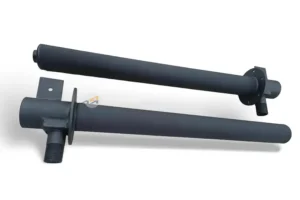
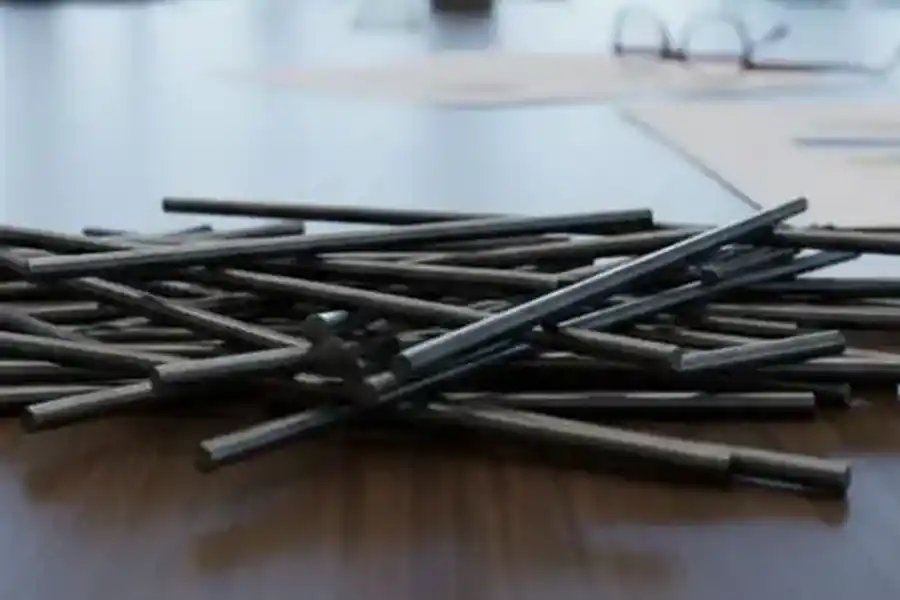
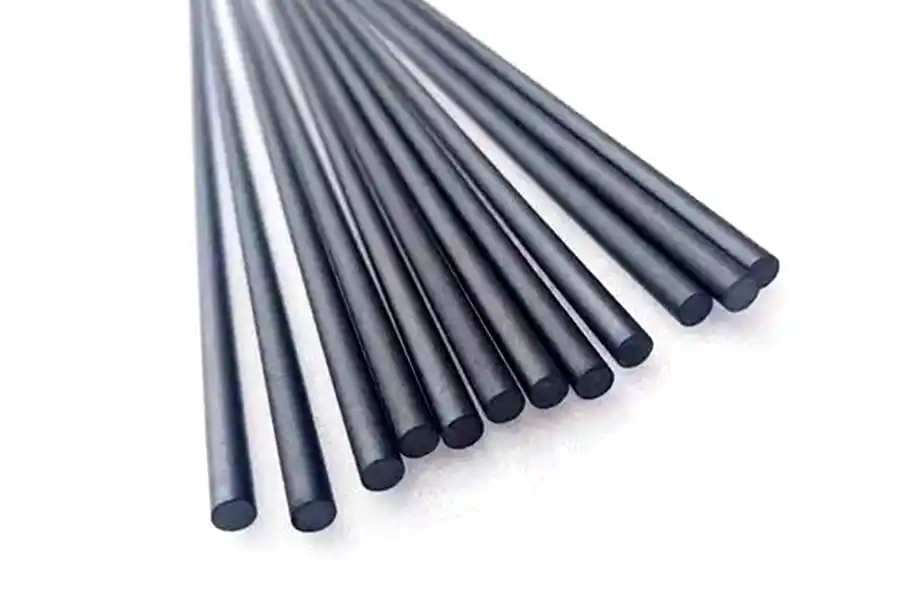
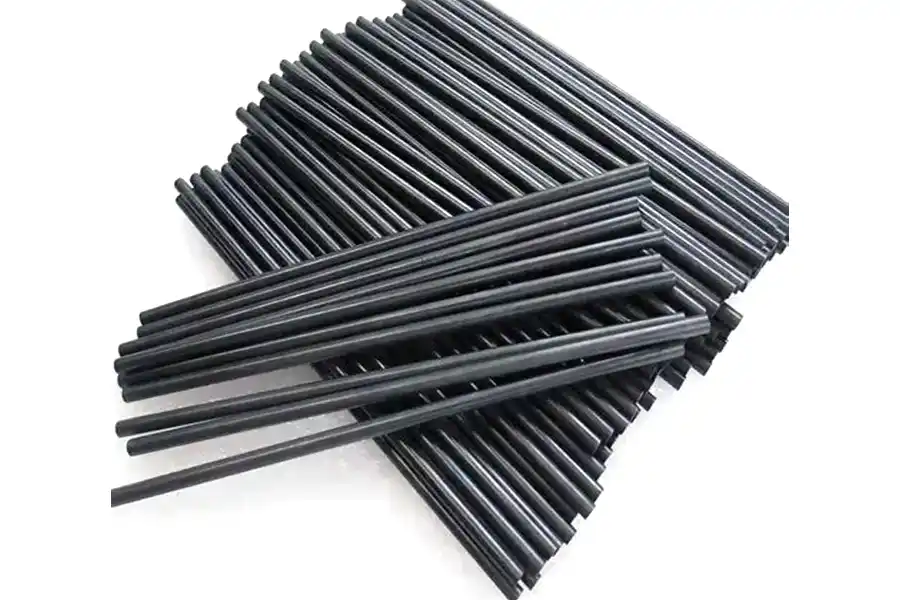
A titanium anode rod is a round dimensionally stable anode in bar form. It comes in two constructions. Solid Grade 2 titanium rod serves as plating stems, hanger bars, and bench electrodes. Titanium-clad copper rod is the workhorse of impressed current cathodic protection (ICCP), where the copper core carries current along the full length and the titanium skin resists the ground or water around it. Both forms take the same mixed metal oxide (MMO) coating used on plate and mesh anodes, applied by thermal decomposition.
Quick Specifications
| Parameter | Typical range |
|---|---|
| Construction | Solid Grade 2 titanium bar, or copper core in a welded titanium sheath |
| Diameter | 6 to 50 mm |
| Length | Cut to order, commonly 300 to 1,500 mm |
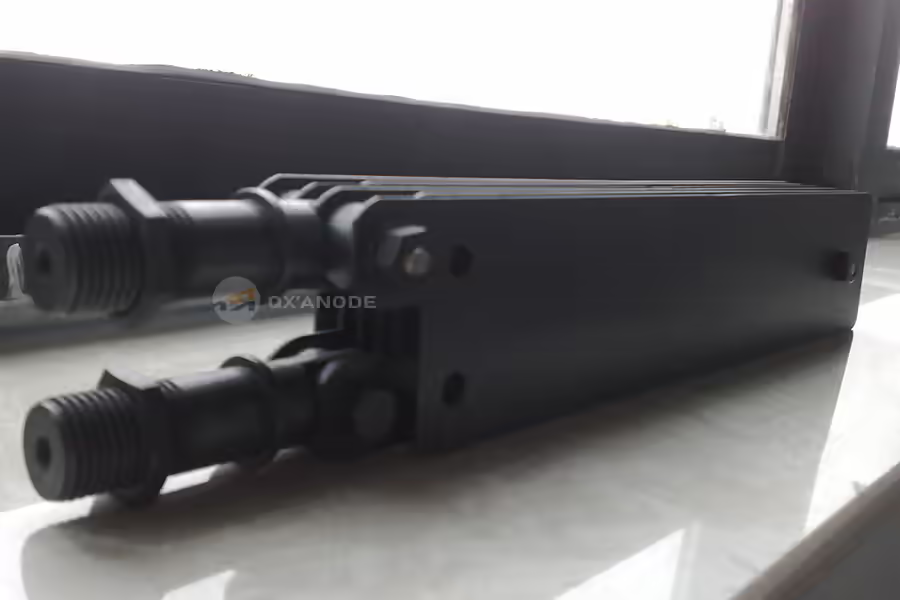
| End details | Machined threads (M6 to M20), drilled and tapped cable cavity, or plain ends |
| Coating | Ir-Ta MMO standard; platinum plating for special duty |
| Service | Soil, deep well groundbeds, fresh water, brackish and seawater systems |
How Titanium Anode Rods Are Made
Bar stock and machining
Solid rods start as drawn or turned titanium bar, machined to the final diameter and cut to length. Threads, cable cavities, and flat wrenching surfaces are cut before coating, because machining an oxide coated rod later would expose bare titanium at exactly the point that needs protection most.
Clad rod construction
For cathodic protection rods, a copper core is inserted into a titanium tube and the assembly is drawn or rolled to bond the two metals, then sealed at the ends by welding. The result conducts like copper along its length but presents only titanium to the electrolyte. Current is delivered to the rod through a cable joined to the copper core inside a machined cavity, locked with a set screw or crimped sleeve, and potted in epoxy so ground moisture never reaches the copper.
Coating
Rods are degreased, sandblasted, and pickled exactly like plates, then coated along the active length by dip application and calcination. The connection cavity and any threaded ends are masked off, so the coating ends where the hardware begins.
Coating Choice for Rod Anodes
Almost all cathodic protection rods run an Ir-Ta type mixed metal oxide. It evolves oxygen well in the wet, low chloride environment of a coke breeze backfill and tolerates the soil chemistry variations that a groundbed sees over decades. Platinum plated rods are used where the anode sees high chloride water directly, for example inside seawater filled tanks and condenser water boxes, and where the premium for a fully precious metal surface is justified by access cost: an anode at the bottom of a deep well is expensive to replace, so buyers pay for the most forgiving surface available.
Where Rod Anodes Are Used
Impressed current groundbeds
ICCP systems for pipelines, tank farms, and plant structures drive protective current through anode beds buried in coke breeze backfill. Rod anodes, usually with a center or dual cable connection so current discharges evenly along the length, are the standard format for both shallow distributed beds and deep well anode assemblies. Design discharge in coke backfill is commonly held around 20 to 50 A/m² of rod surface, which is what lets a groundbed be designed for a 20 year service life.
Internal protection of equipment
Water boxes of condensers, pump internals, and treated water tanks use short rod or stick anodes installed through the wall or on isolators. The rod format survives flow and gives a compact active area in a small nozzle.
Plating line hardware
Solid titanium rod, coated or bare, is the default material for anode stems, hanger bars, and cathode conductor bars in plating shops. It carries the bracket and hook hardware above the solution line and stays corrosion free for years of steam and mist exposure.
Laboratory and pilot electrodes
A coated rod is a convenient, low cost electrode for bench scale electrolysis: easy to clamp, easy to insert through a gland, and available in diameters that suit standard glassware.
Specifying a Rod Anode
- Connection position: a cable joined at one end of a long rod discharges most current near that end. Center connection, or two cables at both ends, balances the discharge.
- Backfill quality: in soil duty the coke breeze consumes the primary reaction, and poor backfill, not the coating, is what usually kills a groundbed early.
- Cable sizing: the dc cable run usually costs more to replace than the anode, so size it for the full system life, not the first year.
- Leave threads bare: specify masked threads. Coating a thread does nothing for the electrochemistry and cracks when the rod is torqued.
Frequently Asked Questions
Why choose a rod instead of a tube for a groundbed?
Both work. Rods are simpler and cheaper per unit, and their solid or copper cored core handles mechanical loading in deep wells well. Tubes offer more surface area per meter and better current distribution on long anode strings, so the choice usually comes down to the groundbed design current and the installation method.
How long does an MMO rod anode last?
Coating consumption is proportional to the charge passed, so life follows from design current density and utilization. Groundbeds designed for 20 years of continuous duty are routine practice when the discharge density is held in the normal range and the backfill is sound.
Can rods be joined to reach deeper wells?
Deep well assemblies are usually built as strings of rods on a common cable and center pipe, rather than physically joined rods. Joining coated rods would create an uncoated weld zone in the active region, which is exactly where failure would start.
Related pages
- All titanium anode types for a side by side comparison of shapes and coatings
- Iridium-tantalum coated anodes, the standard coating system for cathodic protection rods
- Titanium anode tubes for groundbeds and flowing water systems that need more area per meter
Frequently Asked Questions
What is the difference between a solid titanium rod and a copper-cored rod?
A solid titanium rod is the economical choice for short anodes and moderate currents. A copper-cored rod has a copper core along its full length, which lowers the longitudinal resistance dramatically, so it is specified for long impressed current anodes and deep well groundbeds where the rod itself has to carry the full circuit current. The titanium sheath still faces the electrolyte or coke backfill, so corrosion behavior is identical.
Are rods used for cathodic protection in soil?
Yes. Mixed metal oxide coated titanium rods are a standard impressed current anode for buried and deep well groundbeds. They are typically installed inside a coke breeze backfill column, which extends the effective anode surface and lowers the groundbed resistance to earth.
Why is the cable connection made at the center of the rod?
A center feed splits the current into two halves traveling in opposite directions, so every point on the rod surface sees a similar current path length. An end feed forces the full current to travel the entire rod length, which shifts the load toward the connected end and wears the coating there first. Center feeding is the difference between a rod that retires evenly and one that fails at one end while the other end is still healthy.
Which coating is used for rods in seawater versus soil?
For seawater and brackish water, where chlorine evolution dominates, a ruthenium-iridium mixed metal oxide is the standard. For soil and coke backfill, where the reaction shifts toward oxygen evolution, an iridium-tantalum coating is preferred because it resists the acidic microenvironment that forms at the anode surface.
Can rods be threaded or machined at the ends?
Yes. Threaded ends, tapped holes, flats, and step turns are all standard machining operations. The coating is applied after machining is complete, so machined features should be finalized before coating, and any field cutting of a coated rod will expose bare titanium that needs to be resealed or kept out of the electrolyte.
What happens when the coke breeze backfill degrades?
The backfill is a consumable. As it ages it loses conductivity and consolidates, which drives the rod toward the oxygen evolution reaction and acidifies the interface. That is why groundbed design includes backfill quality and quantity, not just the anode itself, and why a failing groundbed often reads as rising circuit resistance long before the rod is consumed.
Need a custom anode for your process?
Send us your drawing or specs — we’ll quote within 12 hours.