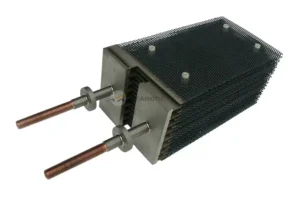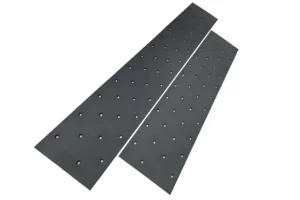
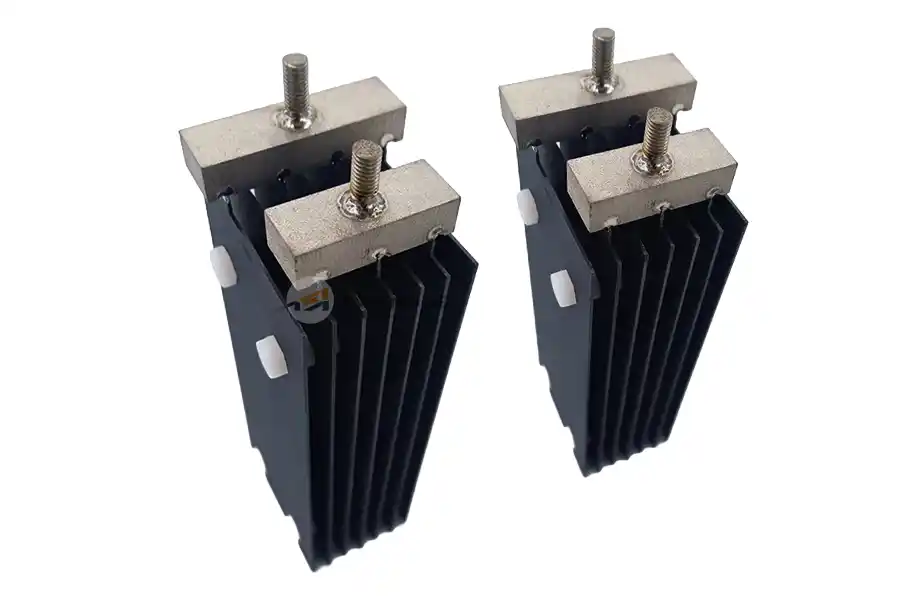
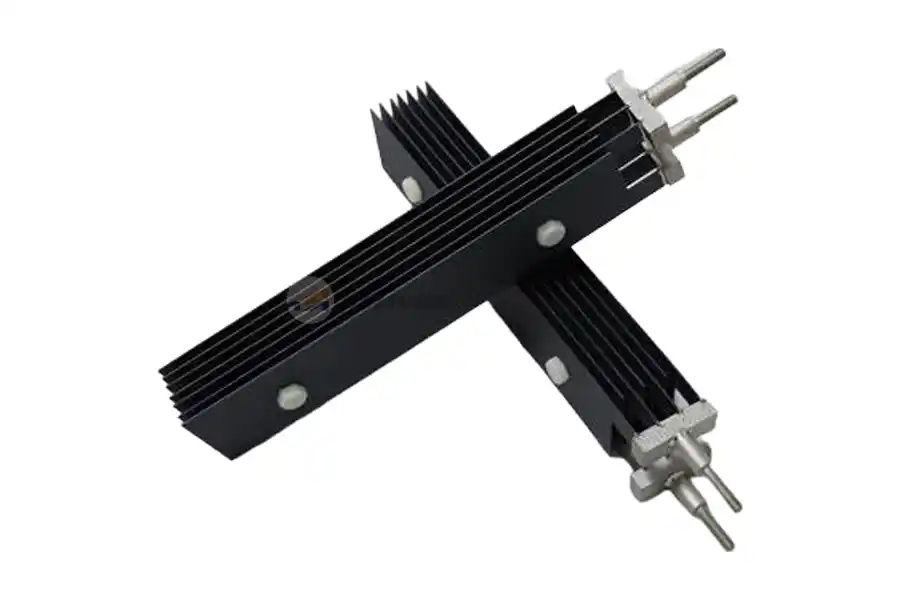
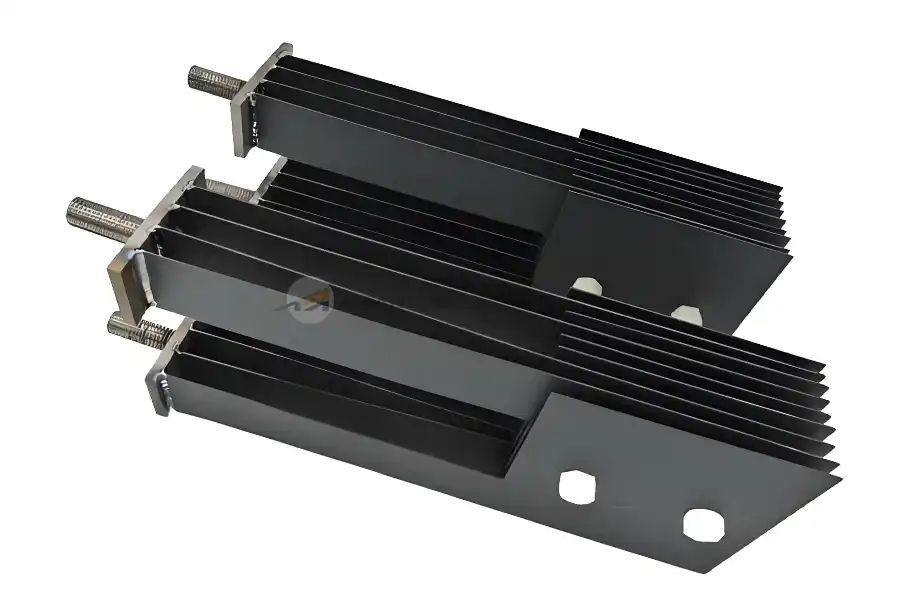
A titanium anode for a salt chlorine generator is the MMO-coated electrode core inside a saltwater pool chlorinator (salt cell). It electrolyzes dissolved salt into free chlorine for pools and spas, and typically delivers 3–5+ years of service life — up to 10,000 operating hours.
- Mixed Metal Oxide coating
Ru-Ir MMO - Pure titanium substrate
Grade 1/2 Ti - Service life per set
8,000‑15,000 h
What Is a Titanium Anode for a Salt Chlorine Generator?
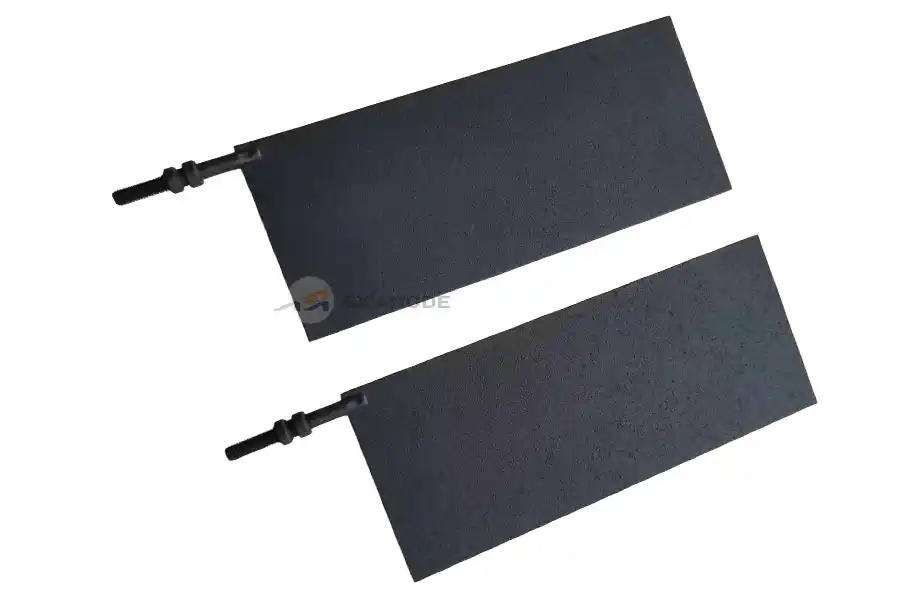
A titanium anode for a salt chlorine generator is a replaceable titanium plate coated with ruthenium-iridium Mixed Metal Oxide (MMO). Mounted inside the salt cell, it converts dissolved salt (2,500–6,000 ppm) into free chlorine through electrolysis, eliminating the need to buy, store, or handle chemical chlorine.
Every salt chlorine generator relies on the same core component: a set of coated titanium electrodes. These plates are mounted inside the electrolytic cell housing, where saltwater flows between them while the control box applies a low-voltage DC current.
The pure titanium substrate provides structural strength and corrosion resistance in the aggressive chloride environment. The MMO coating — a catalytic layer of ruthenium oxide (RuO₂) and iridium oxide (IrO₂) — is what actually drives the electrolysis. This coating is what makes the anode dimensionally stable. Unlike graphite or lead-dioxide electrodes, it neither dissolves nor passivates during operation.
>85%
Current efficiency
(chlorine output)
8,000-15,000 h
Typical max service life
How Does a Titanium Anode Produce Chlorine?
Five steps from dissolved salt to clean, sanitized pool water.
- Salt dissolves
Pool salt raises water to 3,000–4,000 ppm NaCl (2,500–6,000 ppm operating range). - Water flows through
Filtered saltwater passes through the cell housing containing the titanium plates. - DC current applied
The controller feeds low-voltage DC (typically 5–24 V) to the MMO-coated anodes. - Electrolysis occurs
Salt and water split into chlorine gas, hydrogen, and sodium hydroxide at the electrodes. - Chlorine sanitizes
Chlorine instantly forms hypochlorous acid (HOCl) — the same active sanitizer as liquid chlorine.
Cell reaction: 2NaCl + 2H₂O → Cl₂↑ + H₂↑ + 2NaOH. Chlorine dissolves to form HOCl (hypochlorous acid). A built‑in reverse‑polarity cycle automatically removes calcium scale, extending anode service life.
Key Features & Benefits
Up to 85% current efficiency
The Ru-Ir catalytic coating maximizes chlorine output per amp and keeps energy consumption low because the coating has a lower oxygen overpotential.
Corrosion-resistant substrate
Grade 1 / Grade 2 pure titanium (ASTM B265) withstands the chloride-rich, oxidizing environment inside the cell without warping or dissolving.
Precision MMO coating
8–20 g/m² precious-metal loading, applied in multiple thermal-decomposition layers for uniform thickness and long-term adhesion.
Self-cleaning by design
Compatible with reverse-polarity controllers that shed calcium scale automatically, so maintenance stays minimal.
Eco-friendly sanitation
There is no chemical chlorine to buy, store, or handle, and no stabilizer buildup. The cell makes its own sanitizer on demand.
Cost-effective repair
Replace the anode plates only and keep the housing and electronics — typically 30–50% cheaper than a complete salt cell.
OEM / custom manufacturing
We supply any plate size, shape, thickness, plate count, or terminal design. Low MOQ available for private-label salt cell programs.
Certified quality
ISO 9001 facility; every plate passes conductivity, adhesion, and accelerated life testing (ALT) before shipment.
Technical Specifications
| Parameter | Specification |
| Substrate material | Mixed Metal Oxide — ruthenium oxide (RuO₂) + iridium oxide (IrO₂) |
| Coating loading | 8–20 g/m² (customizable) |
| Coating thickness | 5–25 μm, multi-layer thermal decomposition |
| Plate dimensions | Custom — e.g., 200 × 100 mm; thickness 0.5–1.0 mm |
| Electrode spacing | 3–5 mm |
| Current density | 200–300 A/m² |
| Working salt level | 2,500–6,000 ppm (residential target 3,000–4,000 ppm) |
| Water temperature | 10–40 °C (50–104 °F) |
| Chlorine output | Per-cell specific — e.g., 10–100 g/h (cell-size dependent) |
| Terminal options | Threaded stud, welded tab, screw terminal, solder lug |
Applications
Residential in-ground pools
Most common in residential saltwater pools up to 40,000 gallons (150 m³).
Above-ground pools
Compact cells with 2–6 plates sized for small filters and pumps.
Spas & hot tubs
Low-output cells (10–25 g/h) for portable and in-ground spa sanitation.
Commercial & hotel pools
High-capacity cells (up to 250 g/h) with multi-plate arrays for continuous duty.
Mineral & low-chlorine systems
Platinum-coated variant for copper/silver ion systems and low-salt operation.
Aquaculture & water treatment
Secondary markets: RAS (recirculating aquaculture), cooling towers, and industrial disinfection.
Customization for OEM & Replacement Programs
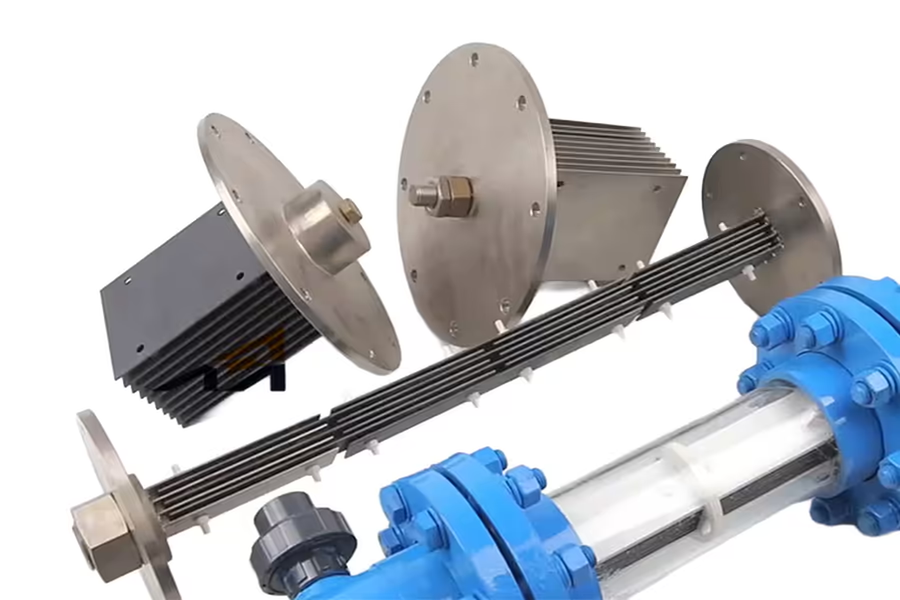
Every salt cell brand uses slightly different electrode geometry. We match your housing exactly — send us a drawing, a sample cell, or your original plates and our engineers will replicate the design.
- Plate size & shape — rectangular, curved, or blade profiles to fit any cell housing
- Coating type — Ru-Ir MMO (standard) or Pt-plated titanium (low-salt systems)
- Coating loading — tuned 8–20 g/m² for your output and lifetime targets
- Plate count & electrode spacing — matched to your controller’s current output
- Terminal design — threaded stud, welded tab, screw terminal, or solder lug
- Packaging & branding — OEM labeling, retail blister packs, or service kits
Frequently Asked Questions
What is a titanium anode for a salt chlorine generator?
A titanium anode for a salt chlorine generator is the replaceable electrode core inside a saltwater pool chlorinator (salt cell). It is a pure titanium plate coated with a Mixed Metal Oxide (MMO) layer — usually ruthenium and iridium oxides — that electrolyzes dissolved salt into free chlorine. It typically lasts 8,000–15,000+ h.
What does MMO coating mean on a titanium anode?
MMO stands for Mixed Metal Oxide. MMO-coated titanium anodes carry a catalytic layer of ruthenium oxide (RuO₂) and iridium oxide (IrO₂) on a pure titanium substrate. This layer drives the electrolysis reaction, resists chloride corrosion, and gives the anode a dimensionally stable service life of 3–5+ years.
Can I replace only the titanium anode plates instead of buying a whole new salt cell?
Yes. In most salt chlorine generators the cell housing and electronics stay serviceable for many years, so replacing only the titanium anode plates is the economical option. New MMO plates restore full chlorine output at roughly 30–50% of the price of a complete salt cell.
How much salt do I need for a titanium anode salt chlorinator to work?
Most salt chlorine generators with MMO titanium anodes require 2,500–6,000 ppm of salt, with 3,000–4,000 ppm the typical residential target. Below about 2,500 ppm the cell produces little or no chlorine and the low-salt warning activates. One 40 lb (18 kg) bag of pool salt per 5,000 gallons of water raises salt by roughly 1,000 ppm.
What is the difference between MMO and platinum-coated titanium anodes?
MMO-coated titanium anodes (ruthenium-iridium) are the standard choice for saltwater pools: economical, high chlorine efficiency, and a 3–5+ year life. Platinum-coated titanium anodes cost more but tolerate lower salt levels, so they are preferred for mineral pools, soft-water systems, and low-salt applications.
How does a salt chlorine generator produce chlorine from a titanium anode?
A salt chlorine generator passes saltwater (2,500–6,000 ppm NaCl) through a cell containing MMO-coated titanium plates. A low-voltage DC current electrolyzes the salt: 2NaCl + 2H₂O → Cl₂ + H₂ + 2NaOH. The chlorine gas instantly dissolves into hypochlorous acid (HOCl) — the same active sanitizer as liquid chlorine.
Do you offer custom titanium anode sizes for OEM salt cell production?
Yes. We manufacture custom titanium anodes for OEM/ODM salt cell programs: plate dimensions, thickness, plate count, electrode spacing, coating type and loading, and terminal design (threaded stud, welded tab) are all customizable. Send us your cell housing drawing or original plates for a free engineering review.